Rafael Rios Moura, Priscila Teixeira Pêgo, Jober F. Sobczak, Marcelo Oliveira Gonzaga
{"title":"Individual diet specialization in the spider Tidarren haemorrhoidale (Bertkau, 1880) (Theridiidae)","authors":"Rafael Rios Moura, Priscila Teixeira Pêgo, Jober F. Sobczak, Marcelo Oliveira Gonzaga","doi":"10.1111/eth.13392","DOIUrl":null,"url":null,"abstract":"<p>Individual specialization (<i>IS</i>) in resource use is common within populations of several animal species because some individuals can be more efficient than others in obtaining specific food items. Spiders are usually classified as euryphagous predators, but the broad diet of populations may result from many individuals specializing in capturing different types of prey. Empirical evidence supporting this pattern, however, is still scarce. In this study, we hypothesized that (1) the diet of individuals of <i>Tidarren haemorrhoidale</i> is more restricted than the population's diet and (2) individual diet restrictions are not determined by the spatial distribution of prey types. We collected the prey remains of 74 webs of females in a conservation area of the Atlantic Forest. Our results indicated that <i>T. haemorrhoidale</i> could be considered a euryphagous predator because its diet comprised Opiliones, Diplopoda, and eight orders of insects. However, spiders exhibited moderate and high degrees of <i>IS</i> for prey size and taxa, respectively. There was no modularity for both prey attributes in the food web, but there was a medium nestedness. Most individuals captured ants, but additional prey taxa were of different orders. There was no correlation between the dissimilarity of prey taxa and the distances between the webs, suggesting that <i>IS</i> did not occur based on the spatial distribution of their potential prey. The diversity of prey defensive strategies may induce spiders to perform specific behavioral routines after prey interception. If this occurs, cognitive constraints may limit their ability to use different capture routines efficiently. Our study supports the predictions of individual niche specialization theory for a euryphagous spider species and highlights the potential of spiders as a study model to investigate the underlying mechanisms.</p>","PeriodicalId":50494,"journal":{"name":"Ethology","volume":"129 11","pages":"559-569"},"PeriodicalIF":1.4000,"publicationDate":"2023-06-27","publicationTypes":"Journal Article","fieldsOfStudy":null,"isOpenAccess":false,"openAccessPdf":"","citationCount":"0","resultStr":null,"platform":"Semanticscholar","paperid":null,"PeriodicalName":"Ethology","FirstCategoryId":"99","ListUrlMain":"https://onlinelibrary.wiley.com/doi/10.1111/eth.13392","RegionNum":4,"RegionCategory":"生物学","ArticlePicture":[],"TitleCN":null,"AbstractTextCN":null,"PMCID":null,"EPubDate":"","PubModel":"","JCR":"Q4","JCRName":"BEHAVIORAL SCIENCES","Score":null,"Total":0}
引用次数: 0
Abstract
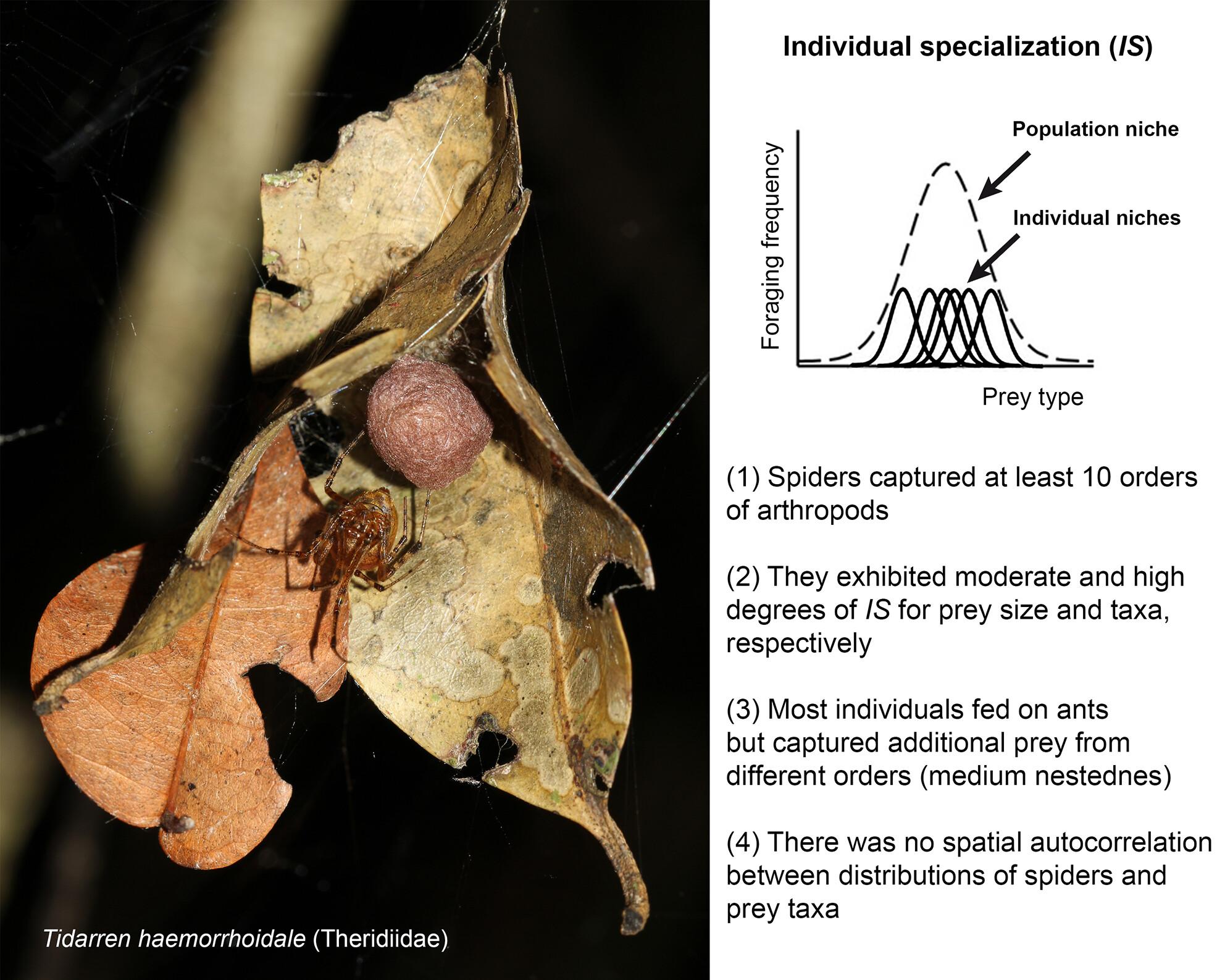
Individual specialization (IS) in resource use is common within populations of several animal species because some individuals can be more efficient than others in obtaining specific food items. Spiders are usually classified as euryphagous predators, but the broad diet of populations may result from many individuals specializing in capturing different types of prey. Empirical evidence supporting this pattern, however, is still scarce. In this study, we hypothesized that (1) the diet of individuals of Tidarren haemorrhoidale is more restricted than the population's diet and (2) individual diet restrictions are not determined by the spatial distribution of prey types. We collected the prey remains of 74 webs of females in a conservation area of the Atlantic Forest. Our results indicated that T. haemorrhoidale could be considered a euryphagous predator because its diet comprised Opiliones, Diplopoda, and eight orders of insects. However, spiders exhibited moderate and high degrees of IS for prey size and taxa, respectively. There was no modularity for both prey attributes in the food web, but there was a medium nestedness. Most individuals captured ants, but additional prey taxa were of different orders. There was no correlation between the dissimilarity of prey taxa and the distances between the webs, suggesting that IS did not occur based on the spatial distribution of their potential prey. The diversity of prey defensive strategies may induce spiders to perform specific behavioral routines after prey interception. If this occurs, cognitive constraints may limit their ability to use different capture routines efficiently. Our study supports the predictions of individual niche specialization theory for a euryphagous spider species and highlights the potential of spiders as a study model to investigate the underlying mechanisms.
期刊介绍:
International in scope, Ethology publishes original research on behaviour including physiological mechanisms, function, and evolution. The Journal addresses behaviour in all species, from slime moulds to humans. Experimental research is preferred, both from the field and the lab, which is grounded in a theoretical framework. The section ''Perspectives and Current Debates'' provides an overview of the field and may include theoretical investigations and essays on controversial topics.



 京公网安备 11010802042870号
京ICP备2023020795号-1
京公网安备 11010802042870号
京ICP备2023020795号-1

 分享
分享
 求助内容:
求助内容: 应助结果提醒方式:
 扫码关注我们
