Veronika Kopylova, Stanislav Boronovskiy, Yaroslav Nartsissov
{"title":"Approaches to vascular network, blood flow, and metabolite distribution modeling in brain tissue.","authors":"Veronika Kopylova, Stanislav Boronovskiy, Yaroslav Nartsissov","doi":"10.1007/s12551-023-01106-0","DOIUrl":null,"url":null,"abstract":"<p><p>The cardiovascular system plays a key role in the transport of nutrients, ensuring a continuous supply of all cells of the body with the metabolites necessary for life. The blood supply to the brain is carried out by the large arteries located on its surface, which branch into smaller arterioles that penetrate the cerebral cortex and feed the capillary bed, thereby forming an extensive branching network. The formation of blood vessels is carried out via vasculogenesis and angiogenesis, which play an important role in both embryo and adult life. The review presents approaches to modeling various aspects of both the formation of vascular networks and the construction of the formed arterial tree. In addition, a brief description of models that allows one to study the blood flow in various parts of the circulatory system and the spatiotemporal metabolite distribution in brain tissues is given. Experimental study of these issues is not always possible due to both the complexity of the cardiovascular system and the mechanisms through which the perfusion of all body cells is carried out. In this regard, mathematical models are a good tool for studying hemodynamics and can be used in clinical practice to diagnose vascular diseases and assess the need for treatment.</p>","PeriodicalId":4,"journal":{"name":"ACS Applied Energy Materials","volume":" ","pages":"1335-1350"},"PeriodicalIF":5.5000,"publicationDate":"2023-08-18","publicationTypes":"Journal Article","fieldsOfStudy":null,"isOpenAccess":false,"openAccessPdf":"https://www.ncbi.nlm.nih.gov/pmc/articles/PMC10643724/pdf/","citationCount":"0","resultStr":null,"platform":"Semanticscholar","paperid":null,"PeriodicalName":"ACS Applied Energy Materials","FirstCategoryId":"1085","ListUrlMain":"https://doi.org/10.1007/s12551-023-01106-0","RegionNum":3,"RegionCategory":"材料科学","ArticlePicture":[],"TitleCN":null,"AbstractTextCN":null,"PMCID":null,"EPubDate":"2023/10/1 0:00:00","PubModel":"eCollection","JCR":"Q2","JCRName":"CHEMISTRY, PHYSICAL","Score":null,"Total":0}
引用次数: 0
Abstract
The cardiovascular system plays a key role in the transport of nutrients, ensuring a continuous supply of all cells of the body with the metabolites necessary for life. The blood supply to the brain is carried out by the large arteries located on its surface, which branch into smaller arterioles that penetrate the cerebral cortex and feed the capillary bed, thereby forming an extensive branching network. The formation of blood vessels is carried out via vasculogenesis and angiogenesis, which play an important role in both embryo and adult life. The review presents approaches to modeling various aspects of both the formation of vascular networks and the construction of the formed arterial tree. In addition, a brief description of models that allows one to study the blood flow in various parts of the circulatory system and the spatiotemporal metabolite distribution in brain tissues is given. Experimental study of these issues is not always possible due to both the complexity of the cardiovascular system and the mechanisms through which the perfusion of all body cells is carried out. In this regard, mathematical models are a good tool for studying hemodynamics and can be used in clinical practice to diagnose vascular diseases and assess the need for treatment.
期刊介绍:
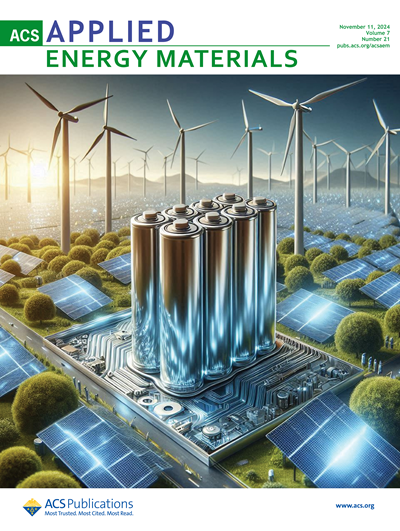
ACS Applied Energy Materials is an interdisciplinary journal publishing original research covering all aspects of materials, engineering, chemistry, physics and biology relevant to energy conversion and storage. The journal is devoted to reports of new and original experimental and theoretical research of an applied nature that integrate knowledge in the areas of materials, engineering, physics, bioscience, and chemistry into important energy applications.



 京公网安备 11010802042870号
京ICP备2023020795号-1
京公网安备 11010802042870号
京ICP备2023020795号-1

 分享
分享
 求助内容:
求助内容: 应助结果提醒方式:
 扫码关注我们
