{"title":"Patterns and driving factors of water and nitrogen use efficiency in Robinia pseudoacacia L. on the Loess Plateau in China","authors":"Bingqian Su , Zhouping Shangguan","doi":"10.1016/j.catena.2020.104790","DOIUrl":null,"url":null,"abstract":"<div><p>Water use efficiency (WUE) and nitrogen use efficiency (NUE) demonstrates the competitive strategies of plants with limited resources, which is important in mediating survival productivity and fitness of plants. Previous studies have found that there is a trade-off relationship between WUE and NUE and that they are affected by many factors, such as climate variables, geographical variables and soil properties. However, the patterns of WUE and NUE in <em>Robinia pseudoacacia</em> on the Loess Plateau are unclear and their driving factors need to be investigated to advance our knowledge of these key parameters to understand the coupling of carbon, nitrogen and water cycle. In this study, we calculated the WUE and NUE in <em>Robinia pseudoacacia</em> along a precipitation transect on the Loess Plateau and examined the effects of influencing factors on WUE and NUE. Our results showed that WUE varied from 64.03 to 103.08 μmol mmol<sup>−1</sup>, and NUE varied from 11.26 to 18.19 gC g<sup>−1</sup>N. Latitude played a substantial role in WUE, and soil nitrogen (ammonium nitrogen and total nitrogen) played a substantial role in NUE. In addition, NUE in <em>Robinia pseudoacacia</em> was lower than the average value of whole plants on the Loess Plateau, and the growth of <em>Robinia pseudoacacia</em> was mainly restricted by phosphorus. By dividing into three zones, zone 3 had higher WUE in where with higher latitude and lower precipitation, and NUE was not significant among the three zones. These results highlight the importance of location variables and soil chemical properties to WUE and NUE and provide useful information for understanding the coupling of carbon, nitrogen and water cycle of plants in ecosystems.</p></div>","PeriodicalId":9801,"journal":{"name":"Catena","volume":"195 ","pages":"Article 104790"},"PeriodicalIF":5.7000,"publicationDate":"2020-12-01","publicationTypes":"Journal Article","fieldsOfStudy":null,"isOpenAccess":false,"openAccessPdf":"https://sci-hub-pdf.com/10.1016/j.catena.2020.104790","citationCount":"11","resultStr":null,"platform":"Semanticscholar","paperid":null,"PeriodicalName":"Catena","FirstCategoryId":"97","ListUrlMain":"https://www.sciencedirect.com/science/article/pii/S0341816220303404","RegionNum":1,"RegionCategory":"农林科学","ArticlePicture":[],"TitleCN":null,"AbstractTextCN":null,"PMCID":null,"EPubDate":"2020/7/18 0:00:00","PubModel":"Epub","JCR":"Q1","JCRName":"GEOSCIENCES, MULTIDISCIPLINARY","Score":null,"Total":0}
引用次数: 11
Abstract
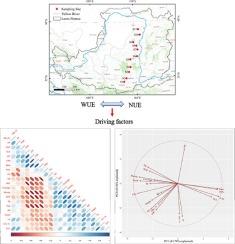
Water use efficiency (WUE) and nitrogen use efficiency (NUE) demonstrates the competitive strategies of plants with limited resources, which is important in mediating survival productivity and fitness of plants. Previous studies have found that there is a trade-off relationship between WUE and NUE and that they are affected by many factors, such as climate variables, geographical variables and soil properties. However, the patterns of WUE and NUE in Robinia pseudoacacia on the Loess Plateau are unclear and their driving factors need to be investigated to advance our knowledge of these key parameters to understand the coupling of carbon, nitrogen and water cycle. In this study, we calculated the WUE and NUE in Robinia pseudoacacia along a precipitation transect on the Loess Plateau and examined the effects of influencing factors on WUE and NUE. Our results showed that WUE varied from 64.03 to 103.08 μmol mmol−1, and NUE varied from 11.26 to 18.19 gC g−1N. Latitude played a substantial role in WUE, and soil nitrogen (ammonium nitrogen and total nitrogen) played a substantial role in NUE. In addition, NUE in Robinia pseudoacacia was lower than the average value of whole plants on the Loess Plateau, and the growth of Robinia pseudoacacia was mainly restricted by phosphorus. By dividing into three zones, zone 3 had higher WUE in where with higher latitude and lower precipitation, and NUE was not significant among the three zones. These results highlight the importance of location variables and soil chemical properties to WUE and NUE and provide useful information for understanding the coupling of carbon, nitrogen and water cycle of plants in ecosystems.
期刊介绍:
Catena publishes papers describing original field and laboratory investigations and reviews on geoecology and landscape evolution with emphasis on interdisciplinary aspects of soil science, hydrology and geomorphology. It aims to disseminate new knowledge and foster better understanding of the physical environment, of evolutionary sequences that have resulted in past and current landscapes, and of the natural processes that are likely to determine the fate of our terrestrial environment.
Papers within any one of the above topics are welcome provided they are of sufficiently wide interest and relevance.




 京公网安备 11010802042870号
京ICP备2023020795号-1
京公网安备 11010802042870号
京ICP备2023020795号-1

 分享
分享
 求助内容:
求助内容: 应助结果提醒方式:
 扫码关注我们
