Zhixuan Lai, Gaoxiang Lou, Linsen Yin, Haicheng Ma, Xuechen Tu
{"title":"Supply chain green strategy considering manufacturers’ financial constraints: how to manage the risk of green supply chain financing","authors":"Zhixuan Lai, Gaoxiang Lou, Linsen Yin, Haicheng Ma, Xuechen Tu","doi":"10.1007/s10479-023-05239-z","DOIUrl":null,"url":null,"abstract":"<div><p>Supply chain members have a variety of green strategic choices in the context of manufacturer’ capital-constrained green supply chains. This paper investigates two types of single-dimensional suppliers’ green strategies (Combination of green practices and financing schemes): the green supply (GS) and green manufacturing (GM) strategies. The GS strategy implies that suppliers implement the GS practice independently; the GM strategy indicates that suppliers provide a green credit guarantee (GCG) to manufacturers to help them implement GM practices. In both green strategies, manufacturers need to solve their production capitals through bank credit financing (BCF). Comparing the GS and GM strategies, this paper aims to identify suppliers preferred green strategy. The results show that, compared to the benchmark case without any green strategy, the GS strategy can effectively improve suppliers’ profits, but the GM strategy cannot. Even if the unit investment cost of the GS practice is higher, suppliers will still implement this strategy when the GCG coefficient is high and manufacturer’s initial capital is low. Furthermore, this paper incorporates green marketing (GA) into GS and GM strategies, investigates two types of dual-dimensional supply chain green strategies (GS-with-GA and GM-with-GA), to analyze the advantages and disadvantages of the dual-dimensional green strategy and single-dimensional green strategy. The conclusions show that compared to the single-dimensional green strategy, the dual-dimensional green strategy can improve product greenness and supply chain efficiency, but it does not necessarily improve manufacturer’s profit, especially when both the demand uncertainty level and manufacturer’s initial capital are high. This paper contributes to the literature on operational risk management by guiding enterprises to develop operational and financing strategies to reduce potential operational and financing risks.</p></div>","PeriodicalId":8215,"journal":{"name":"Annals of Operations Research","volume":"348 2","pages":"1037 - 1068"},"PeriodicalIF":4.5000,"publicationDate":"2023-03-16","publicationTypes":"Journal Article","fieldsOfStudy":null,"isOpenAccess":false,"openAccessPdf":"","citationCount":"0","resultStr":null,"platform":"Semanticscholar","paperid":null,"PeriodicalName":"Annals of Operations Research","FirstCategoryId":"91","ListUrlMain":"https://link.springer.com/article/10.1007/s10479-023-05239-z","RegionNum":3,"RegionCategory":"管理学","ArticlePicture":[],"TitleCN":null,"AbstractTextCN":null,"PMCID":null,"EPubDate":"","PubModel":"","JCR":"Q1","JCRName":"OPERATIONS RESEARCH & MANAGEMENT SCIENCE","Score":null,"Total":0}
引用次数: 0
Abstract
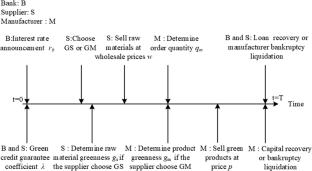
Supply chain members have a variety of green strategic choices in the context of manufacturer’ capital-constrained green supply chains. This paper investigates two types of single-dimensional suppliers’ green strategies (Combination of green practices and financing schemes): the green supply (GS) and green manufacturing (GM) strategies. The GS strategy implies that suppliers implement the GS practice independently; the GM strategy indicates that suppliers provide a green credit guarantee (GCG) to manufacturers to help them implement GM practices. In both green strategies, manufacturers need to solve their production capitals through bank credit financing (BCF). Comparing the GS and GM strategies, this paper aims to identify suppliers preferred green strategy. The results show that, compared to the benchmark case without any green strategy, the GS strategy can effectively improve suppliers’ profits, but the GM strategy cannot. Even if the unit investment cost of the GS practice is higher, suppliers will still implement this strategy when the GCG coefficient is high and manufacturer’s initial capital is low. Furthermore, this paper incorporates green marketing (GA) into GS and GM strategies, investigates two types of dual-dimensional supply chain green strategies (GS-with-GA and GM-with-GA), to analyze the advantages and disadvantages of the dual-dimensional green strategy and single-dimensional green strategy. The conclusions show that compared to the single-dimensional green strategy, the dual-dimensional green strategy can improve product greenness and supply chain efficiency, but it does not necessarily improve manufacturer’s profit, especially when both the demand uncertainty level and manufacturer’s initial capital are high. This paper contributes to the literature on operational risk management by guiding enterprises to develop operational and financing strategies to reduce potential operational and financing risks.
期刊介绍:
The Annals of Operations Research publishes peer-reviewed original articles dealing with key aspects of operations research, including theory, practice, and computation. The journal publishes full-length research articles, short notes, expositions and surveys, reports on computational studies, and case studies that present new and innovative practical applications.
In addition to regular issues, the journal publishes periodic special volumes that focus on defined fields of operations research, ranging from the highly theoretical to the algorithmic and the applied. These volumes have one or more Guest Editors who are responsible for collecting the papers and overseeing the refereeing process.



 京公网安备 11010802042870号
京ICP备2023020795号-1
京公网安备 11010802042870号
京ICP备2023020795号-1

 分享
分享
 求助内容:
求助内容: 应助结果提醒方式:
 扫码关注我们
