Growth performance and gene expression of FAS, CPT1, G6P, and HK in juveniles of the freshwater prawn, Macrobrachium acanthurus, fed diets with different levels of protein, lipids, and carbohydrates
Susana Alejandra Frías Gómez, Madison S. Powell, Carlos Alfonso Álvarez González, Luis Héctor Hernández Hernández
{"title":"Growth performance and gene expression of FAS, CPT1, G6P, and HK in juveniles of the freshwater prawn, Macrobrachium acanthurus, fed diets with different levels of protein, lipids, and carbohydrates","authors":"Susana Alejandra Frías Gómez, Madison S. Powell, Carlos Alfonso Álvarez González, Luis Héctor Hernández Hernández","doi":"10.1111/jwas.13014","DOIUrl":null,"url":null,"abstract":"<p>A feeding trial with <i>Macrobrachium acanthurus</i> juveniles was performed to determine growth performance and utilization of diets varying in protein, lipid, and carbohydrate level. Twelve diets were formulated with three levels of protein (P) and supplemented with different proportions of lipids (L) and carbohydrates (C): P30-L20-C8, P30-L15-C19, P30-L12-C25, P30-L10-C31, P35-L20-C3, P35-L15-C15, P35-L10-C26, P35-L5-C38, P40-L15-C8, P40-L10-C19, P40-L5-C31, and P40-L1-C40. Lipids and carbohydrates were added allowing an overall energy content limit of 400 kcal per 100 g of diet. Each diet was fed to triplicate groups of juveniles with an initial weight of 60.9 ± 10.9 mg (mean ± SD) for 60 days. Overall growth performance and gene expression of fatty acid synthase (<i>FAS</i>), carnitine palmitoyltransferase 1 (<i>CPT1</i>), glucose-6-phosphatase (<i>G6P</i>), and hexokinase (<i>HK</i>) in the hepatopancreas were assessed. Highest weight gain values and specific growth rates were observed in prawns fed diets with 35% of protein inclusion. Expression of <i>FAS</i> was downregulated when fed 30% of protein. Results indicate <i>M. acanthurus</i> use protein as their primary source of energy and when this is low in the diet, lipids are used to spare the energy from proteins. Suggested inclusion of protein, lipids, and carbohydrates in diets for <i>M. acanthurus</i> should be 35%, 15%, and 15%, respectively.</p>","PeriodicalId":17284,"journal":{"name":"Journal of The World Aquaculture Society","volume":"54 6","pages":"1644-1658"},"PeriodicalIF":3.2000,"publicationDate":"2023-08-02","publicationTypes":"Journal Article","fieldsOfStudy":null,"isOpenAccess":false,"openAccessPdf":"https://onlinelibrary.wiley.com/doi/epdf/10.1111/jwas.13014","citationCount":"0","resultStr":null,"platform":"Semanticscholar","paperid":null,"PeriodicalName":"Journal of The World Aquaculture Society","FirstCategoryId":"97","ListUrlMain":"https://onlinelibrary.wiley.com/doi/10.1111/jwas.13014","RegionNum":3,"RegionCategory":"农林科学","ArticlePicture":[],"TitleCN":null,"AbstractTextCN":null,"PMCID":null,"EPubDate":"","PubModel":"","JCR":"Q2","JCRName":"FISHERIES","Score":null,"Total":0}
引用次数: 0
Abstract
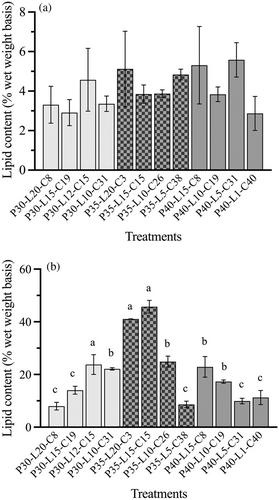
A feeding trial with Macrobrachium acanthurus juveniles was performed to determine growth performance and utilization of diets varying in protein, lipid, and carbohydrate level. Twelve diets were formulated with three levels of protein (P) and supplemented with different proportions of lipids (L) and carbohydrates (C): P30-L20-C8, P30-L15-C19, P30-L12-C25, P30-L10-C31, P35-L20-C3, P35-L15-C15, P35-L10-C26, P35-L5-C38, P40-L15-C8, P40-L10-C19, P40-L5-C31, and P40-L1-C40. Lipids and carbohydrates were added allowing an overall energy content limit of 400 kcal per 100 g of diet. Each diet was fed to triplicate groups of juveniles with an initial weight of 60.9 ± 10.9 mg (mean ± SD) for 60 days. Overall growth performance and gene expression of fatty acid synthase (FAS), carnitine palmitoyltransferase 1 (CPT1), glucose-6-phosphatase (G6P), and hexokinase (HK) in the hepatopancreas were assessed. Highest weight gain values and specific growth rates were observed in prawns fed diets with 35% of protein inclusion. Expression of FAS was downregulated when fed 30% of protein. Results indicate M. acanthurus use protein as their primary source of energy and when this is low in the diet, lipids are used to spare the energy from proteins. Suggested inclusion of protein, lipids, and carbohydrates in diets for M. acanthurus should be 35%, 15%, and 15%, respectively.
期刊介绍:
The Journal of the World Aquaculture Society is an international scientific journal publishing original research on the culture of aquatic plants and animals including:
Nutrition;
Disease;
Genetics and breeding;
Physiology;
Environmental quality;
Culture systems engineering;
Husbandry practices;
Economics and marketing.



 京公网安备 11010802042870号
京ICP备2023020795号-1
京公网安备 11010802042870号
京ICP备2023020795号-1

 分享
分享
 求助内容:
求助内容: 应助结果提醒方式:
 扫码关注我们
