Yuanhu Yao, Nan Yao, Zhaohui Qin, Ji Ma, Jiaying Lu, Li Cui, Wanxi Qu, Shiwang Yuan, Shaodong Tong, Na Li, Hao Li
{"title":"Extensive-stage small cell lung cancer: Is prophylactic cranial irradiation necessary in the era of immunotherapy with MRI surveillance?","authors":"Yuanhu Yao, Nan Yao, Zhaohui Qin, Ji Ma, Jiaying Lu, Li Cui, Wanxi Qu, Shiwang Yuan, Shaodong Tong, Na Li, Hao Li","doi":"10.1002/pro6.1200","DOIUrl":null,"url":null,"abstract":"<p><strong>Objective: </strong>The role of prophylactic cranial irradiation (PCI) in treating extensive-stage small-cell lung cancer (ES-SCLC) has been controversial. This study aimed to comprehensively analyze the efficacy of PCI for the treatment of ES-SCLC under active brain magnetic resonance imaging (MRI) surveillance.</p><p><strong>Methods: </strong>Patients with ES-SCLC with no brain metastases (BM) confirmed by MRI at the time of diagnosis who responded well to first-line chemoimmunotherapy at three general hospitals were retrospectively included. Overall survival (OS), progression-free survival (PFS), and cumulative incidence of BM were compared between patients who underwent PCI and those who did not.</p><p><strong>Results: </strong>In total, 66 consecutive patients treated between March 2019 and December 2021 were included in our dataset. Seventeen patients underwent PCI (PCI group) and 49 patients did not (non-PCI group). In comparison with the non-PCI group, PCI did not provide OS (median OS: 18.53 <i>vs</i>. 17.35 months, <i>p</i> = 0.28) or PFS (median PFS: 8.61 <i>vs</i>. 7.56 months, <i>p</i> = 0.41) benefits. When death was counted as a competing risk, the difference in the cumulative incidence rate of BM was not statistically significant (1-year: 12.79% <i>vs</i>. 38.09%; <i>p</i> = 0.14).</p><p><strong>Conclusion: </strong>Compared to active MRI surveillance, first-line chemoimmunotherapy followed by PCI did not improve the prognosis of patients with ES-SCLC. Further studies are warranted to evaluate the therapeutic effects of PCI following chemoimmunotherapy.</p>","PeriodicalId":32406,"journal":{"name":"Precision Radiation Oncology","volume":"7 1","pages":"111-117"},"PeriodicalIF":2.1000,"publicationDate":"2023-06-21","publicationTypes":"Journal Article","fieldsOfStudy":null,"isOpenAccess":false,"openAccessPdf":"https://www.ncbi.nlm.nih.gov/pmc/articles/PMC11935183/pdf/","citationCount":"0","resultStr":null,"platform":"Semanticscholar","paperid":null,"PeriodicalName":"Precision Radiation Oncology","FirstCategoryId":"1085","ListUrlMain":"https://doi.org/10.1002/pro6.1200","RegionNum":0,"RegionCategory":null,"ArticlePicture":[],"TitleCN":null,"AbstractTextCN":null,"PMCID":null,"EPubDate":"2023/6/1 0:00:00","PubModel":"eCollection","JCR":"Q4","JCRName":"Medicine","Score":null,"Total":0}
引用次数: 0
Abstract
Objective: The role of prophylactic cranial irradiation (PCI) in treating extensive-stage small-cell lung cancer (ES-SCLC) has been controversial. This study aimed to comprehensively analyze the efficacy of PCI for the treatment of ES-SCLC under active brain magnetic resonance imaging (MRI) surveillance.
Methods: Patients with ES-SCLC with no brain metastases (BM) confirmed by MRI at the time of diagnosis who responded well to first-line chemoimmunotherapy at three general hospitals were retrospectively included. Overall survival (OS), progression-free survival (PFS), and cumulative incidence of BM were compared between patients who underwent PCI and those who did not.
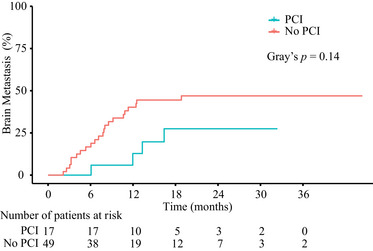
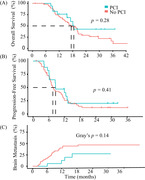
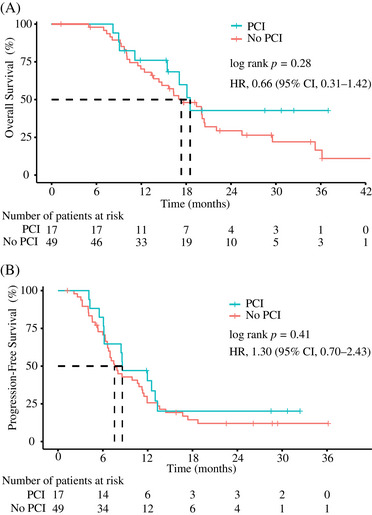
Results: In total, 66 consecutive patients treated between March 2019 and December 2021 were included in our dataset. Seventeen patients underwent PCI (PCI group) and 49 patients did not (non-PCI group). In comparison with the non-PCI group, PCI did not provide OS (median OS: 18.53 vs. 17.35 months, p = 0.28) or PFS (median PFS: 8.61 vs. 7.56 months, p = 0.41) benefits. When death was counted as a competing risk, the difference in the cumulative incidence rate of BM was not statistically significant (1-year: 12.79% vs. 38.09%; p = 0.14).
Conclusion: Compared to active MRI surveillance, first-line chemoimmunotherapy followed by PCI did not improve the prognosis of patients with ES-SCLC. Further studies are warranted to evaluate the therapeutic effects of PCI following chemoimmunotherapy.




 京公网安备 11010802042870号
京ICP备2023020795号-1
京公网安备 11010802042870号
京ICP备2023020795号-1

 分享
分享
 求助内容:
求助内容: 应助结果提醒方式:
 扫码关注我们
