{"title":"China’s Potential for Trade in Renewable Energy Products in RCEP Countries: A Gravity Model Analysis","authors":"Qing Guo, Zishan Mai","doi":"10.1155/2023/1530969","DOIUrl":null,"url":null,"abstract":"<div>\n <p>China’s renewable energy products have an important place in international trade, and the conclusion of the RCEP agreement can create favourable external conditions for China’s renewable energy product exports. This paper measures the export potential of China’s renewable energy products to other RCEP countries through a trade gravity model. The results show that (1) the GDP of the importing and exporting countries, the energy consumption of the importing countries, and the particulate emissions damage significantly enhance China’s renewable energy product exports; (2) among the RCEP countries, China has a greater potential to export renewable energy products to five countries in 2020, which are mainly located in East and Southeast Asia; and (3) from a dynamic perspective, China’s renewable energy trade potential is increasing, while in the Oceania region it is weakening, while trade links to Southeast Asian countries are developing in a more mature direction. Based on the above research, this paper puts forward corresponding policy recommendations.</p>\n </div>","PeriodicalId":14051,"journal":{"name":"International Journal of Energy Research","volume":"2023 1","pages":""},"PeriodicalIF":4.3000,"publicationDate":"2023-05-05","publicationTypes":"Journal Article","fieldsOfStudy":null,"isOpenAccess":false,"openAccessPdf":"https://onlinelibrary.wiley.com/doi/epdf/10.1155/2023/1530969","citationCount":"0","resultStr":null,"platform":"Semanticscholar","paperid":null,"PeriodicalName":"International Journal of Energy Research","FirstCategoryId":"5","ListUrlMain":"https://onlinelibrary.wiley.com/doi/10.1155/2023/1530969","RegionNum":3,"RegionCategory":"工程技术","ArticlePicture":[],"TitleCN":null,"AbstractTextCN":null,"PMCID":null,"EPubDate":"","PubModel":"","JCR":"Q2","JCRName":"ENERGY & FUELS","Score":null,"Total":0}
引用次数: 0
Abstract
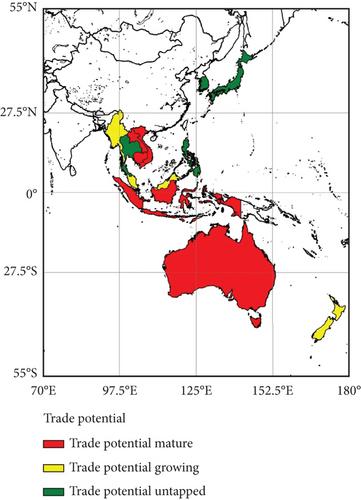
China’s renewable energy products have an important place in international trade, and the conclusion of the RCEP agreement can create favourable external conditions for China’s renewable energy product exports. This paper measures the export potential of China’s renewable energy products to other RCEP countries through a trade gravity model. The results show that (1) the GDP of the importing and exporting countries, the energy consumption of the importing countries, and the particulate emissions damage significantly enhance China’s renewable energy product exports; (2) among the RCEP countries, China has a greater potential to export renewable energy products to five countries in 2020, which are mainly located in East and Southeast Asia; and (3) from a dynamic perspective, China’s renewable energy trade potential is increasing, while in the Oceania region it is weakening, while trade links to Southeast Asian countries are developing in a more mature direction. Based on the above research, this paper puts forward corresponding policy recommendations.
期刊介绍:
The International Journal of Energy Research (IJER) is dedicated to providing a multidisciplinary, unique platform for researchers, scientists, engineers, technology developers, planners, and policy makers to present their research results and findings in a compelling manner on novel energy systems and applications. IJER covers the entire spectrum of energy from production to conversion, conservation, management, systems, technologies, etc. We encourage papers submissions aiming at better efficiency, cost improvements, more effective resource use, improved design and analysis, reduced environmental impact, and hence leading to better sustainability.
IJER is concerned with the development and exploitation of both advanced traditional and new energy sources, systems, technologies and applications. Interdisciplinary subjects in the area of novel energy systems and applications are also encouraged. High-quality research papers are solicited in, but are not limited to, the following areas with innovative and novel contents:
-Biofuels and alternatives
-Carbon capturing and storage technologies
-Clean coal technologies
-Energy conversion, conservation and management
-Energy storage
-Energy systems
-Hybrid/combined/integrated energy systems for multi-generation
-Hydrogen energy and fuel cells
-Hydrogen production technologies
-Micro- and nano-energy systems and technologies
-Nuclear energy
-Renewable energies (e.g. geothermal, solar, wind, hydro, tidal, wave, biomass)
-Smart energy system




 京公网安备 11010802042870号
京ICP备2023020795号-1
京公网安备 11010802042870号
京ICP备2023020795号-1

 分享
分享
 求助内容:
求助内容: 应助结果提醒方式:
 扫码关注我们
