{"title":"God save the queen! How and why the dominant evergreen species of the Mediterranean Basin is declining?","authors":"Francesca Alderotti, Erika Verdiani","doi":"10.1093/aobpla/plad051","DOIUrl":null,"url":null,"abstract":"<p><p><i>Quercus ilex</i> may be considered the <i>queen</i> tree of the Mediterranean Basin, dominating coastal forest areas up to 2000 m above sea level at some sites. However, an increase in holm oak decline has been observed in the last decade. In this review, we analysed the current literature to answer the following questions: what are the traits that allow holm oak to thrive in the Mediterranean environment, and what are the main factors that are currently weakening this species? In this framework, we attempt to answer these questions by proposing a triangle as a graphical summary. The first vertex focuses on the main morpho-anatomical, biochemical and physiological traits that allow holm oak to dominate Mediterranean forests. The other two vertices consider abiotic and biotic stressors that are closely related to holm oak decline. Here, we discuss the current evidence of holm oak responses to abiotic and biotic stresses and propose a possible solution to its decline through adequate forest management choices, thus allowing the species to maintain its ecological domain.</p>","PeriodicalId":2,"journal":{"name":"ACS Applied Bio Materials","volume":" ","pages":"plad051"},"PeriodicalIF":4.7000,"publicationDate":"2023-08-01","publicationTypes":"Journal Article","fieldsOfStudy":null,"isOpenAccess":false,"openAccessPdf":"https://www.ncbi.nlm.nih.gov/pmc/articles/PMC10601391/pdf/","citationCount":"0","resultStr":null,"platform":"Semanticscholar","paperid":null,"PeriodicalName":"ACS Applied Bio Materials","FirstCategoryId":"99","ListUrlMain":"https://doi.org/10.1093/aobpla/plad051","RegionNum":0,"RegionCategory":null,"ArticlePicture":[],"TitleCN":null,"AbstractTextCN":null,"PMCID":null,"EPubDate":"2023/10/1 0:00:00","PubModel":"eCollection","JCR":"Q2","JCRName":"MATERIALS SCIENCE, BIOMATERIALS","Score":null,"Total":0}
引用次数: 0
Abstract
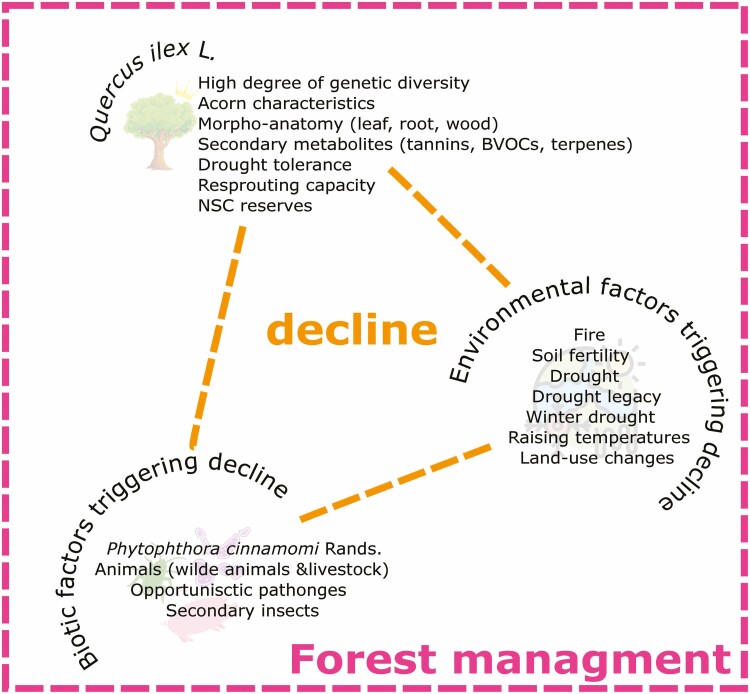
Quercus ilex may be considered the queen tree of the Mediterranean Basin, dominating coastal forest areas up to 2000 m above sea level at some sites. However, an increase in holm oak decline has been observed in the last decade. In this review, we analysed the current literature to answer the following questions: what are the traits that allow holm oak to thrive in the Mediterranean environment, and what are the main factors that are currently weakening this species? In this framework, we attempt to answer these questions by proposing a triangle as a graphical summary. The first vertex focuses on the main morpho-anatomical, biochemical and physiological traits that allow holm oak to dominate Mediterranean forests. The other two vertices consider abiotic and biotic stressors that are closely related to holm oak decline. Here, we discuss the current evidence of holm oak responses to abiotic and biotic stresses and propose a possible solution to its decline through adequate forest management choices, thus allowing the species to maintain its ecological domain.
期刊介绍:
ACS Applied Bio Materials is an interdisciplinary journal publishing original research covering all aspects of biomaterials and biointerfaces including and beyond the traditional biosensing, biomedical and therapeutic applications.
The journal is devoted to reports of new and original experimental and theoretical research of an applied nature that integrates knowledge in the areas of materials, engineering, physics, bioscience, and chemistry into important bio applications. The journal is specifically interested in work that addresses the relationship between structure and function and assesses the stability and degradation of materials under relevant environmental and biological conditions.




 京公网安备 11010802042870号
京ICP备2023020795号-1
京公网安备 11010802042870号
京ICP备2023020795号-1

 分享
分享
 求助内容:
求助内容: 应助结果提醒方式:
 扫码关注我们
