Si Qin, Yindi Zhang, Fadong Yu, Yinxing Ni, Jian Zhong
{"title":"A Novel Heterozygous <i>NF1</i> Variant in a Neurofibromatosis-Noonan Syndrome Patient with Growth Hormone Deficiency: A Case Report","authors":"Si Qin, Yindi Zhang, Fadong Yu, Yinxing Ni, Jian Zhong","doi":"10.4274/jcrpe.galenos.2022.2021-12-24","DOIUrl":null,"url":null,"abstract":"<p><p>Neurofibromatosis-Noonan syndrome (NFNS), a rare autosomal-dominant hereditary disease, is characterized by clinical manifestations of both neurofibromatosis type 1 (<i>NF1</i>) and NS. We present a case of NFNS with short stature caused by a heterozygous nonsense variant of the <i>NF1</i> gene. A 12-year-old boy was admitted because of short stature, numerous café-au-lait spots, low-set and posteriorly rotated ears, sparse eyebrows, broad forehead, and inverted triangular face. Cranial and spinal magnetic resonance imaging showed abnormal nodular lesions. Molecular analysis revealed a novel heterozygous c.6189 C > G (p.(Tyr2063*)) variant in the <i>NF1</i> gene. The patient was not prescribed recombinant growth hormone (GH) therapy because exogenous GH may have enlarged the abnormal skeletal lesions. During follow-up, Lisch nodules were found in the ophthalmologic examination. NFNS, a variant form of <i>NF1</i>, is caused by heterozygous mutations in the <i>NF1</i> gene. The mechanism of GH deficiency caused by <i>NF1</i> is still unclear. Whether NFNS patients should be treated with exogenous GH remains controversial.</p>","PeriodicalId":1,"journal":{"name":"Accounts of Chemical Research","volume":" ","pages":"438-443"},"PeriodicalIF":17.7000,"publicationDate":"2023-11-22","publicationTypes":"Journal Article","fieldsOfStudy":null,"isOpenAccess":false,"openAccessPdf":"https://www.ncbi.nlm.nih.gov/pmc/articles/PMC10683535/pdf/","citationCount":"1","resultStr":null,"platform":"Semanticscholar","paperid":null,"PeriodicalName":"Accounts of Chemical Research","FirstCategoryId":"3","ListUrlMain":"https://doi.org/10.4274/jcrpe.galenos.2022.2021-12-24","RegionNum":1,"RegionCategory":"化学","ArticlePicture":[],"TitleCN":null,"AbstractTextCN":null,"PMCID":null,"EPubDate":"2022/5/31 0:00:00","PubModel":"Epub","JCR":"Q1","JCRName":"CHEMISTRY, MULTIDISCIPLINARY","Score":null,"Total":0}
引用次数: 1
Abstract
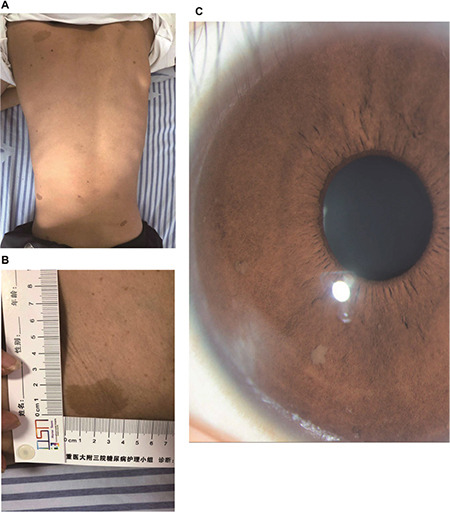
Neurofibromatosis-Noonan syndrome (NFNS), a rare autosomal-dominant hereditary disease, is characterized by clinical manifestations of both neurofibromatosis type 1 (NF1) and NS. We present a case of NFNS with short stature caused by a heterozygous nonsense variant of the NF1 gene. A 12-year-old boy was admitted because of short stature, numerous café-au-lait spots, low-set and posteriorly rotated ears, sparse eyebrows, broad forehead, and inverted triangular face. Cranial and spinal magnetic resonance imaging showed abnormal nodular lesions. Molecular analysis revealed a novel heterozygous c.6189 C > G (p.(Tyr2063*)) variant in the NF1 gene. The patient was not prescribed recombinant growth hormone (GH) therapy because exogenous GH may have enlarged the abnormal skeletal lesions. During follow-up, Lisch nodules were found in the ophthalmologic examination. NFNS, a variant form of NF1, is caused by heterozygous mutations in the NF1 gene. The mechanism of GH deficiency caused by NF1 is still unclear. Whether NFNS patients should be treated with exogenous GH remains controversial.
期刊介绍:
Accounts of Chemical Research presents short, concise and critical articles offering easy-to-read overviews of basic research and applications in all areas of chemistry and biochemistry. These short reviews focus on research from the author’s own laboratory and are designed to teach the reader about a research project. In addition, Accounts of Chemical Research publishes commentaries that give an informed opinion on a current research problem. Special Issues online are devoted to a single topic of unusual activity and significance.
Accounts of Chemical Research replaces the traditional article abstract with an article "Conspectus." These entries synopsize the research affording the reader a closer look at the content and significance of an article. Through this provision of a more detailed description of the article contents, the Conspectus enhances the article's discoverability by search engines and the exposure for the research.






 京公网安备 11010802042870号
京ICP备2023020795号-1
京公网安备 11010802042870号
京ICP备2023020795号-1

 分享
分享
 求助内容:
求助内容: 应助结果提醒方式:
 扫码关注我们
