Jin Chen, Yuxia Zhan, Jun Zhang, Yang Yu, Shuang Yao, Guanghua Luo
{"title":"Rapid Identification of Seven Common <i>ABO</i> Alleles by Two-Dimensional Polymerase Chain Reaction Technology.","authors":"Jin Chen, Yuxia Zhan, Jun Zhang, Yang Yu, Shuang Yao, Guanghua Luo","doi":"10.1159/000530013","DOIUrl":null,"url":null,"abstract":"<p><strong>Introduction: </strong>The molecular biology detection technology of the human <i>ABO</i> blood group system makes up for the limitations in many aspects compared with conventional serological typing technology. This study aimed to establish a new method to identify seven common <i>ABO</i> alleles (<i>ABO</i>*<i>A1.01</i>, <i>ABO</i>*<i>A1.02</i>, <i>ABO</i>*<i>A2.01</i>, <i>ABO</i>*<i>B.01</i>, <i>ABO</i>*<i>O.01.01</i>, <i>ABO</i>*<i>O.01.02</i>, and <i>ABO</i>*<i>O.02.01</i>) by two-dimensional polymerase chain reaction (2D PCR). 2D PCR can identify multiple target genes in a closed test tube by labeling specific primers with tags homologous to the sequence of fluorescently labeled probes, and melting curve analysis is performed after the fluorescent probes are hybridized with tag complementary sequences in PCR-specific products. In this study, 2D PCR and PCR sequence-specific primer (PCR-SSP) were combined to discriminate different alleles in a single reaction, which has the characteristics of high throughput, and compared with other typing techniques; the typing results can be obtained without additional operations.</p><p><strong>Methods: </strong>The <i>ABO</i>*<i>A1.01</i> allele genetic sequence was used as the reference sequence. The specific sense and antisense primers for seven common <i>ABO</i> alleles were designed on exons 6 and 7 according to the principle of 2D PCR and PCR-SSP. Single nucleotide polymorphism sites for identifying seven alleles were detected in FAM and HEX channels, respectively. Two hundred sixty DNA samples were enrolled for rapid <i>ABO</i> genotyping by 2D PCR, and 95 of them were selected for Sanger sequencing. The <i>Kappa</i> test was used to analyze the agreement of the methodologies.</p><p><strong>Results: </strong>These 7 alleles each had four characteristic melting valleys at different single nucleotide polymorphism loci. A total of 15 genotypes were detected, including <i>ABO</i>*<i>A1.01/A1.02</i>, <i>ABO</i>*<i>A1.01/O.01.01</i>, <i>ABO</i>*<i>A1.01/O.01.02</i>, <i>ABO</i>*<i>A1.02/A1.02</i>, <i>ABO</i>*<i>A1.02/O.01.01</i>, <i>ABO</i>*<i>A1.02/O.01.02</i>, <i>ABO</i>*<i>B.01/B.01</i>, <i>ABO</i>*<i>B.01/O.01.01</i>, <i>ABO</i>*<i>B.01/O.01.02</i>, <i>ABO</i>*<i>O.01.01/O.01.01</i>, <i>ABO</i>*<i>O.01.01/O.01.02</i>, <i>ABO</i>*<i>O.01.02/O.01.02</i>, <i>ABO</i>*<i>A1.01/B.01</i>, <i>ABO</i>*<i>A1.02/B.01</i>, and <i>ABO</i>*<i>B.01/O.01. v</i> (containing a rare <i>ABO*O</i> allele, based on the sequencing results). The <i>Kappa</i> test showed completely consistent results for 2D PCR and Sanger sequencing (<i>Kappa</i> = 1).</p><p><strong>Conclusion: </strong>The 2D PCR technique could be used for molecular typing of the ABO blood group, which was efficient, rapid, accurate, and economical.</p>","PeriodicalId":1,"journal":{"name":"Accounts of Chemical Research","volume":" ","pages":"502-514"},"PeriodicalIF":17.7000,"publicationDate":"2023-04-24","publicationTypes":"Journal Article","fieldsOfStudy":null,"isOpenAccess":false,"openAccessPdf":"https://www.ncbi.nlm.nih.gov/pmc/articles/PMC10712971/pdf/","citationCount":"0","resultStr":null,"platform":"Semanticscholar","paperid":null,"PeriodicalName":"Accounts of Chemical Research","FirstCategoryId":"3","ListUrlMain":"https://doi.org/10.1159/000530013","RegionNum":1,"RegionCategory":"化学","ArticlePicture":[],"TitleCN":null,"AbstractTextCN":null,"PMCID":null,"EPubDate":"2023/12/1 0:00:00","PubModel":"eCollection","JCR":"Q1","JCRName":"CHEMISTRY, MULTIDISCIPLINARY","Score":null,"Total":0}
引用次数: 0
Abstract
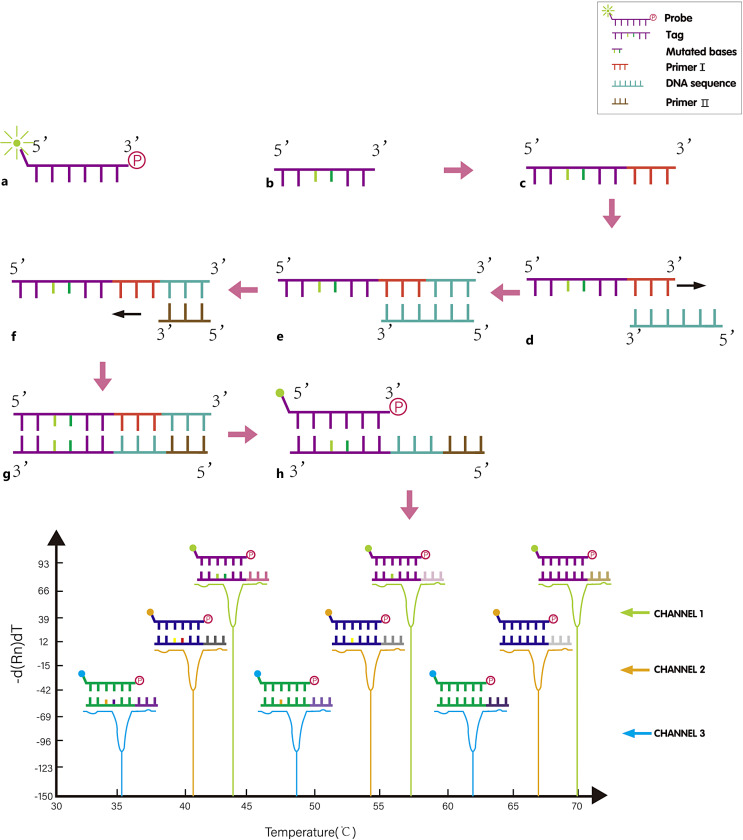
Introduction: The molecular biology detection technology of the human ABO blood group system makes up for the limitations in many aspects compared with conventional serological typing technology. This study aimed to establish a new method to identify seven common ABO alleles (ABO*A1.01, ABO*A1.02, ABO*A2.01, ABO*B.01, ABO*O.01.01, ABO*O.01.02, and ABO*O.02.01) by two-dimensional polymerase chain reaction (2D PCR). 2D PCR can identify multiple target genes in a closed test tube by labeling specific primers with tags homologous to the sequence of fluorescently labeled probes, and melting curve analysis is performed after the fluorescent probes are hybridized with tag complementary sequences in PCR-specific products. In this study, 2D PCR and PCR sequence-specific primer (PCR-SSP) were combined to discriminate different alleles in a single reaction, which has the characteristics of high throughput, and compared with other typing techniques; the typing results can be obtained without additional operations.
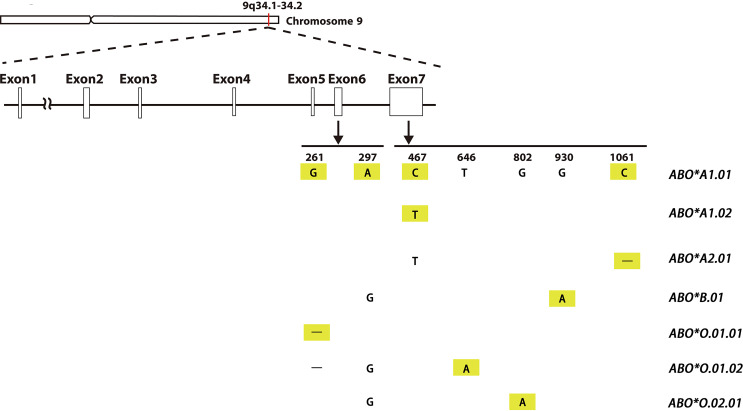
Methods: The ABO*A1.01 allele genetic sequence was used as the reference sequence. The specific sense and antisense primers for seven common ABO alleles were designed on exons 6 and 7 according to the principle of 2D PCR and PCR-SSP. Single nucleotide polymorphism sites for identifying seven alleles were detected in FAM and HEX channels, respectively. Two hundred sixty DNA samples were enrolled for rapid ABO genotyping by 2D PCR, and 95 of them were selected for Sanger sequencing. The Kappa test was used to analyze the agreement of the methodologies.
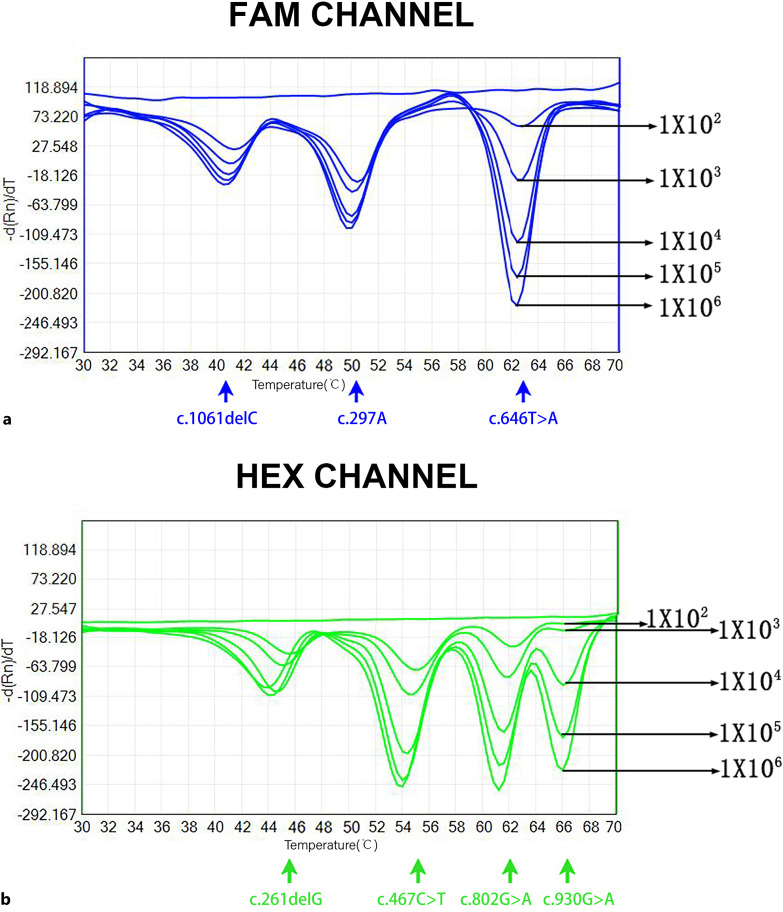
Results: These 7 alleles each had four characteristic melting valleys at different single nucleotide polymorphism loci. A total of 15 genotypes were detected, including ABO*A1.01/A1.02, ABO*A1.01/O.01.01, ABO*A1.01/O.01.02, ABO*A1.02/A1.02, ABO*A1.02/O.01.01, ABO*A1.02/O.01.02, ABO*B.01/B.01, ABO*B.01/O.01.01, ABO*B.01/O.01.02, ABO*O.01.01/O.01.01, ABO*O.01.01/O.01.02, ABO*O.01.02/O.01.02, ABO*A1.01/B.01, ABO*A1.02/B.01, and ABO*B.01/O.01. v (containing a rare ABO*O allele, based on the sequencing results). The Kappa test showed completely consistent results for 2D PCR and Sanger sequencing (Kappa = 1).
Conclusion: The 2D PCR technique could be used for molecular typing of the ABO blood group, which was efficient, rapid, accurate, and economical.
期刊介绍:
Accounts of Chemical Research presents short, concise and critical articles offering easy-to-read overviews of basic research and applications in all areas of chemistry and biochemistry. These short reviews focus on research from the author’s own laboratory and are designed to teach the reader about a research project. In addition, Accounts of Chemical Research publishes commentaries that give an informed opinion on a current research problem. Special Issues online are devoted to a single topic of unusual activity and significance.
Accounts of Chemical Research replaces the traditional article abstract with an article "Conspectus." These entries synopsize the research affording the reader a closer look at the content and significance of an article. Through this provision of a more detailed description of the article contents, the Conspectus enhances the article's discoverability by search engines and the exposure for the research.




 京公网安备 11010802042870号
京ICP备2023020795号-1
京公网安备 11010802042870号
京ICP备2023020795号-1

 分享
分享
 求助内容:
求助内容: 应助结果提醒方式:
 扫码关注我们
