{"title":"Phaeohyphomycosis caused by <i>Corynespora cassiicola</i>, a plant pathogen worldwide.","authors":"Dongying Hu, Weiwei Jiang, Xinlin Zhu, Qing Hou, Min Chen, Xiaochun Xue, Jing Zhao, Macit Ilkit, Amir Arastehfar, Wenjie Fang, Shunzhang Lin, Weihua Pan, Wanqing Liao","doi":"10.1080/21501203.2023.2247433","DOIUrl":null,"url":null,"abstract":"<p><p>Although rare, trans-kingdom infection features an interesting infection biology concept, in which highly versatile pathogenic attributes allow successful infections in evolutionarily highly divergent species. <i>Corynespora cassiicola</i> is a phytopathogenic fungus and occasionally causes human infections. Herein, we report a phaeohyphomycosis case caused by <i>C</i>. <i>cassiicola</i>. Given that sporadic reports may contribute to a lack of awareness of the transmission route, clinical manifestations, and diagnostic and clinical management, we systematically reviewed the cases reported thus far. Nine patients were identified and included in the pooled analysis, 88.9% (8/9) of whom were reported after 2010. All patients were from Asian, African, and Latin American countries, among whom 77.8% (7/9) were farmers or lived in areas with active agriculture. Exposed body parts were the major affected infection area, and clinical manifestations were mainly non-specific inflammatory reactions. Although biochemical and morphological examinations confirmed the presence of fungal infection, molecular analysis was used for the final diagnosis, with 77.8% (7/9) being identified by internal transcribed spacer sequencing. Whereas voriconazole, terbinafine, and AmB, either alone or in combination, resulted in successful infection resolution in most cases (5/9; 55.5%), those suffering from invasive facial infections and <i>CARD9</i> deficiency showed poor outcomes. Our patient is the third case of invasive facial infection caused by <i>C</i>. <i>cassiicola</i> and was successfully treated with intravenous LAmB followed by oral voriconazole combined with topical antifungal irrigation. Molecular identification of fungus and prompt antifungal treatment is pivotal in the clinical success of patients suspected to have phaeohyphomycosis. Moreover, as evidenced by our data, itraconazole treatment is not recommended.</p>","PeriodicalId":4,"journal":{"name":"ACS Applied Energy Materials","volume":" ","pages":"91-100"},"PeriodicalIF":5.5000,"publicationDate":"2023-08-21","publicationTypes":"Journal Article","fieldsOfStudy":null,"isOpenAccess":false,"openAccessPdf":"https://www.ncbi.nlm.nih.gov/pmc/articles/PMC10977011/pdf/","citationCount":"0","resultStr":null,"platform":"Semanticscholar","paperid":null,"PeriodicalName":"ACS Applied Energy Materials","FirstCategoryId":"1085","ListUrlMain":"https://doi.org/10.1080/21501203.2023.2247433","RegionNum":3,"RegionCategory":"材料科学","ArticlePicture":[],"TitleCN":null,"AbstractTextCN":null,"PMCID":null,"EPubDate":"2024/1/1 0:00:00","PubModel":"eCollection","JCR":"Q2","JCRName":"CHEMISTRY, PHYSICAL","Score":null,"Total":0}
引用次数: 0
Abstract
Although rare, trans-kingdom infection features an interesting infection biology concept, in which highly versatile pathogenic attributes allow successful infections in evolutionarily highly divergent species. Corynespora cassiicola is a phytopathogenic fungus and occasionally causes human infections. Herein, we report a phaeohyphomycosis case caused by C. cassiicola. Given that sporadic reports may contribute to a lack of awareness of the transmission route, clinical manifestations, and diagnostic and clinical management, we systematically reviewed the cases reported thus far. Nine patients were identified and included in the pooled analysis, 88.9% (8/9) of whom were reported after 2010. All patients were from Asian, African, and Latin American countries, among whom 77.8% (7/9) were farmers or lived in areas with active agriculture. Exposed body parts were the major affected infection area, and clinical manifestations were mainly non-specific inflammatory reactions. Although biochemical and morphological examinations confirmed the presence of fungal infection, molecular analysis was used for the final diagnosis, with 77.8% (7/9) being identified by internal transcribed spacer sequencing. Whereas voriconazole, terbinafine, and AmB, either alone or in combination, resulted in successful infection resolution in most cases (5/9; 55.5%), those suffering from invasive facial infections and CARD9 deficiency showed poor outcomes. Our patient is the third case of invasive facial infection caused by C. cassiicola and was successfully treated with intravenous LAmB followed by oral voriconazole combined with topical antifungal irrigation. Molecular identification of fungus and prompt antifungal treatment is pivotal in the clinical success of patients suspected to have phaeohyphomycosis. Moreover, as evidenced by our data, itraconazole treatment is not recommended.
期刊介绍:
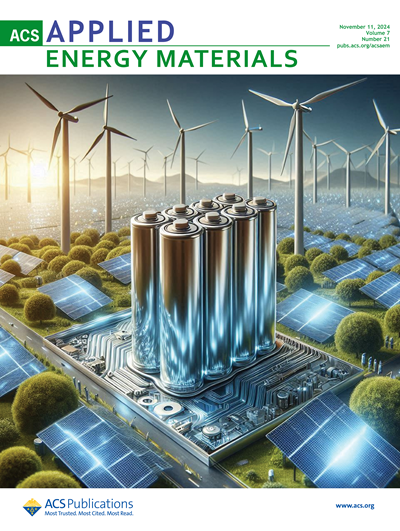
ACS Applied Energy Materials is an interdisciplinary journal publishing original research covering all aspects of materials, engineering, chemistry, physics and biology relevant to energy conversion and storage. The journal is devoted to reports of new and original experimental and theoretical research of an applied nature that integrate knowledge in the areas of materials, engineering, physics, bioscience, and chemistry into important energy applications.



 京公网安备 11010802042870号
京ICP备2023020795号-1
京公网安备 11010802042870号
京ICP备2023020795号-1

 分享
分享
 求助内容:
求助内容: 应助结果提醒方式:
 扫码关注我们
