Zhu Zhou MSc, Lei Xing PhD, Vijay Venkatesan PhD, Haoran Xu PhD, Wenhua Chen PhD, Jin Xuan PhD
{"title":"Novel porous electrode designs for reversible solid oxide hydrogen planar cell through multi-physics modeling","authors":"Zhu Zhou MSc, Lei Xing PhD, Vijay Venkatesan PhD, Haoran Xu PhD, Wenhua Chen PhD, Jin Xuan PhD","doi":"10.1002/fuce.202200151","DOIUrl":null,"url":null,"abstract":"<p>A comprehensive multiphysics 3D model of an anode-supported planar reversible solid oxide cell (rSOC) with a half-channel-unit-cell geometry is created and validated. The physical phenomena that are modeled include reversible electrochemistry/charge transport, coupled with momentum/mass/heat transport. Several electrode microstructures comprising the homogeneous and functionally graded porosity distributions are applied to the validated model, to evaluate and compare the current-voltage (j-V) performance in both fuel cell mode and electrolysis mode. The results indicate that increasing the porosity in a homogeneous porous electrode does not always promote the cell's j-V performance. An optimal porosity emerges where the effect of porosity on the mass transport is maximized, which ranges between 0.5 and 0.7 in the working conditions of the present study. Compared with homogeneous porous electrodes, the heterogeneous porous electrode design with a functionally graded porosity distribution is found to be a potential option to better the overall j-V performance of the rSOC. Furthermore, it is discovered that theoretically grading the porosity in the width direction (i.e., increasing porosity from the center of each gas channel to the center of each adjacent rib) brings an outsize benefit on the cell's performance, compared to the traditional way of improving the porosity along the cell thickness direction.</p>","PeriodicalId":91482,"journal":{"name":"","volume":"23 1","pages":"119-134"},"PeriodicalIF":0.0,"publicationDate":"2022-11-04","publicationTypes":"Journal Article","fieldsOfStudy":null,"isOpenAccess":false,"openAccessPdf":"https://onlinelibrary.wiley.com/doi/epdf/10.1002/fuce.202200151","citationCount":"2","resultStr":null,"platform":"Semanticscholar","paperid":null,"PeriodicalName":"","FirstCategoryId":"5","ListUrlMain":"https://onlinelibrary.wiley.com/doi/10.1002/fuce.202200151","RegionNum":0,"RegionCategory":null,"ArticlePicture":[],"TitleCN":null,"AbstractTextCN":null,"PMCID":null,"EPubDate":"","PubModel":"","JCR":"","JCRName":"","Score":null,"Total":0}
引用次数: 2
Abstract
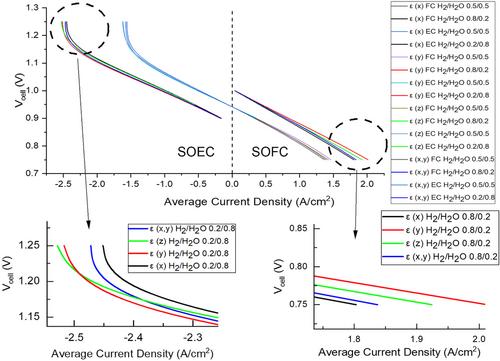
A comprehensive multiphysics 3D model of an anode-supported planar reversible solid oxide cell (rSOC) with a half-channel-unit-cell geometry is created and validated. The physical phenomena that are modeled include reversible electrochemistry/charge transport, coupled with momentum/mass/heat transport. Several electrode microstructures comprising the homogeneous and functionally graded porosity distributions are applied to the validated model, to evaluate and compare the current-voltage (j-V) performance in both fuel cell mode and electrolysis mode. The results indicate that increasing the porosity in a homogeneous porous electrode does not always promote the cell's j-V performance. An optimal porosity emerges where the effect of porosity on the mass transport is maximized, which ranges between 0.5 and 0.7 in the working conditions of the present study. Compared with homogeneous porous electrodes, the heterogeneous porous electrode design with a functionally graded porosity distribution is found to be a potential option to better the overall j-V performance of the rSOC. Furthermore, it is discovered that theoretically grading the porosity in the width direction (i.e., increasing porosity from the center of each gas channel to the center of each adjacent rib) brings an outsize benefit on the cell's performance, compared to the traditional way of improving the porosity along the cell thickness direction.



 京公网安备 11010802042870号
京ICP备2023020795号-1
京公网安备 11010802042870号
京ICP备2023020795号-1

 分享
分享
 求助内容:
求助内容: 应助结果提醒方式:
 扫码关注我们
