{"title":"CRISPR genomic screening informs gene–environment interactions","authors":"Amin Sobh, Chris Vulpe","doi":"10.1016/j.cotox.2019.02.009","DOIUrl":null,"url":null,"abstract":"<div><p><span><span>Gene–environment interactions impact the adverse health effects of environmental exposure to toxicants. Identification of genetic factors<span><span> modulating organismal and cellular response to environmental toxicants can inform risk assessment. Genome-wide clustered regularly interspaced short palindromic repeats (CRISPR)–based </span>genetic perturbation screening has recently emerged as a powerful approach to illuminate complex </span></span>cellular processes including mechanisms modulating </span>chemical toxicity. Here, we review key studies that demonstrate the utility of CRISPR screens in deciphering the molecular determinants of sensitivity and tolerance to toxic substances. We reflect on key considerations for implementing a CRISPR screen in toxicology. We also discuss computational methods used for analyzing CRISPR screens and strategies for validating screening results. Finally, we highlight potential future directions to address limitations in CRISPR screening approaches as applied to toxicology.</p></div>","PeriodicalId":37736,"journal":{"name":"Current Opinion in Toxicology","volume":"18 ","pages":"Pages 46-53"},"PeriodicalIF":3.6000,"publicationDate":"2019-12-01","publicationTypes":"Journal Article","fieldsOfStudy":null,"isOpenAccess":false,"openAccessPdf":"https://sci-hub-pdf.com/10.1016/j.cotox.2019.02.009","citationCount":"5","resultStr":null,"platform":"Semanticscholar","paperid":null,"PeriodicalName":"Current Opinion in Toxicology","FirstCategoryId":"1085","ListUrlMain":"https://www.sciencedirect.com/science/article/pii/S2468202019300075","RegionNum":0,"RegionCategory":null,"ArticlePicture":[],"TitleCN":null,"AbstractTextCN":null,"PMCID":null,"EPubDate":"","PubModel":"","JCR":"Q1","JCRName":"TOXICOLOGY","Score":null,"Total":0}
引用次数: 5
Abstract
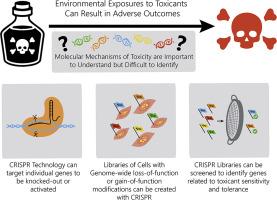
Gene–environment interactions impact the adverse health effects of environmental exposure to toxicants. Identification of genetic factors modulating organismal and cellular response to environmental toxicants can inform risk assessment. Genome-wide clustered regularly interspaced short palindromic repeats (CRISPR)–based genetic perturbation screening has recently emerged as a powerful approach to illuminate complex cellular processes including mechanisms modulating chemical toxicity. Here, we review key studies that demonstrate the utility of CRISPR screens in deciphering the molecular determinants of sensitivity and tolerance to toxic substances. We reflect on key considerations for implementing a CRISPR screen in toxicology. We also discuss computational methods used for analyzing CRISPR screens and strategies for validating screening results. Finally, we highlight potential future directions to address limitations in CRISPR screening approaches as applied to toxicology.
期刊介绍:
The aims and scope of Current Opinion in Toxicology is to systematically provide the reader with timely and provocative views and opinions of the highest qualified and recognized experts on current advances in selected topics within the field of toxicology. The goal is that Current Opinion in Toxicology will be an invaluable source of information and perspective for researchers, teachers, managers and administrators, policy makers and students. Division of the subject into sections: For this purpose, the scope of Toxicology is divided into six selected high impact themed sections, each of which is reviewed once a year: Mechanistic Toxicology, Metabolic Toxicology, Risk assessment in Toxicology, Genomic Toxicology, Systems Toxicology, Translational Toxicology.



 京公网安备 11010802042870号
京ICP备2023020795号-1
京公网安备 11010802042870号
京ICP备2023020795号-1

 分享
分享
 求助内容:
求助内容: 应助结果提醒方式:
 扫码关注我们
