{"title":"Classification of Myopathy and Amyotrophic Lateral Sclerosis Electromyograms Using Bat Algorithm and Deep Neural Networks.","authors":"A Bakiya, A Anitha, T Sridevi, K Kamalanand","doi":"10.1155/2022/3517872","DOIUrl":null,"url":null,"abstract":"<p><p>Electromyograms (EMG) are a recorded galvanic action of nerves and muscles which assists in diagnosing the disorders associated with muscles and nerves. The efficient discrimination of abnormal EMG signals, myopathy and amyotrophic lateral sclerosis, engage crucial role in automatic diagnostic assistance tools, since EMG signals are nonstationary signals. Hence, for computer-aided identification of abnormalities, extraction of features, selection of superlative feature subset, and developing an efficient classifier are indispensable. Initially, time domain and Wigner-Ville transformed time-frequency features were extracted from abnormal EMG signals for experiments. The selection of substantial characteristics from time and time-frequency features was performed using bat algorithm. Extensively, deep neural network classifier is modelled for selected feature subset using bat algorithm from extracted time and time-frequency features. The performance of deep neural network exerting selected features from bat algorithm was compared with conventional artificial neural network. Results demonstrate that the deep neural network modelled with layers 2 and 3 (neurons = 2 and 4) using time domain features is efficient in classifying the abnormalities of EMG signals with an accuracy, sensitivity, and specificity of 100% and also exhibited finer performance. Correspondingly, the developed conventional single layer artificial neural network (neurons = 7) with time domain features has shown an accuracy of 83.3%, sensitivity of 100%, and specificity of 71.42%. The work materializes the significance of conventional and deep neural network using time and time-frequency features in diagnosing the abnormal signals exists in neuromuscular system using efficient classification.</p>","PeriodicalId":2,"journal":{"name":"ACS Applied Bio Materials","volume":" ","pages":"3517872"},"PeriodicalIF":4.7000,"publicationDate":"2022-04-04","publicationTypes":"Journal Article","fieldsOfStudy":null,"isOpenAccess":false,"openAccessPdf":"https://www.ncbi.nlm.nih.gov/pmc/articles/PMC9001138/pdf/","citationCount":"4","resultStr":null,"platform":"Semanticscholar","paperid":null,"PeriodicalName":"ACS Applied Bio Materials","FirstCategoryId":"3","ListUrlMain":"https://doi.org/10.1155/2022/3517872","RegionNum":0,"RegionCategory":null,"ArticlePicture":[],"TitleCN":null,"AbstractTextCN":null,"PMCID":null,"EPubDate":"2022/1/1 0:00:00","PubModel":"eCollection","JCR":"Q2","JCRName":"MATERIALS SCIENCE, BIOMATERIALS","Score":null,"Total":0}
引用次数: 4
Abstract
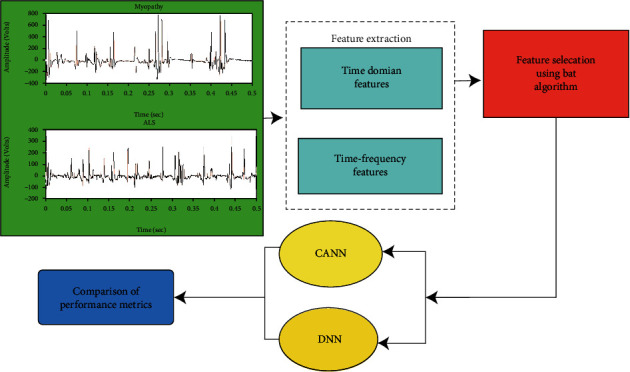
Electromyograms (EMG) are a recorded galvanic action of nerves and muscles which assists in diagnosing the disorders associated with muscles and nerves. The efficient discrimination of abnormal EMG signals, myopathy and amyotrophic lateral sclerosis, engage crucial role in automatic diagnostic assistance tools, since EMG signals are nonstationary signals. Hence, for computer-aided identification of abnormalities, extraction of features, selection of superlative feature subset, and developing an efficient classifier are indispensable. Initially, time domain and Wigner-Ville transformed time-frequency features were extracted from abnormal EMG signals for experiments. The selection of substantial characteristics from time and time-frequency features was performed using bat algorithm. Extensively, deep neural network classifier is modelled for selected feature subset using bat algorithm from extracted time and time-frequency features. The performance of deep neural network exerting selected features from bat algorithm was compared with conventional artificial neural network. Results demonstrate that the deep neural network modelled with layers 2 and 3 (neurons = 2 and 4) using time domain features is efficient in classifying the abnormalities of EMG signals with an accuracy, sensitivity, and specificity of 100% and also exhibited finer performance. Correspondingly, the developed conventional single layer artificial neural network (neurons = 7) with time domain features has shown an accuracy of 83.3%, sensitivity of 100%, and specificity of 71.42%. The work materializes the significance of conventional and deep neural network using time and time-frequency features in diagnosing the abnormal signals exists in neuromuscular system using efficient classification.
期刊介绍:
ACS Applied Bio Materials is an interdisciplinary journal publishing original research covering all aspects of biomaterials and biointerfaces including and beyond the traditional biosensing, biomedical and therapeutic applications.
The journal is devoted to reports of new and original experimental and theoretical research of an applied nature that integrates knowledge in the areas of materials, engineering, physics, bioscience, and chemistry into important bio applications. The journal is specifically interested in work that addresses the relationship between structure and function and assesses the stability and degradation of materials under relevant environmental and biological conditions.






 京公网安备 11010802042870号
京ICP备2023020795号-1
京公网安备 11010802042870号
京ICP备2023020795号-1

 分享
分享
 求助内容:
求助内容: 应助结果提醒方式:
 扫码关注我们
