Simona Ceraulo, Polina L. Perelman, Francesca Dumas
{"title":"Massive LINE-1 retrotransposon enrichment in tamarins of the Cebidae family (Platyrrhini, Primates) and its significance for genome evolution","authors":"Simona Ceraulo, Polina L. Perelman, Francesca Dumas","doi":"10.1111/jzs.12536","DOIUrl":null,"url":null,"abstract":"<p>To study heterochromatin distribution differences among tamarins, we applied LINE-1 probes using fluorescence <i>in situ</i> hybridization onto chromosomes of <i>Saguinus mystax, Leontocebus fuscicollis,</i> and <i>Leontopithecus rosalia</i> with the aim to investigate possible evolutionary implications. LINE-1 repeats were shown to be involved in genome architecture and in the occurrence of chromosomal rearrangements in many vertebrates. We found bright LINE-1 probe signals at centromeric or pericentromeric areas, GC rich, on almost all chromosomes in three tamarin species. We also found non-centromeric signals along chromosome arms. In a phylogenetic perspective, we analyzed the pattern of LINE-1 distribution considering human chromosomal homologies and C banding patterns. Our data indicate that LINE-1 centromeric expansions and accumulation presumably arose in a common tamarin ancestor and that the presence of LINE-1 at the junction of human chromosome associations is presumably linked to interchromosomal rearrangements. For example, we found bright centromeric signals as well as non-centromeric signals on chromosomes 1 and 2, in all species analyzed, in correspondence to human chromosome associations 13/9/22 and 20/17/13, which are synapomorphic for all tamarins. Furthermore, we found other faint signals that could be apomorphisms linked both to intrachromosomal rearrangements as well as to retro-transposition events. Our results confirm that the three species have similar karyotypes but small differences in LINE-1 and heterochromatin amplification and distribution; in particular on chromosome pairs 19–22, where we show the occurrence of small inversions, in agreement with previous classic cytogenetic hypotheses.</p>","PeriodicalId":91350,"journal":{"name":"","volume":"59 8","pages":"2553-2561"},"PeriodicalIF":0.0,"publicationDate":"2021-09-27","publicationTypes":"Journal Article","fieldsOfStudy":null,"isOpenAccess":false,"openAccessPdf":"","citationCount":"4","resultStr":null,"platform":"Semanticscholar","paperid":null,"PeriodicalName":"","FirstCategoryId":"99","ListUrlMain":"https://onlinelibrary.wiley.com/doi/10.1111/jzs.12536","RegionNum":0,"RegionCategory":null,"ArticlePicture":[],"TitleCN":null,"AbstractTextCN":null,"PMCID":null,"EPubDate":"","PubModel":"","JCR":"","JCRName":"","Score":null,"Total":0}
引用次数: 4
Abstract
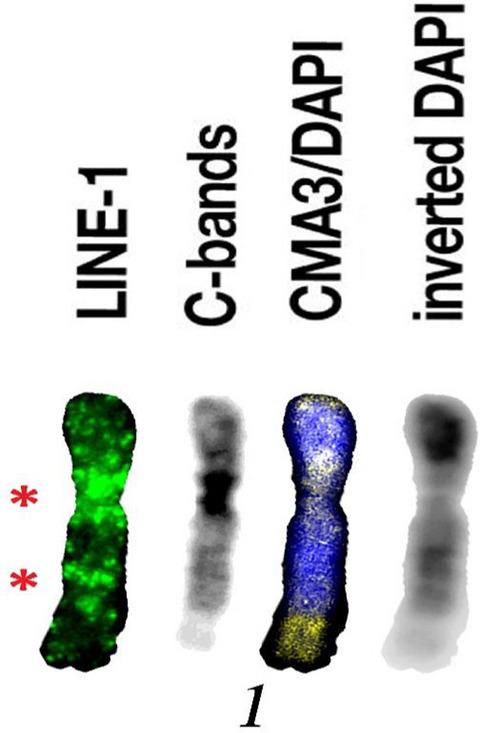
To study heterochromatin distribution differences among tamarins, we applied LINE-1 probes using fluorescence in situ hybridization onto chromosomes of Saguinus mystax, Leontocebus fuscicollis, and Leontopithecus rosalia with the aim to investigate possible evolutionary implications. LINE-1 repeats were shown to be involved in genome architecture and in the occurrence of chromosomal rearrangements in many vertebrates. We found bright LINE-1 probe signals at centromeric or pericentromeric areas, GC rich, on almost all chromosomes in three tamarin species. We also found non-centromeric signals along chromosome arms. In a phylogenetic perspective, we analyzed the pattern of LINE-1 distribution considering human chromosomal homologies and C banding patterns. Our data indicate that LINE-1 centromeric expansions and accumulation presumably arose in a common tamarin ancestor and that the presence of LINE-1 at the junction of human chromosome associations is presumably linked to interchromosomal rearrangements. For example, we found bright centromeric signals as well as non-centromeric signals on chromosomes 1 and 2, in all species analyzed, in correspondence to human chromosome associations 13/9/22 and 20/17/13, which are synapomorphic for all tamarins. Furthermore, we found other faint signals that could be apomorphisms linked both to intrachromosomal rearrangements as well as to retro-transposition events. Our results confirm that the three species have similar karyotypes but small differences in LINE-1 and heterochromatin amplification and distribution; in particular on chromosome pairs 19–22, where we show the occurrence of small inversions, in agreement with previous classic cytogenetic hypotheses.



 京公网安备 11010802042870号
京ICP备2023020795号-1
京公网安备 11010802042870号
京ICP备2023020795号-1

 分享
分享
 求助内容:
求助内容: 应助结果提醒方式:
 扫码关注我们
