Understanding the real magnitude of the arachnid order Ricinulei through deep Sanger sequencing across its distribution range and phylogenomics, with the formalization of the first species from the Lesser Antilles
Ligia R. Benavides, Savel R. Daniels, Gonzalo Giribet
{"title":"Understanding the real magnitude of the arachnid order Ricinulei through deep Sanger sequencing across its distribution range and phylogenomics, with the formalization of the first species from the Lesser Antilles","authors":"Ligia R. Benavides, Savel R. Daniels, Gonzalo Giribet","doi":"10.1111/jzs.12546","DOIUrl":null,"url":null,"abstract":"<p>Ricinulei (hooded tick spiders or tick beetles), considered one of the smaller arachnid orders, is an ancient clade whose affinities are still debated. With three recognized genera, short-range endemism, and strict fidelity to the landmasses that have seen them evolve for hundreds of millions of years, the group has emerged as a novel system to understand deep biogeographic processes. Here we undertake a combined approach using phylotranscriptomics and deep Sanger sequencing of 133 ricinuleid specimens to better understand their relationships, divergence times, and species ranges by using a series of species delimitation analyses. Our results support the monophyly of the three recognized genera, <i>Ricinoides</i> in Africa, <i>Pseudocellus</i> in North America, and <i>Cryptocellus</i> in Mesoamerica and South America. <i>Ricinoides</i> is further divided into two or three deep clades corresponding to different ancestral forest refugia, and the sampled <i>Cryptocellus</i> segregate into a Mesoamerican and a South American clade, but a new species from Tobago is the sister group to the Mesoamerican clade in the transcriptomic analysis and not part of the South American clade. Despite not being known from adults, but given the fact that this is the only Ricinulei species from the Lesser Antilles and its pivotal phylogenetic position, the species is here formalized as <i>Cryptocellus tobagoensis</i> Giribet & Benavides <b>sp. nov.</b> Finally, species delimitation methods generally do well recognizing morphospecies, but they are unable to distinguish among some of them, suggesting the need for re-study of some of these species complexes and perhaps synonymy.</p>","PeriodicalId":91350,"journal":{"name":"","volume":"59 8","pages":"1850-1873"},"PeriodicalIF":0.0,"publicationDate":"2021-11-26","publicationTypes":"Journal Article","fieldsOfStudy":null,"isOpenAccess":false,"openAccessPdf":"","citationCount":"0","resultStr":null,"platform":"Semanticscholar","paperid":null,"PeriodicalName":"","FirstCategoryId":"99","ListUrlMain":"https://onlinelibrary.wiley.com/doi/10.1111/jzs.12546","RegionNum":0,"RegionCategory":null,"ArticlePicture":[],"TitleCN":null,"AbstractTextCN":null,"PMCID":null,"EPubDate":"","PubModel":"","JCR":"","JCRName":"","Score":null,"Total":0}
引用次数: 0
Abstract
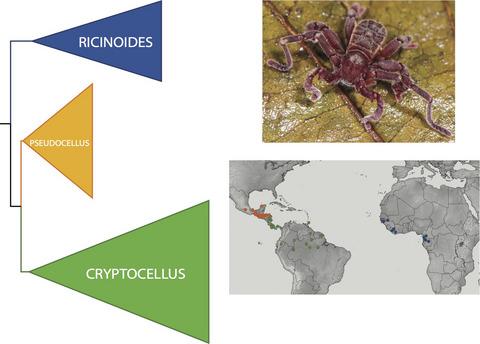
Ricinulei (hooded tick spiders or tick beetles), considered one of the smaller arachnid orders, is an ancient clade whose affinities are still debated. With three recognized genera, short-range endemism, and strict fidelity to the landmasses that have seen them evolve for hundreds of millions of years, the group has emerged as a novel system to understand deep biogeographic processes. Here we undertake a combined approach using phylotranscriptomics and deep Sanger sequencing of 133 ricinuleid specimens to better understand their relationships, divergence times, and species ranges by using a series of species delimitation analyses. Our results support the monophyly of the three recognized genera, Ricinoides in Africa, Pseudocellus in North America, and Cryptocellus in Mesoamerica and South America. Ricinoides is further divided into two or three deep clades corresponding to different ancestral forest refugia, and the sampled Cryptocellus segregate into a Mesoamerican and a South American clade, but a new species from Tobago is the sister group to the Mesoamerican clade in the transcriptomic analysis and not part of the South American clade. Despite not being known from adults, but given the fact that this is the only Ricinulei species from the Lesser Antilles and its pivotal phylogenetic position, the species is here formalized as Cryptocellus tobagoensis Giribet & Benavides sp. nov. Finally, species delimitation methods generally do well recognizing morphospecies, but they are unable to distinguish among some of them, suggesting the need for re-study of some of these species complexes and perhaps synonymy.



 京公网安备 11010802042870号
京ICP备2023020795号-1
京公网安备 11010802042870号
京ICP备2023020795号-1

 分享
分享
 求助内容:
求助内容: 应助结果提醒方式:
 扫码关注我们
