Dallas Rogers, Andrew Leach, Jasper Ludewig, Amelia Thorpe, Laurence Troy
{"title":"Mapping the frontiers of private property in New South Wales, Australia","authors":"Dallas Rogers, Andrew Leach, Jasper Ludewig, Amelia Thorpe, Laurence Troy","doi":"10.1111/1745-5871.12581","DOIUrl":null,"url":null,"abstract":"<p>This article addresses the process and patterns by which private property has been applied on the Australian continent. Alongside both lease-holdings that are limited by term or perpetual and squatting practices, identifying and documenting private property in both individual cases and in aggregate over a large geography offers a compelling approximation of the appearance and spread of British–Australian settlement. Plots and patterns of private land ownership can be read in relation to other forms of land use and tenure each subject to specific historical legal instruments and definitions. We explore how, in particular, the first-generation alienation of private property might be constructed, represented, and theorised using a critical approach to GIS tools and practices. What technical considerations are required to identify the extent of a site and map its transfer into private hands? How far can the process of mapping the initial alienation of parcels of Crown land over time expose legacies of colonial practices in present-day methods and serve as a testbed to generate other layers that capture, for instance, patterns of informal privatisation or interact with other phenomena—most notably that of frontier violence—that likewise occur on land, in time? Such work can be located among those wrestling with problems of mapping colonial land occupation with technologies that share a heritage with the surveying tools that allowed that same acquisition and can enhance a critical approach to GIS in relation to appropriation and dispossession of Aboriginal land.</p>","PeriodicalId":47233,"journal":{"name":"Geographical Research","volume":"63 2","pages":"236-248"},"PeriodicalIF":2.7000,"publicationDate":"2023-01-17","publicationTypes":"Journal Article","fieldsOfStudy":null,"isOpenAccess":false,"openAccessPdf":"https://onlinelibrary.wiley.com/doi/epdf/10.1111/1745-5871.12581","citationCount":"0","resultStr":null,"platform":"Semanticscholar","paperid":null,"PeriodicalName":"Geographical Research","FirstCategoryId":"90","ListUrlMain":"https://onlinelibrary.wiley.com/doi/10.1111/1745-5871.12581","RegionNum":2,"RegionCategory":"社会学","ArticlePicture":[],"TitleCN":null,"AbstractTextCN":null,"PMCID":null,"EPubDate":"","PubModel":"","JCR":"Q1","JCRName":"GEOGRAPHY","Score":null,"Total":0}
引用次数: 0
Abstract
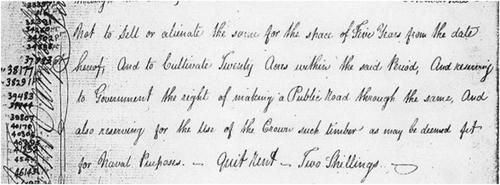
This article addresses the process and patterns by which private property has been applied on the Australian continent. Alongside both lease-holdings that are limited by term or perpetual and squatting practices, identifying and documenting private property in both individual cases and in aggregate over a large geography offers a compelling approximation of the appearance and spread of British–Australian settlement. Plots and patterns of private land ownership can be read in relation to other forms of land use and tenure each subject to specific historical legal instruments and definitions. We explore how, in particular, the first-generation alienation of private property might be constructed, represented, and theorised using a critical approach to GIS tools and practices. What technical considerations are required to identify the extent of a site and map its transfer into private hands? How far can the process of mapping the initial alienation of parcels of Crown land over time expose legacies of colonial practices in present-day methods and serve as a testbed to generate other layers that capture, for instance, patterns of informal privatisation or interact with other phenomena—most notably that of frontier violence—that likewise occur on land, in time? Such work can be located among those wrestling with problems of mapping colonial land occupation with technologies that share a heritage with the surveying tools that allowed that same acquisition and can enhance a critical approach to GIS in relation to appropriation and dispossession of Aboriginal land.



 京公网安备 11010802042870号
京ICP备2023020795号-1
京公网安备 11010802042870号
京ICP备2023020795号-1

 分享
分享
 求助内容:
求助内容: 应助结果提醒方式:
 扫码关注我们
