Sophie Perry, Grant Falvo, Samantha Mosier, G. Philip Robertson
{"title":"Long-term changes in soil carbon and nitrogen fractions in switchgrass, native grasses, and no-till corn bioenergy production systems","authors":"Sophie Perry, Grant Falvo, Samantha Mosier, G. Philip Robertson","doi":"10.1002/saj2.20575","DOIUrl":null,"url":null,"abstract":"<p>Cellulosic bioenergy is a primary land-based climate mitigation strategy, with soil carbon (C) storage and nitrogen (N) conservation as important mitigation elements. Here, we present 13 years of soil C and N change under three cellulosic cropping systems: monoculture switchgrass (<i>Panicum virgatum</i> L.), a five native grasses polyculture, and no-till corn (<i>Zea mays</i> L.). Soil C and N fractions were measured four times over 12 years. Bulk soil C in the 0–25 cm depth at the end of the study period ranged from 28.4 (± 1.4 se) Mg C ha<sup>−1</sup> in no-till corn, to 30.8 (± 1.4) Mg C ha<sup>−1</sup> in switchgrass, and to 34.8 (± 1.4) Mg C ha<sup>−1</sup> in native grasses. Mineral-associated organic matter (MAOM) ranged from 60% to 90% and particulate organic matter (POM) from 10% to 40% of total soil C. Over 12 years, total C as well as both C fractions persisted under no-till corn and switchgrass and increased under native grasses. In contrast, POM N stocks decreased 33% to 45% across systems, whereas MAOM N decreased only in no-till corn and by less than 13%. Declining POM N stocks likely reflect pre-establishment land use, which included alfalfa and manure in earlier rotations. Root production and large soil aggregate formation explained 69% (<i>p</i> < 0.001) and 36% (<i>p</i> = 0.024) of total soil C change, respectively, and 60% (<i>p</i> = 0.020) and 41% (<i>p</i> = 0.023) of soil N change, demonstrating the importance of belowground productivity and soil aggregates for producing and protecting soil C and conserving soil N. Differences between switchgrass and native grasses also indicate a dependence on plant diversity. Soil C and N benefits of bioenergy crops depend strongly on root productivity and pre-establishment land use.</p>","PeriodicalId":101043,"journal":{"name":"Proceedings - Soil Science Society of America","volume":"87 6","pages":"1365-1375"},"PeriodicalIF":0.0000,"publicationDate":"2023-07-26","publicationTypes":"Journal Article","fieldsOfStudy":null,"isOpenAccess":false,"openAccessPdf":"https://onlinelibrary.wiley.com/doi/epdf/10.1002/saj2.20575","citationCount":"0","resultStr":null,"platform":"Semanticscholar","paperid":null,"PeriodicalName":"Proceedings - Soil Science Society of America","FirstCategoryId":"1085","ListUrlMain":"https://onlinelibrary.wiley.com/doi/10.1002/saj2.20575","RegionNum":0,"RegionCategory":null,"ArticlePicture":[],"TitleCN":null,"AbstractTextCN":null,"PMCID":null,"EPubDate":"","PubModel":"","JCR":"","JCRName":"","Score":null,"Total":0}
引用次数: 0
Abstract
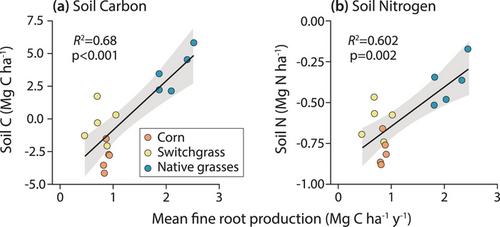
Cellulosic bioenergy is a primary land-based climate mitigation strategy, with soil carbon (C) storage and nitrogen (N) conservation as important mitigation elements. Here, we present 13 years of soil C and N change under three cellulosic cropping systems: monoculture switchgrass (Panicum virgatum L.), a five native grasses polyculture, and no-till corn (Zea mays L.). Soil C and N fractions were measured four times over 12 years. Bulk soil C in the 0–25 cm depth at the end of the study period ranged from 28.4 (± 1.4 se) Mg C ha−1 in no-till corn, to 30.8 (± 1.4) Mg C ha−1 in switchgrass, and to 34.8 (± 1.4) Mg C ha−1 in native grasses. Mineral-associated organic matter (MAOM) ranged from 60% to 90% and particulate organic matter (POM) from 10% to 40% of total soil C. Over 12 years, total C as well as both C fractions persisted under no-till corn and switchgrass and increased under native grasses. In contrast, POM N stocks decreased 33% to 45% across systems, whereas MAOM N decreased only in no-till corn and by less than 13%. Declining POM N stocks likely reflect pre-establishment land use, which included alfalfa and manure in earlier rotations. Root production and large soil aggregate formation explained 69% (p < 0.001) and 36% (p = 0.024) of total soil C change, respectively, and 60% (p = 0.020) and 41% (p = 0.023) of soil N change, demonstrating the importance of belowground productivity and soil aggregates for producing and protecting soil C and conserving soil N. Differences between switchgrass and native grasses also indicate a dependence on plant diversity. Soil C and N benefits of bioenergy crops depend strongly on root productivity and pre-establishment land use.



 京公网安备 11010802042870号
京ICP备2023020795号-1
京公网安备 11010802042870号
京ICP备2023020795号-1

 分享
分享

 求助内容:
求助内容: 应助结果提醒方式:
 扫码关注我们
