{"title":"The biopsychosociotechnical model: a systems-based framework for human-centered health improvement.","authors":"Alan J Card","doi":"10.1080/20476965.2022.2029584","DOIUrl":null,"url":null,"abstract":"<p><p>The biopsychosocial model is among the most influential frameworks for human-centered health improvement but has faced significant criticism- both conceptual and pragmatic. This paper extends and fundamentally re-structures the biopsychosocial model by combining it with sociotechnical systems theory. The resulting biopsychosociotechnical model addresses key critiques of the biopsychosocial model, providing a more \"practical theory\" for human-centered health improvement. It depicts the determinants of health as complex adaptive system of systems; includes the the artificial world (technology); and provides a roadmap for systems improvement by: differentiating between \"health status\" and \"health and needs assessment\", [promoting problem framing]; explaining health as an emergent property of the biopsychosociotechnical context [imposing a systems orientation]; focusing on \"interventions\" vs. \"treatments\" to modify the biopsychosociotechnical determinants of health, [expanding the solution space]; calling for a participatory design process [supporting systems awareness and goal-orientation]; and including intervention management to support the full lifecycle of health improvement.</p>","PeriodicalId":1,"journal":{"name":"Accounts of Chemical Research","volume":" ","pages":"387-407"},"PeriodicalIF":17.7000,"publicationDate":"2022-01-30","publicationTypes":"Journal Article","fieldsOfStudy":null,"isOpenAccess":false,"openAccessPdf":"https://www.ncbi.nlm.nih.gov/pmc/articles/PMC10791103/pdf/","citationCount":"0","resultStr":null,"platform":"Semanticscholar","paperid":null,"PeriodicalName":"Accounts of Chemical Research","FirstCategoryId":"1085","ListUrlMain":"https://doi.org/10.1080/20476965.2022.2029584","RegionNum":1,"RegionCategory":"化学","ArticlePicture":[],"TitleCN":null,"AbstractTextCN":null,"PMCID":null,"EPubDate":"2023/1/1 0:00:00","PubModel":"eCollection","JCR":"Q1","JCRName":"CHEMISTRY, MULTIDISCIPLINARY","Score":null,"Total":0}
引用次数: 0
Abstract
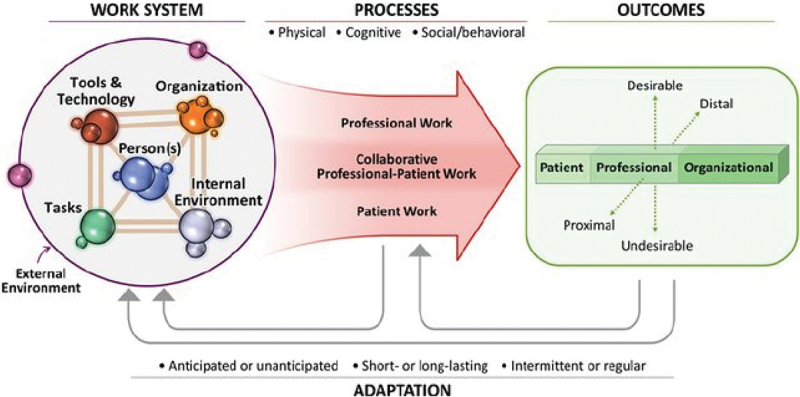
The biopsychosocial model is among the most influential frameworks for human-centered health improvement but has faced significant criticism- both conceptual and pragmatic. This paper extends and fundamentally re-structures the biopsychosocial model by combining it with sociotechnical systems theory. The resulting biopsychosociotechnical model addresses key critiques of the biopsychosocial model, providing a more "practical theory" for human-centered health improvement. It depicts the determinants of health as complex adaptive system of systems; includes the the artificial world (technology); and provides a roadmap for systems improvement by: differentiating between "health status" and "health and needs assessment", [promoting problem framing]; explaining health as an emergent property of the biopsychosociotechnical context [imposing a systems orientation]; focusing on "interventions" vs. "treatments" to modify the biopsychosociotechnical determinants of health, [expanding the solution space]; calling for a participatory design process [supporting systems awareness and goal-orientation]; and including intervention management to support the full lifecycle of health improvement.
期刊介绍:
Accounts of Chemical Research presents short, concise and critical articles offering easy-to-read overviews of basic research and applications in all areas of chemistry and biochemistry. These short reviews focus on research from the author’s own laboratory and are designed to teach the reader about a research project. In addition, Accounts of Chemical Research publishes commentaries that give an informed opinion on a current research problem. Special Issues online are devoted to a single topic of unusual activity and significance.
Accounts of Chemical Research replaces the traditional article abstract with an article "Conspectus." These entries synopsize the research affording the reader a closer look at the content and significance of an article. Through this provision of a more detailed description of the article contents, the Conspectus enhances the article's discoverability by search engines and the exposure for the research.





 京公网安备 11010802042870号
京ICP备2023020795号-1
京公网安备 11010802042870号
京ICP备2023020795号-1

 分享
分享
 求助内容:
求助内容: 应助结果提醒方式:
 扫码关注我们
