{"title":"Magnetic Bead-Immobilized Mammalian Cells Are Effective Targets to Enrich Ligand-Displaying Yeast","authors":"Patrick S. Lown, Benjamin J. Hackel*","doi":"10.1021/acscombsci.0c00036","DOIUrl":null,"url":null,"abstract":"<p >Yeast surface display empowers selection of protein binding ligands, typically using recombinant soluble antigens. However, ectodomain fragments of transmembrane targets may fail to recapitulate their true, membrane-bound form. Direct selections against adhered mammalian cells empower enrichment of genuine binders yet benefit from high target expression, robustly adherent mammalian cells, and nanomolar affinity ligands. This study evaluates a modified format with mammalian cells immobilized to magnetic beads; yeast-displayed fibronectin domain and affibody ligands of known affinities and cells with expression ranges of epidermal growth factor receptor (EGFR) and CD276 elucidate important parameters to ligand enrichment and yield in cell suspension panning with comparison to adherent panning. Cell suspension panning is hindered by significant background of nondisplaying yeast but exhibits yield advantages in model EGFR systems for a high affinity (<i>K</i><sub>D</sub> = 2 nM) binder on cells with both high (10<sup>6</sup> per cell) target expression (9.6 ± 0.6% vs 3.2 ± 0.4%, <i>p</i> < 0.0001) and mid (10<sup>5</sup>) target expression (2.3 ± 0.5% vs 0.41 ± 0.09%, <i>p</i> = 0.0008), as well as for a low affinity (<i>K</i><sub>D</sub> > 600 nM) binder on high target expression cells (2.0 ± 0.5% vs 0.017 ± 0.005%; <i>p</i> = 0.001). Significant enrichment was observed for all EGFR systems except the low-affinity, high expression system. The CD276 system failed to provide significant enrichment, indicating that this technique may not be suitable for all targets. Collectively, this study highlights new approaches that yield successful enrichment of yeast-displayed ligands via panning on immobilized mammalian cells.</p>","PeriodicalId":14,"journal":{"name":"ACS Combinatorial Science","volume":"22 5","pages":"274–284"},"PeriodicalIF":3.7840,"publicationDate":"2020-04-13","publicationTypes":"Journal Article","fieldsOfStudy":null,"isOpenAccess":false,"openAccessPdf":"https://sci-hub-pdf.com/10.1021/acscombsci.0c00036","citationCount":"6","resultStr":null,"platform":"Semanticscholar","paperid":null,"PeriodicalName":"ACS Combinatorial Science","FirstCategoryId":"92","ListUrlMain":"https://pubs.acs.org/doi/10.1021/acscombsci.0c00036","RegionNum":3,"RegionCategory":"化学","ArticlePicture":[],"TitleCN":null,"AbstractTextCN":null,"PMCID":null,"EPubDate":"","PubModel":"","JCR":"Q1","JCRName":"Chemistry","Score":null,"Total":0}
引用次数: 6
Abstract
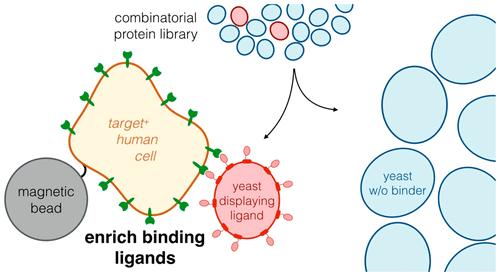
Yeast surface display empowers selection of protein binding ligands, typically using recombinant soluble antigens. However, ectodomain fragments of transmembrane targets may fail to recapitulate their true, membrane-bound form. Direct selections against adhered mammalian cells empower enrichment of genuine binders yet benefit from high target expression, robustly adherent mammalian cells, and nanomolar affinity ligands. This study evaluates a modified format with mammalian cells immobilized to magnetic beads; yeast-displayed fibronectin domain and affibody ligands of known affinities and cells with expression ranges of epidermal growth factor receptor (EGFR) and CD276 elucidate important parameters to ligand enrichment and yield in cell suspension panning with comparison to adherent panning. Cell suspension panning is hindered by significant background of nondisplaying yeast but exhibits yield advantages in model EGFR systems for a high affinity (KD = 2 nM) binder on cells with both high (106 per cell) target expression (9.6 ± 0.6% vs 3.2 ± 0.4%, p < 0.0001) and mid (105) target expression (2.3 ± 0.5% vs 0.41 ± 0.09%, p = 0.0008), as well as for a low affinity (KD > 600 nM) binder on high target expression cells (2.0 ± 0.5% vs 0.017 ± 0.005%; p = 0.001). Significant enrichment was observed for all EGFR systems except the low-affinity, high expression system. The CD276 system failed to provide significant enrichment, indicating that this technique may not be suitable for all targets. Collectively, this study highlights new approaches that yield successful enrichment of yeast-displayed ligands via panning on immobilized mammalian cells.
期刊介绍:
The Journal of Combinatorial Chemistry has been relaunched as ACS Combinatorial Science under the leadership of new Editor-in-Chief M.G. Finn of The Scripps Research Institute. The journal features an expanded scope and will build upon the legacy of the Journal of Combinatorial Chemistry, a highly cited leader in the field.



 京公网安备 11010802042870号
京ICP备2023020795号-1
京公网安备 11010802042870号
京ICP备2023020795号-1

 分享
分享
 求助内容:
求助内容: 应助结果提醒方式:
 扫码关注我们
