Richard J Siegert, Andrew Zhu, Xiaoyun Jia, Guanyu Jason Ran, Nigel French, David Johnston, Jun Lu, Liangni Sally Liu
{"title":"A cross-sectional online survey of depression symptoms among New Zealand's Asian community in the first 10 months of the COVID-19 pandemic.","authors":"Richard J Siegert, Andrew Zhu, Xiaoyun Jia, Guanyu Jason Ran, Nigel French, David Johnston, Jun Lu, Liangni Sally Liu","doi":"10.1080/03036758.2023.2251900","DOIUrl":null,"url":null,"abstract":"<p><p>The COVID-19 pandemic has elevated levels of distress and resulted in anti-Asian discrimination in many countries. We aimed to determine the 10-month prevalence of depression symptoms in Asian adults in New Zealand during the pandemic and to see if this was related to experience of racism. An online survey was conducted and a stratified sample of 402 respondents completed the brief Centre for Epidemiological Studies-Depression (CES-D) scale. Analyses included: descriptive statistics, depression scores by age/gender, factor analysis of the 10 item CES-D and partial correlation network analysis of CES-D items together with questions about experience of racism. Results show that half of the sample reported clinically significant symptoms of depression. Depression was higher among younger participants but there was no gender difference. Internal consistency was high (α = 0.85) for the CES-D which revealed a clear two-factor structure. Network analysis suggested that sleeping problems might be the bridge between experiences of racism and depression. The prevalence of low mood was high with clinically significant levels of depressive symptoms. Depression was higher in younger people and had a modest positive correlation with personal experience of racism.</p>","PeriodicalId":49984,"journal":{"name":"Journal of the Royal Society of New Zealand","volume":" ","pages":"98-112"},"PeriodicalIF":2.1000,"publicationDate":"2023-09-03","publicationTypes":"Journal Article","fieldsOfStudy":null,"isOpenAccess":false,"openAccessPdf":"https://www.ncbi.nlm.nih.gov/pmc/articles/PMC11619012/pdf/","citationCount":"0","resultStr":null,"platform":"Semanticscholar","paperid":null,"PeriodicalName":"Journal of the Royal Society of New Zealand","FirstCategoryId":"103","ListUrlMain":"https://doi.org/10.1080/03036758.2023.2251900","RegionNum":4,"RegionCategory":"综合性期刊","ArticlePicture":[],"TitleCN":null,"AbstractTextCN":null,"PMCID":null,"EPubDate":"2025/1/1 0:00:00","PubModel":"eCollection","JCR":"Q2","JCRName":"MULTIDISCIPLINARY SCIENCES","Score":null,"Total":0}
引用次数: 0
Abstract
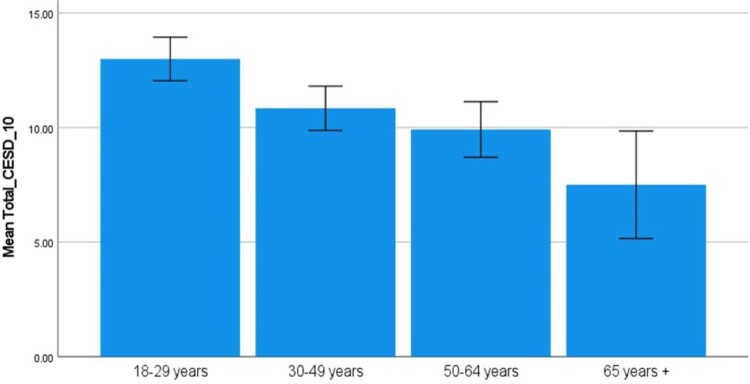
The COVID-19 pandemic has elevated levels of distress and resulted in anti-Asian discrimination in many countries. We aimed to determine the 10-month prevalence of depression symptoms in Asian adults in New Zealand during the pandemic and to see if this was related to experience of racism. An online survey was conducted and a stratified sample of 402 respondents completed the brief Centre for Epidemiological Studies-Depression (CES-D) scale. Analyses included: descriptive statistics, depression scores by age/gender, factor analysis of the 10 item CES-D and partial correlation network analysis of CES-D items together with questions about experience of racism. Results show that half of the sample reported clinically significant symptoms of depression. Depression was higher among younger participants but there was no gender difference. Internal consistency was high (α = 0.85) for the CES-D which revealed a clear two-factor structure. Network analysis suggested that sleeping problems might be the bridge between experiences of racism and depression. The prevalence of low mood was high with clinically significant levels of depressive symptoms. Depression was higher in younger people and had a modest positive correlation with personal experience of racism.
期刊介绍:
Aims: The Journal of the Royal Society of New Zealand reflects the role of Royal Society Te Aparangi in fostering research and debate across natural sciences, social sciences, and the humanities in New Zealand/Aotearoa and the surrounding Pacific. Research published in Journal of the Royal Society of New Zealand advances scientific knowledge, informs government policy, public awareness and broader society, and is read by researchers worldwide.





 京公网安备 11010802042870号
京ICP备2023020795号-1
京公网安备 11010802042870号
京ICP备2023020795号-1

 分享
分享
 求助内容:
求助内容: 应助结果提醒方式:
 扫码关注我们
