{"title":"Libania rhodia sp. nov., a new predatory semislug from Rhodes (Gastropoda: Oxychilidae), and its phylogenetic and biogeographic relationships","authors":"Bernhard Hausdorf, Konstantinos Kalaentzis","doi":"10.1111/jzs.12570","DOIUrl":null,"url":null,"abstract":"<p>A new predatory semislug, <i>Libania rhodia</i> sp. nov. (Oxychilidae: Daudebardiinae), is described from Rhodes. Whereas rudimentary shells of <i>L. rhodia</i> were previously identified with <i>Lotharia cretica</i> from Crete, the investigation of the genitalia demonstrated that it is a distinct species that differs from <i>L</i>. <i>cretica</i> in the lack of an externally differentiated epiphallus, the lack of a penis coecum, and the longer pedunculus of the bursa copulatrix. Molecular phylogenetic analyses based on mitochondrial and nuclear DNA sequences showed that, contrary to previous classifications, <i>Libania</i> is more closely related to <i>Lotharia</i> than to <i>Daudebardia</i>. <i>Libania rhodia</i> and <i>L. cretica</i> split already in the Early Miocene. The ancestor of the <i>Libania</i>–<i>Lotharia</i> clade colonized Crete from the east before a marine ingression formed the mid-Aegean trench, which separated Crete from the east Aegean Islands and Anatolia.</p>","PeriodicalId":91350,"journal":{"name":"","volume":"59 8","pages":"1816-1823"},"PeriodicalIF":0.0,"publicationDate":"2021-11-29","publicationTypes":"Journal Article","fieldsOfStudy":null,"isOpenAccess":false,"openAccessPdf":"https://onlinelibrary.wiley.com/doi/epdf/10.1111/jzs.12570","citationCount":"1","resultStr":null,"platform":"Semanticscholar","paperid":null,"PeriodicalName":"","FirstCategoryId":"99","ListUrlMain":"https://onlinelibrary.wiley.com/doi/10.1111/jzs.12570","RegionNum":0,"RegionCategory":null,"ArticlePicture":[],"TitleCN":null,"AbstractTextCN":null,"PMCID":null,"EPubDate":"","PubModel":"","JCR":"","JCRName":"","Score":null,"Total":0}
引用次数: 1
Abstract
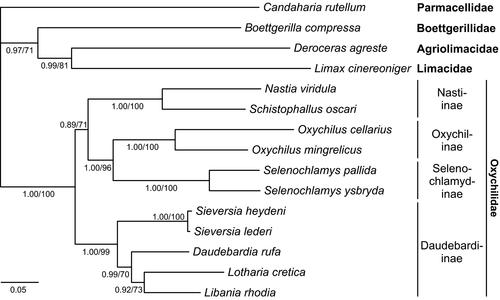
A new predatory semislug, Libania rhodia sp. nov. (Oxychilidae: Daudebardiinae), is described from Rhodes. Whereas rudimentary shells of L. rhodia were previously identified with Lotharia cretica from Crete, the investigation of the genitalia demonstrated that it is a distinct species that differs from L. cretica in the lack of an externally differentiated epiphallus, the lack of a penis coecum, and the longer pedunculus of the bursa copulatrix. Molecular phylogenetic analyses based on mitochondrial and nuclear DNA sequences showed that, contrary to previous classifications, Libania is more closely related to Lotharia than to Daudebardia. Libania rhodia and L. cretica split already in the Early Miocene. The ancestor of the Libania–Lotharia clade colonized Crete from the east before a marine ingression formed the mid-Aegean trench, which separated Crete from the east Aegean Islands and Anatolia.



 京公网安备 11010802042870号
京ICP备2023020795号-1
京公网安备 11010802042870号
京ICP备2023020795号-1

 分享
分享
 求助内容:
求助内容: 应助结果提醒方式:
 扫码关注我们
