{"title":"The effects of different repolishing procedures on the color change of bulk-fill resin composites.","authors":"Muhammet Fidan","doi":"10.26650/eor.20231234627","DOIUrl":null,"url":null,"abstract":"<p><strong>Purpose: </strong>The purpose of the study was to investigate the impact of repolishing procedures on the color change of bulk-fill resin composites after being exposed to coffee.</p><p><strong>Materials and methods: </strong>Four bulk-fill resin composites (Filtek One bulk-fill, Tetric EvoCeram bulk-fill, Admira Fusion x-tra bulk-fill, Grandio SO x-tra bulk-fill) were tested. Sixty samples were prepared with each resin composite and were randomly divided into two groups: first one received the one-step polishing system (Optragloss) and the other group received the two-step polishing system (Nova Twist) (n=30). After being kept in coffee for 12 days, the samples were divided into three subgroups according to repolishing: one-step repolishing group, two-step repolishing group, and non-repolishing group (n=10 for each). Color measurements of the resin composite samples were determined with a spectrophotometer. The difference in color change was calculated using the CIEDE 2000 color formula. The data were analyzed using three-way ANOVA and Tukey test.</p><p><strong>Results: </strong>Among composite materials, Filtek One bulk-fill (1.84 ± 0.98) less color change was observed compared to others (p<0.001). In terms of polishing systems, Optragloss (2.96 ± 1.51) showed significantly greater color change than Nova Twist (2.21 ± 1.07) (p<0.001). The non-repolishing group (3.78 ± 1.25) presented significantly greater color change than the Nova Twist sytem (1.49 ± 0.61) and Optragloss system (2.50 ± 1.01) (p<0.001).</p><p><strong>Conclusion: </strong>The repolishing process reduced discoloration. A two-step repolishing system results in less color change compared to a one-step repolishing application. In polishing systems containing diamond particles, increasing the number of steps can contribute to color stability.</p>","PeriodicalId":0,"journal":{"name":"","volume":" ","pages":"14-21"},"PeriodicalIF":0.0,"publicationDate":"2024-01-05","publicationTypes":"Journal Article","fieldsOfStudy":null,"isOpenAccess":false,"openAccessPdf":"https://www.ncbi.nlm.nih.gov/pmc/articles/PMC10927711/pdf/","citationCount":"0","resultStr":null,"platform":"Semanticscholar","paperid":null,"PeriodicalName":"","FirstCategoryId":"1085","ListUrlMain":"https://doi.org/10.26650/eor.20231234627","RegionNum":0,"RegionCategory":null,"ArticlePicture":[],"TitleCN":null,"AbstractTextCN":null,"PMCID":null,"EPubDate":"","PubModel":"","JCR":"","JCRName":"","Score":null,"Total":0}
引用次数: 0
Abstract
Purpose: The purpose of the study was to investigate the impact of repolishing procedures on the color change of bulk-fill resin composites after being exposed to coffee.
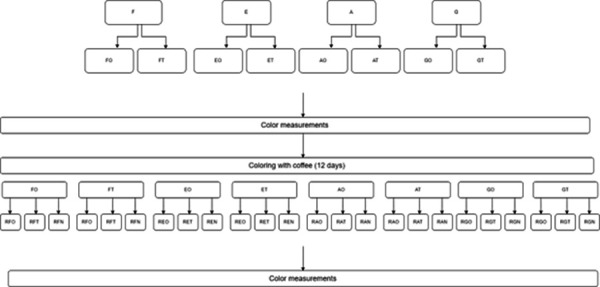
Materials and methods: Four bulk-fill resin composites (Filtek One bulk-fill, Tetric EvoCeram bulk-fill, Admira Fusion x-tra bulk-fill, Grandio SO x-tra bulk-fill) were tested. Sixty samples were prepared with each resin composite and were randomly divided into two groups: first one received the one-step polishing system (Optragloss) and the other group received the two-step polishing system (Nova Twist) (n=30). After being kept in coffee for 12 days, the samples were divided into three subgroups according to repolishing: one-step repolishing group, two-step repolishing group, and non-repolishing group (n=10 for each). Color measurements of the resin composite samples were determined with a spectrophotometer. The difference in color change was calculated using the CIEDE 2000 color formula. The data were analyzed using three-way ANOVA and Tukey test.
Results: Among composite materials, Filtek One bulk-fill (1.84 ± 0.98) less color change was observed compared to others (p<0.001). In terms of polishing systems, Optragloss (2.96 ± 1.51) showed significantly greater color change than Nova Twist (2.21 ± 1.07) (p<0.001). The non-repolishing group (3.78 ± 1.25) presented significantly greater color change than the Nova Twist sytem (1.49 ± 0.61) and Optragloss system (2.50 ± 1.01) (p<0.001).
Conclusion: The repolishing process reduced discoloration. A two-step repolishing system results in less color change compared to a one-step repolishing application. In polishing systems containing diamond particles, increasing the number of steps can contribute to color stability.

 分享
分享



 京公网安备 11010802042870号
京ICP备2023020795号-1
京公网安备 11010802042870号
京ICP备2023020795号-1

 求助内容:
求助内容: 应助结果提醒方式:
 扫码关注我们
