Maarten Barendrecht, Carl C Barten, Willem van Mechelen, Evert Verhagen, Bouwien C M Smits-Engelsman
{"title":"Injuries in Physical Education Teacher Students: Differences between Sex, Curriculum Year, Setting, and Sports.","authors":"Maarten Barendrecht, Carl C Barten, Willem van Mechelen, Evert Verhagen, Bouwien C M Smits-Engelsman","doi":"10.1155/2023/8643402","DOIUrl":null,"url":null,"abstract":"<p><strong>Background: </strong>Injury risk is high in Physical Education Teacher Education (PETE) students. Insights into specific injury locations per sex, setting, sports, and curriculum year are needed to develop preventive measures.</p><p><strong>Purpose: </strong>To compare injury distributions by body locations in PETE students and how these distributions differ by sex, type, onset, curriculum year, settings, or sports.</p><p><strong>Methods: </strong>In a historical cohort study over 14 years, data from 2899 students (male 76.2%, <i>n</i> = 1947) enlisted in the first three years of a PETE curriculum were analysed. Injuries reported at the institution's medical facility were categorised per sex, body location, onset, type, setting, sports, and curriculum year.</p><p><strong>Results: </strong>Forty-three percent (<i>n</i> = 1247) of all students (female 54.9%, <i>n</i> = 523, male 37.2%, and <i>n</i> = 429) reported a total of 2129 injuries (freshmen 56.4%; 2<sup>nd</sup> year 28.2%; 3<sup>rd</sup> year 15.5%). The most prevalent sudden onset injury locations (63.4% of all injuries) were the ankle (32.5%) and knee (16.6). The most prevalent gradual onset injuries were the lower leg (27.8%) and knee (25.2%). Joint/ligament injuries (45.8%) and muscle/tendon injuries (23.4%) were the most prevalent injury types. Proportions for injury locations and injury types differed significantly between curriculum years. Injury prevalence per setting and sport differed significantly between the sexes. Injury locations differed significantly between sports and between the sexes per sport.</p><p><strong>Conclusion: </strong>A differential approach per injury location, onset, type, sex, setting, sports, and curriculum year is needed to develop adequate preventive measures in PETE studies. The engagement of precurricular, intracurricular, and extracurricular stakeholders is needed in the development of these measures.</p>","PeriodicalId":1,"journal":{"name":"Accounts of Chemical Research","volume":" ","pages":"8643402"},"PeriodicalIF":17.7000,"publicationDate":"2023-01-05","publicationTypes":"Journal Article","fieldsOfStudy":null,"isOpenAccess":false,"openAccessPdf":"https://www.ncbi.nlm.nih.gov/pmc/articles/PMC11023724/pdf/","citationCount":"0","resultStr":null,"platform":"Semanticscholar","paperid":null,"PeriodicalName":"Accounts of Chemical Research","FirstCategoryId":"1085","ListUrlMain":"https://doi.org/10.1155/2023/8643402","RegionNum":1,"RegionCategory":"化学","ArticlePicture":[],"TitleCN":null,"AbstractTextCN":null,"PMCID":null,"EPubDate":"2023/1/1 0:00:00","PubModel":"eCollection","JCR":"Q1","JCRName":"CHEMISTRY, MULTIDISCIPLINARY","Score":null,"Total":0}
引用次数: 0
Abstract
Background: Injury risk is high in Physical Education Teacher Education (PETE) students. Insights into specific injury locations per sex, setting, sports, and curriculum year are needed to develop preventive measures.
Purpose: To compare injury distributions by body locations in PETE students and how these distributions differ by sex, type, onset, curriculum year, settings, or sports.
Methods: In a historical cohort study over 14 years, data from 2899 students (male 76.2%, n = 1947) enlisted in the first three years of a PETE curriculum were analysed. Injuries reported at the institution's medical facility were categorised per sex, body location, onset, type, setting, sports, and curriculum year.
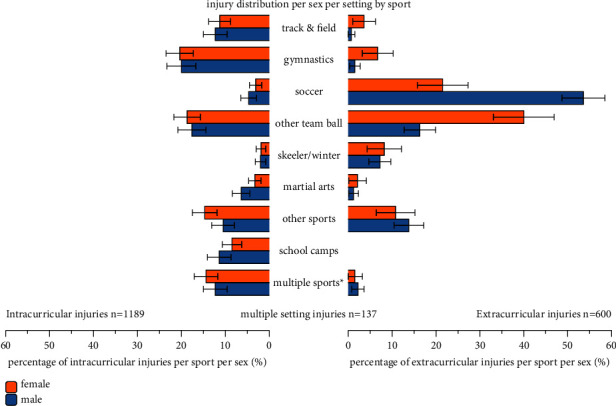
Results: Forty-three percent (n = 1247) of all students (female 54.9%, n = 523, male 37.2%, and n = 429) reported a total of 2129 injuries (freshmen 56.4%; 2nd year 28.2%; 3rd year 15.5%). The most prevalent sudden onset injury locations (63.4% of all injuries) were the ankle (32.5%) and knee (16.6). The most prevalent gradual onset injuries were the lower leg (27.8%) and knee (25.2%). Joint/ligament injuries (45.8%) and muscle/tendon injuries (23.4%) were the most prevalent injury types. Proportions for injury locations and injury types differed significantly between curriculum years. Injury prevalence per setting and sport differed significantly between the sexes. Injury locations differed significantly between sports and between the sexes per sport.
Conclusion: A differential approach per injury location, onset, type, sex, setting, sports, and curriculum year is needed to develop adequate preventive measures in PETE studies. The engagement of precurricular, intracurricular, and extracurricular stakeholders is needed in the development of these measures.
期刊介绍:
Accounts of Chemical Research presents short, concise and critical articles offering easy-to-read overviews of basic research and applications in all areas of chemistry and biochemistry. These short reviews focus on research from the author’s own laboratory and are designed to teach the reader about a research project. In addition, Accounts of Chemical Research publishes commentaries that give an informed opinion on a current research problem. Special Issues online are devoted to a single topic of unusual activity and significance.
Accounts of Chemical Research replaces the traditional article abstract with an article "Conspectus." These entries synopsize the research affording the reader a closer look at the content and significance of an article. Through this provision of a more detailed description of the article contents, the Conspectus enhances the article's discoverability by search engines and the exposure for the research.






 京公网安备 11010802042870号
京ICP备2023020795号-1
京公网安备 11010802042870号
京ICP备2023020795号-1

 分享
分享
 求助内容:
求助内容: 应助结果提醒方式:
 扫码关注我们
