Wendy Dusenbury, Georgios Tsivgoulis, Jason Chang, Nitin Goyal, Victoria Swatzell, Andrei V Alexandrov, Patrick Lyden, Anne W Alexandrov
{"title":"Validation of the National Institutes of Health Stroke Scale in Intracerebral Hemorrhage.","authors":"Wendy Dusenbury, Georgios Tsivgoulis, Jason Chang, Nitin Goyal, Victoria Swatzell, Andrei V Alexandrov, Patrick Lyden, Anne W Alexandrov","doi":"10.1161/SVIN.123.000834","DOIUrl":null,"url":null,"abstract":"<p><strong>Background: </strong>We sought to determine if the National Institutes of Health Stroke Scale (NIHSS) has a greater discriminative power than Glasgow coma scale (GCS) to identify patients at risk of poor early functional outcomes and large hematoma volumes.</p><p><strong>Methods: </strong>We prospectively collected clinical assessments, imaging, and outcome data in consecutive patients with intracerebral hemorrhage, and determined the ability of GCS and NIHSS to predict poor functional outcome (modified Rankin scale 3-6) and hematoma volume >30 cm<sup>3</sup> using receiver operating characteristics analysis, C-statistics, and the DeLong test.</p><p><strong>Results: </strong>We studied 672 patients with intracerebral hemorrhage (mean age 62±14 years; 56% men; median intracerebral hemorrhage score=1, interquartile range (IQR) 0-2; median intracerebral hemorrhage volume 7 cm<sup>3</sup>, IQR 2-19) with median NIHSS of 8 (IQR 3-18) and GCS 15 (IQR 7-15). NIHSS correlated strongly to GCS (r=-0.773; <i>P</i><0.001). Admission NIHSS (C-statistic: 0.91; 95% CI, 0.89-0.93) predicted better than GCS (0.78; 95% CI, 0.75-0.81) discharge poor functional outcome (DeLong test <i>P</i><0.001). NIHSS (0.82; 95% CI, 0.78-0.86) also discriminated better than GCS (0.78; 95% CI, 0.73-0.83) patients with large hematoma volume (DeLong test <i>P</i>=0.029).</p><p><strong>Conclusion: </strong>The NIHSS has a greater discriminative power than GCS to identify patients at risk of poor early functional outcomes and large hematoma volumes.</p>","PeriodicalId":74875,"journal":{"name":"Stroke (Hoboken, N.J.)","volume":" ","pages":"e000834"},"PeriodicalIF":2.8000,"publicationDate":"2023-06-09","publicationTypes":"Journal Article","fieldsOfStudy":null,"isOpenAccess":false,"openAccessPdf":"https://www.ncbi.nlm.nih.gov/pmc/articles/PMC12778679/pdf/","citationCount":"0","resultStr":null,"platform":"Semanticscholar","paperid":null,"PeriodicalName":"Stroke (Hoboken, N.J.)","FirstCategoryId":"1085","ListUrlMain":"https://doi.org/10.1161/SVIN.123.000834","RegionNum":0,"RegionCategory":null,"ArticlePicture":[],"TitleCN":null,"AbstractTextCN":null,"PMCID":null,"EPubDate":"2023/7/1 0:00:00","PubModel":"eCollection","JCR":"Q3","JCRName":"CLINICAL NEUROLOGY","Score":null,"Total":0}
引用次数: 0
Abstract
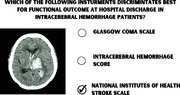
Background: We sought to determine if the National Institutes of Health Stroke Scale (NIHSS) has a greater discriminative power than Glasgow coma scale (GCS) to identify patients at risk of poor early functional outcomes and large hematoma volumes.
Methods: We prospectively collected clinical assessments, imaging, and outcome data in consecutive patients with intracerebral hemorrhage, and determined the ability of GCS and NIHSS to predict poor functional outcome (modified Rankin scale 3-6) and hematoma volume >30 cm3 using receiver operating characteristics analysis, C-statistics, and the DeLong test.
Results: We studied 672 patients with intracerebral hemorrhage (mean age 62±14 years; 56% men; median intracerebral hemorrhage score=1, interquartile range (IQR) 0-2; median intracerebral hemorrhage volume 7 cm3, IQR 2-19) with median NIHSS of 8 (IQR 3-18) and GCS 15 (IQR 7-15). NIHSS correlated strongly to GCS (r=-0.773; P<0.001). Admission NIHSS (C-statistic: 0.91; 95% CI, 0.89-0.93) predicted better than GCS (0.78; 95% CI, 0.75-0.81) discharge poor functional outcome (DeLong test P<0.001). NIHSS (0.82; 95% CI, 0.78-0.86) also discriminated better than GCS (0.78; 95% CI, 0.73-0.83) patients with large hematoma volume (DeLong test P=0.029).
Conclusion: The NIHSS has a greater discriminative power than GCS to identify patients at risk of poor early functional outcomes and large hematoma volumes.
我们试图确定美国国立卫生研究院卒中量表(NIHSS)是否比格拉斯哥昏迷量表(GCS)具有更大的判别力,以识别早期功能不良和血肿体积大的患者。我们前瞻性地收集了连续脑出血患者的临床评估、影像学和结果数据,并使用受试者操作特征分析、C‐统计量和DeLong检验确定了GCS和NIHSS预测不良功能结果(改良Rankin量表3-6)和血肿体积>30 cm 3的能力。我们研究了672名脑出血患者(平均年龄62±14岁;56%为男性;脑出血中位得分=1,四分位数间距(IQR)0-2;中位脑出血量7 cm 3,IQR 2–19),中位NIHSS为8(IQR 3–18),GCS为15(IQR 7–15)。NIHSS与GCS密切相关(r=−0.773;P<0.001)。入院NIHSS(C统计:0.91;95%CI,0.89–0.93)比GCS(0.78;95%CI,0.75–0.81)更好地预测出院不良功能结果(DeLong检验P<0.001在识别早期功能不良和血肿体积大的风险患者方面,GCS具有比GCS更大的辨别力。




 京公网安备 11010802042870号
京ICP备2023020795号-1
京公网安备 11010802042870号
京ICP备2023020795号-1

 分享
分享

 求助内容:
求助内容: 应助结果提醒方式:
 扫码关注我们
