Christiano R. R. Alves, Willian das Neves, Gabriel C. Tobias, Ney R. de Almeida, Raphael F. Barreto, Camila M. Melo, Camila de G. Carneiro, Alexandre T. Garcez, Daniele de P. Faria, Roger Chammas, Patricia C. Brum
{"title":"High-intensity interval training slows down tumor progression in mice bearing Lewis lung carcinoma","authors":"Christiano R. R. Alves, Willian das Neves, Gabriel C. Tobias, Ney R. de Almeida, Raphael F. Barreto, Camila M. Melo, Camila de G. Carneiro, Alexandre T. Garcez, Daniele de P. Faria, Roger Chammas, Patricia C. Brum","doi":"10.1002/j.2617-1619.2018.tb00008.x","DOIUrl":null,"url":null,"abstract":"<div>\n \n \n <section>\n \n <h3> Background</h3>\n \n <p>We aimed to determine whether a short-term high-intensity interval training (HIIT) protocol could counteract tumor progression in an experimental model of lung cancer.</p>\n </section>\n \n <section>\n \n <h3> Methods</h3>\n \n <p>Mice were injected subcutaneously with Lewis Lung Carcinoma (LLC) cells and then randomly assigned into two groups: sedentary mice (LLC group) or mice submitted to HIIT (LLC + HIIT group).</p>\n </section>\n \n <section>\n \n <h3> Results</h3>\n \n <p>LLC + HIIT group had lower tumor mass than LLC group (-52% after 18 days), with no differences in glycolytic activity as measured by PET/CT imaging. HIIT increased Cd274 (PD-L1) mRNA expression by ~6 folds and Vegfa mRNA expression by 2.5 folds, suggesting that HIIT stimulates local inflammation and angiogenesis in LLC tumors. Additionally, HIIT improved running capacity, skeletal muscle contractility and survival rate in LLC tumor-bearing mice.</p>\n </section>\n \n <section>\n \n <h3> Conclusions</h3>\n \n <p>These novel findings demonstrate that a short-term HIIT protocol slows down tumor progression, ultimately increasing survival in LLC tumor-bearing mice. Thus, this study provides novel pre-clinical evidence that exercise training may be a beneficial co-therapy for lung cancer.</p>\n </section>\n </div>","PeriodicalId":73544,"journal":{"name":"JCSM rapid communications","volume":"1 2","pages":"1-10"},"PeriodicalIF":0.0000,"publicationDate":"2018-11-21","publicationTypes":"Journal Article","fieldsOfStudy":null,"isOpenAccess":false,"openAccessPdf":"https://sci-hub-pdf.com/10.1002/j.2617-1619.2018.tb00008.x","citationCount":"14","resultStr":null,"platform":"Semanticscholar","paperid":null,"PeriodicalName":"JCSM rapid communications","FirstCategoryId":"1085","ListUrlMain":"https://onlinelibrary.wiley.com/doi/10.1002/j.2617-1619.2018.tb00008.x","RegionNum":0,"RegionCategory":null,"ArticlePicture":[],"TitleCN":null,"AbstractTextCN":null,"PMCID":null,"EPubDate":"","PubModel":"","JCR":"","JCRName":"","Score":null,"Total":0}
引用次数: 14
Abstract
Background
We aimed to determine whether a short-term high-intensity interval training (HIIT) protocol could counteract tumor progression in an experimental model of lung cancer.
Methods
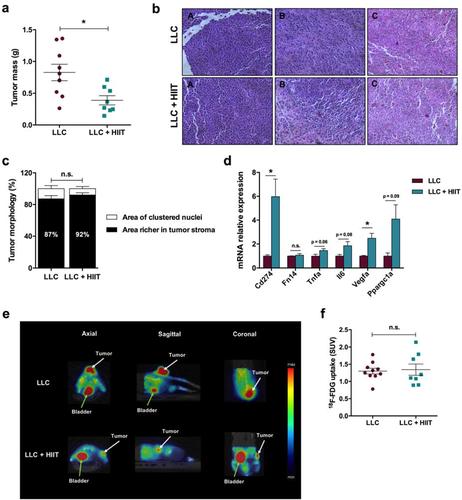
Mice were injected subcutaneously with Lewis Lung Carcinoma (LLC) cells and then randomly assigned into two groups: sedentary mice (LLC group) or mice submitted to HIIT (LLC + HIIT group).
Results
LLC + HIIT group had lower tumor mass than LLC group (-52% after 18 days), with no differences in glycolytic activity as measured by PET/CT imaging. HIIT increased Cd274 (PD-L1) mRNA expression by ~6 folds and Vegfa mRNA expression by 2.5 folds, suggesting that HIIT stimulates local inflammation and angiogenesis in LLC tumors. Additionally, HIIT improved running capacity, skeletal muscle contractility and survival rate in LLC tumor-bearing mice.
Conclusions
These novel findings demonstrate that a short-term HIIT protocol slows down tumor progression, ultimately increasing survival in LLC tumor-bearing mice. Thus, this study provides novel pre-clinical evidence that exercise training may be a beneficial co-therapy for lung cancer.



 京公网安备 11010802042870号
京ICP备2023020795号-1
京公网安备 11010802042870号
京ICP备2023020795号-1

 分享
分享

 求助内容:
求助内容: 应助结果提醒方式:
 扫码关注我们
