{"title":"Effect of sterilization techniques on biomaterial inks’ properties and 3D bioprinting parameters","authors":"Rohin Shyam , Arunkumar Palaniappan","doi":"10.1016/j.bprint.2023.e00294","DOIUrl":null,"url":null,"abstract":"<div><p><span>3D bioprinting is an emerging technology for the fabrication of tissue constructs to repair damaged or diseased human tissues or as </span><em>in vitro</em><span><span> model systems for drug screening applications. Biomaterial-inks (polymeric hydrogel materials devoid of cells) or bio-inks (combination of polymeric hydrogel materials and cells) form the basis of 3D bioprinting. Successful 3D bioprinting requires optimisation of various process parameters such as biomaterial/bio inks’ viscoelastic, mechanical, and physiochemical properties which influence the printability. However, clinical translation of 3D bioprinted constructs requires that implantable devices<span> are free of microbial contamination and further do not invoke microbial activity post implantation. Sterilization plays an important role in ensuring that inks are free of microorganisms. Recent investigations have shown that sterilization techniques directly influence the intrinsic properties of these inks, thereby affecting bioprinting process parameters. In this communication, we review the most common sterilization techniques that are used in the sterilization of biomaterial/bio inks and their effects on the inks’ properties such as </span></span>viscoelasticity<span>, mechanical, physiochemical and biological properties, and their influence on bioprinting parameters. To conclude, the available studies in the literature indicate that the sterilization processes influence the properties of biomaterial inks. Thus, the effect of sterilization methods on the materials’ properties needs to be thoroughly evaluated and reported while developing them for 3D bioprinting applications.</span></span></p></div>","PeriodicalId":72406,"journal":{"name":"","volume":"33 ","pages":"Article e00294"},"PeriodicalIF":0.0,"publicationDate":"2023-09-01","publicationTypes":"Journal Article","fieldsOfStudy":null,"isOpenAccess":false,"openAccessPdf":"","citationCount":"0","resultStr":null,"platform":"Semanticscholar","paperid":null,"PeriodicalName":"","FirstCategoryId":"1085","ListUrlMain":"https://www.sciencedirect.com/science/article/pii/S2405886623000374","RegionNum":0,"RegionCategory":null,"ArticlePicture":[],"TitleCN":null,"AbstractTextCN":null,"PMCID":null,"EPubDate":"","PubModel":"","JCR":"","JCRName":"","Score":null,"Total":0}
引用次数: 0
Abstract
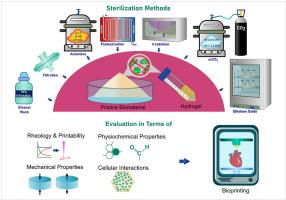
3D bioprinting is an emerging technology for the fabrication of tissue constructs to repair damaged or diseased human tissues or as in vitro model systems for drug screening applications. Biomaterial-inks (polymeric hydrogel materials devoid of cells) or bio-inks (combination of polymeric hydrogel materials and cells) form the basis of 3D bioprinting. Successful 3D bioprinting requires optimisation of various process parameters such as biomaterial/bio inks’ viscoelastic, mechanical, and physiochemical properties which influence the printability. However, clinical translation of 3D bioprinted constructs requires that implantable devices are free of microbial contamination and further do not invoke microbial activity post implantation. Sterilization plays an important role in ensuring that inks are free of microorganisms. Recent investigations have shown that sterilization techniques directly influence the intrinsic properties of these inks, thereby affecting bioprinting process parameters. In this communication, we review the most common sterilization techniques that are used in the sterilization of biomaterial/bio inks and their effects on the inks’ properties such as viscoelasticity, mechanical, physiochemical and biological properties, and their influence on bioprinting parameters. To conclude, the available studies in the literature indicate that the sterilization processes influence the properties of biomaterial inks. Thus, the effect of sterilization methods on the materials’ properties needs to be thoroughly evaluated and reported while developing them for 3D bioprinting applications.



 京公网安备 11010802042870号
京ICP备2023020795号-1
京公网安备 11010802042870号
京ICP备2023020795号-1

 分享
分享
 求助内容:
求助内容: 应助结果提醒方式:
 扫码关注我们
