Armando Peña-Duarte, Alexis J. Acevedo-González, Richard M. Lagle, Mebougna Drabo, Stephen U. Egarievwe and Carlos R. Cabrera*,
{"title":"Stable Uranium Oxide Under Atmospheric Conditions: An Electroplating Technique for U Film Fabrication at Boron-Doped Diamond Electrodes","authors":"Armando Peña-Duarte, Alexis J. Acevedo-González, Richard M. Lagle, Mebougna Drabo, Stephen U. Egarievwe and Carlos R. Cabrera*, ","doi":"10.1021/acsmaterialsau.3c00007","DOIUrl":null,"url":null,"abstract":"<p >An electrodeposition technique of low-enriched uranium onto boron-doped diamond (BDD) electrodes for uranium electro-assembling, sequestration, uranium electrowinning (as the electroextraction alternative), and future neutron detection applications has been developed. Our findings through physicochemical characterization and an in-depth XPS analysis show that the U/BDD system consists of a blend of uranium oxides with IV, V, and VI oxidation states. Results show that U<sup>5+</sup> is present and stable under open atmospheric conditions. The U electrodeposition on BDD creates smooth surfaces, free of voids, with uniform deposition of homogeneous tiny particles of stable uranium oxides, instead of chunky particles, and uranium compound mixtures, like large fibers of the precursor uranyl. Our electrochemical method operates without high temperatures or hazardous compounds. Uranium corrosion and oxidation processes occur spontaneously and parallel to the electrochemical formation of metallic uranium on BDD electrode surfaces, with metallic uranium reacting with water, producing fine particles of UO<sub>2</sub>. This work represents the first attempt to create a surface of uranium oxides, where the film thickness can be controlled for future applications, <i>e.g.</i>, improving sensitivity in neutron detection technologies. Our U electro-assembling method provides a sustainable strategy for uranium electro-recovery from nuclear wastes, immobilizing uranium as a storage method or as U-film fabrication (U/BDD) for future neutron detection applications. Besides, this work contributes to uranium-based technologies, improving them and providing a better understanding of their electrochemical properties, <i>e.g.</i>, uranium redox processes, uranium oxides’ formation, and stability evaluation. These properties are of remarkable need for uranium-based target formation. The use of our U/BDD method is proposed as an environmental protocol to recover and immobilize uranium-235, and other fissile materials, from civil and defense wastes, contaminated systems, and stockpiles.</p>","PeriodicalId":29798,"journal":{"name":"ACS Materials Au","volume":"3 4","pages":"351–359"},"PeriodicalIF":6.5000,"publicationDate":"2023-05-17","publicationTypes":"Journal Article","fieldsOfStudy":null,"isOpenAccess":false,"openAccessPdf":"https://pubs.acs.org/doi/epdf/10.1021/acsmaterialsau.3c00007","citationCount":"2","resultStr":null,"platform":"Semanticscholar","paperid":null,"PeriodicalName":"ACS Materials Au","FirstCategoryId":"1085","ListUrlMain":"https://pubs.acs.org/doi/10.1021/acsmaterialsau.3c00007","RegionNum":0,"RegionCategory":null,"ArticlePicture":[],"TitleCN":null,"AbstractTextCN":null,"PMCID":null,"EPubDate":"","PubModel":"","JCR":"Q2","JCRName":"CHEMISTRY, PHYSICAL","Score":null,"Total":0}
引用次数: 2
Abstract
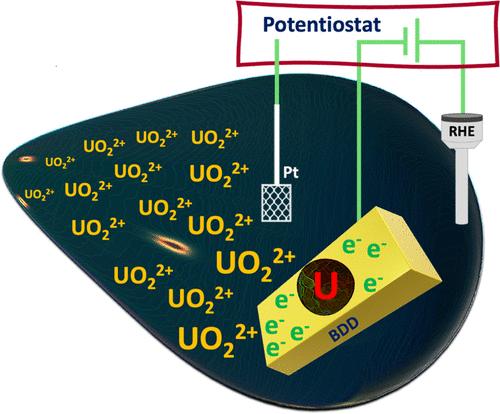
An electrodeposition technique of low-enriched uranium onto boron-doped diamond (BDD) electrodes for uranium electro-assembling, sequestration, uranium electrowinning (as the electroextraction alternative), and future neutron detection applications has been developed. Our findings through physicochemical characterization and an in-depth XPS analysis show that the U/BDD system consists of a blend of uranium oxides with IV, V, and VI oxidation states. Results show that U5+ is present and stable under open atmospheric conditions. The U electrodeposition on BDD creates smooth surfaces, free of voids, with uniform deposition of homogeneous tiny particles of stable uranium oxides, instead of chunky particles, and uranium compound mixtures, like large fibers of the precursor uranyl. Our electrochemical method operates without high temperatures or hazardous compounds. Uranium corrosion and oxidation processes occur spontaneously and parallel to the electrochemical formation of metallic uranium on BDD electrode surfaces, with metallic uranium reacting with water, producing fine particles of UO2. This work represents the first attempt to create a surface of uranium oxides, where the film thickness can be controlled for future applications, e.g., improving sensitivity in neutron detection technologies. Our U electro-assembling method provides a sustainable strategy for uranium electro-recovery from nuclear wastes, immobilizing uranium as a storage method or as U-film fabrication (U/BDD) for future neutron detection applications. Besides, this work contributes to uranium-based technologies, improving them and providing a better understanding of their electrochemical properties, e.g., uranium redox processes, uranium oxides’ formation, and stability evaluation. These properties are of remarkable need for uranium-based target formation. The use of our U/BDD method is proposed as an environmental protocol to recover and immobilize uranium-235, and other fissile materials, from civil and defense wastes, contaminated systems, and stockpiles.
期刊介绍:
ACS Materials Au is an open access journal publishing letters articles reviews and perspectives describing high-quality research at the forefront of fundamental and applied research and at the interface between materials and other disciplines such as chemistry engineering and biology. Papers that showcase multidisciplinary and innovative materials research addressing global challenges are especially welcome. Areas of interest include but are not limited to:Design synthesis characterization and evaluation of forefront and emerging materialsUnderstanding structure property performance relationships and their underlying mechanismsDevelopment of materials for energy environmental biomedical electronic and catalytic applications



 京公网安备 11010802042870号
京ICP备2023020795号-1
京公网安备 11010802042870号
京ICP备2023020795号-1

 分享
分享
 求助内容:
求助内容: 应助结果提醒方式:
 扫码关注我们
