{"title":"Influence of climate variability on wind-sea and swell wave height extreme over the Indo-Pacific Ocean","authors":"Prashant Kumar, Divya Sardana, Sukhwinder Kaur, Remya PG, Rajni, Evan Weller","doi":"10.1002/joc.7584","DOIUrl":null,"url":null,"abstract":"<p>In the Indo-Pacific Ocean (IPO), extreme significant wave heights (SWHs) can substantially induce coastal erosion, flooding, and devastating impacts on coastal livelihoods. This study examines the seasonal influence of the El Niño–Southern Oscillation (ENSO), Indian Ocean Dipole (IOD), Southern Annular Mode (SAM), and Pacific North American (PNA) pattern on extreme wind-wave parameters. The climatic extremes are calculated utilizing ERA5 reanalysis datasets from 1979 to 2019 and a nonstationary generalized extreme value distribution. Significant increases in extreme wind-sea (Hmax) and swell SWH (Hmax<sub>Sw</sub>) response to ENSO occur over the northeast North Pacific (NP) during December–February (DJF) and western NP during June–August (JJA). The PNA influence exhibits a similar pattern to ENSO during DJF yet is inactive in JJA. Hmax and Hmax<sub>Sw</sub> responses to the IOD during September–November (SON) include significant increases over the western Pacific, southern Indian Ocean (IO), and southwest tropical IO, yet decreases over the central tropical IO. The Hmax<sub>Sw</sub> response to the SAM is larger than that for Hmax over the southern IPO during DJF, which extends toward the eastern Pacific in March–May (MAM). Overall, extreme wind-sea and swell parameter responses are found to be associated with sea level pressure (SLP) and SLP gradients.</p>","PeriodicalId":13779,"journal":{"name":"International Journal of Climatology","volume":"42 12","pages":"6183-6203"},"PeriodicalIF":2.8000,"publicationDate":"2022-02-21","publicationTypes":"Journal Article","fieldsOfStudy":null,"isOpenAccess":false,"openAccessPdf":"","citationCount":"5","resultStr":null,"platform":"Semanticscholar","paperid":null,"PeriodicalName":"International Journal of Climatology","FirstCategoryId":"89","ListUrlMain":"https://onlinelibrary.wiley.com/doi/10.1002/joc.7584","RegionNum":3,"RegionCategory":"地球科学","ArticlePicture":[],"TitleCN":null,"AbstractTextCN":null,"PMCID":null,"EPubDate":"","PubModel":"","JCR":"Q2","JCRName":"METEOROLOGY & ATMOSPHERIC SCIENCES","Score":null,"Total":0}
引用次数: 5
Abstract
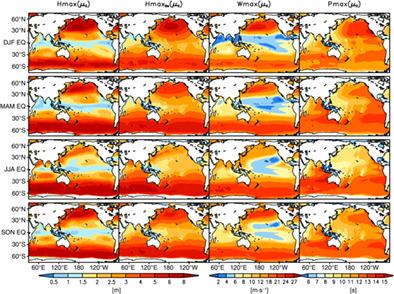
In the Indo-Pacific Ocean (IPO), extreme significant wave heights (SWHs) can substantially induce coastal erosion, flooding, and devastating impacts on coastal livelihoods. This study examines the seasonal influence of the El Niño–Southern Oscillation (ENSO), Indian Ocean Dipole (IOD), Southern Annular Mode (SAM), and Pacific North American (PNA) pattern on extreme wind-wave parameters. The climatic extremes are calculated utilizing ERA5 reanalysis datasets from 1979 to 2019 and a nonstationary generalized extreme value distribution. Significant increases in extreme wind-sea (Hmax) and swell SWH (HmaxSw) response to ENSO occur over the northeast North Pacific (NP) during December–February (DJF) and western NP during June–August (JJA). The PNA influence exhibits a similar pattern to ENSO during DJF yet is inactive in JJA. Hmax and HmaxSw responses to the IOD during September–November (SON) include significant increases over the western Pacific, southern Indian Ocean (IO), and southwest tropical IO, yet decreases over the central tropical IO. The HmaxSw response to the SAM is larger than that for Hmax over the southern IPO during DJF, which extends toward the eastern Pacific in March–May (MAM). Overall, extreme wind-sea and swell parameter responses are found to be associated with sea level pressure (SLP) and SLP gradients.
期刊介绍:
The International Journal of Climatology aims to span the well established but rapidly growing field of climatology, through the publication of research papers, short communications, major reviews of progress and reviews of new books and reports in the area of climate science. The Journal’s main role is to stimulate and report research in climatology, from the expansive fields of the atmospheric, biophysical, engineering and social sciences. Coverage includes: Climate system science; Local to global scale climate observations and modelling; Seasonal to interannual climate prediction; Climatic variability and climate change; Synoptic, dynamic and urban climatology, hydroclimatology, human bioclimatology, ecoclimatology, dendroclimatology, palaeoclimatology, marine climatology and atmosphere-ocean interactions; Application of climatological knowledge to environmental assessment and management and economic production; Climate and society interactions



 京公网安备 11010802042870号
京ICP备2023020795号-1
京公网安备 11010802042870号
京ICP备2023020795号-1

 分享
分享
 求助内容:
求助内容: 应助结果提醒方式:
 扫码关注我们
