Qiwei Yao, Hongying Zheng, Shuyun Huang, Mingqiang Lin, Jun Yang, Jiancheng Li
{"title":"Low versus high dose of postoperative radiotherapy for locally advanced esophageal squamous cell carcinoma: a propensity score-matched analysis.","authors":"Qiwei Yao, Hongying Zheng, Shuyun Huang, Mingqiang Lin, Jun Yang, Jiancheng Li","doi":"10.1002/pro6.1192","DOIUrl":null,"url":null,"abstract":"<p><strong>Objective: </strong>This study aimed to investigate the effect of different postoperative radiotherapy doses on the prognosis of patients with esophageal squamous cell carcinoma (ESCC).</p><p><strong>Methods: </strong>A total of 199 patients (aged 18-75 years) with locally advanced ESCC who underwent esophagectomy and postoperative radiotherapy/chemoradiotherapy at the Fujian Cancer Hospital between July 2008 and January 2018 were included. Based on the postoperative radiotherapy dose, the patients were divided into a low-dose group (50-50.4 Gy; median dose 50 Gy) and a high-dose group (>50.4 Gy; median dose 60 Gy). Neoadjuvant and adjuvant chemotherapy regimens included PF (fluorouracil and cisplatin) and TP (paclitaxel and cisplatin) regimens. Patients were followed-up every 3 months in the first 2 years after surgery, every 6 months for the next 3 years, and then subsequently once a year. The primary endpoints were overall survival (OS) and progression-free survival (PFS) rates. The propensity-score matching (PSM) method was applied to identify a 1:1, well-balanced matched cohort with 33 patients in each group for survival comparison.</p><p><strong>Results: </strong>Among the 199 patients enrolled in this study, 144 and 55 were in the low-dose and high-dose groups, respectively. Univariate and multivariate analyses showed that pathological N classification, vascular tumor emboli, and postoperative radiotherapy dose were independent prognostic factors for both OS and PFS, all <i>p</i> < 0.05. Before PSM, the OS and the PFS of the low-dose group were significantly longer than those of the high-dose group, both <i>p</i> < 0.05. After PSM, better OS and PFS rates were observed in the low-dose group, both <i>p</i> < 0.05. The results showed that patients with pathological stages N0-2 or N3, negative surgical margins, and no vascular tumor emboli could obtain a significant benefit in both OS and PFS after treatment with a low dose of postoperative radiotherapy (50-50.4 Gy). In the subgroup with positive surgical margins, treatment with a low dose of postoperative radiotherapy offered a non-significant survival benefit compared to treatment with a high dose of postoperative radiotherapy.</p><p><strong>Conclusions: </strong>Our study revealed that for patients with ESCC, the low-dose group (50-50.4 Gy) had a significantly higher OS and PFS than the high-dose group (>50.4 Gy). It was suggested that 50-50.4 Gy might be the recommended postoperative radiotherapy dose for ESCC patients.</p>","PeriodicalId":32406,"journal":{"name":"Precision Radiation Oncology","volume":"7 1","pages":"101-110"},"PeriodicalIF":2.1000,"publicationDate":"2023-04-19","publicationTypes":"Journal Article","fieldsOfStudy":null,"isOpenAccess":false,"openAccessPdf":"https://www.ncbi.nlm.nih.gov/pmc/articles/PMC11935151/pdf/","citationCount":"0","resultStr":null,"platform":"Semanticscholar","paperid":null,"PeriodicalName":"Precision Radiation Oncology","FirstCategoryId":"1085","ListUrlMain":"https://doi.org/10.1002/pro6.1192","RegionNum":0,"RegionCategory":null,"ArticlePicture":[],"TitleCN":null,"AbstractTextCN":null,"PMCID":null,"EPubDate":"2023/6/1 0:00:00","PubModel":"eCollection","JCR":"Q4","JCRName":"Medicine","Score":null,"Total":0}
引用次数: 0
Abstract
Objective: This study aimed to investigate the effect of different postoperative radiotherapy doses on the prognosis of patients with esophageal squamous cell carcinoma (ESCC).
Methods: A total of 199 patients (aged 18-75 years) with locally advanced ESCC who underwent esophagectomy and postoperative radiotherapy/chemoradiotherapy at the Fujian Cancer Hospital between July 2008 and January 2018 were included. Based on the postoperative radiotherapy dose, the patients were divided into a low-dose group (50-50.4 Gy; median dose 50 Gy) and a high-dose group (>50.4 Gy; median dose 60 Gy). Neoadjuvant and adjuvant chemotherapy regimens included PF (fluorouracil and cisplatin) and TP (paclitaxel and cisplatin) regimens. Patients were followed-up every 3 months in the first 2 years after surgery, every 6 months for the next 3 years, and then subsequently once a year. The primary endpoints were overall survival (OS) and progression-free survival (PFS) rates. The propensity-score matching (PSM) method was applied to identify a 1:1, well-balanced matched cohort with 33 patients in each group for survival comparison.
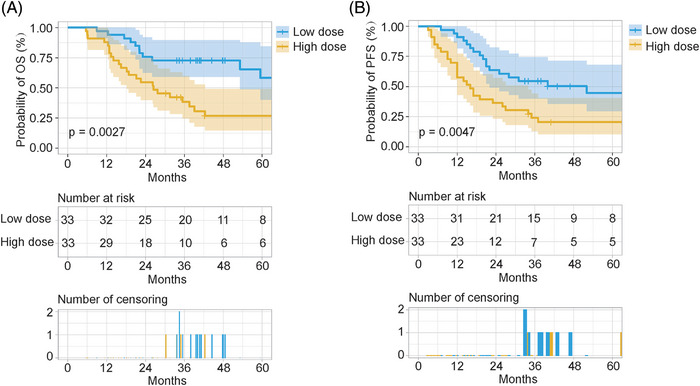
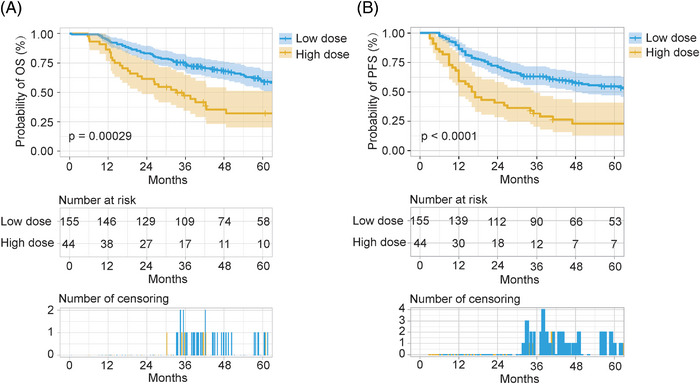
Results: Among the 199 patients enrolled in this study, 144 and 55 were in the low-dose and high-dose groups, respectively. Univariate and multivariate analyses showed that pathological N classification, vascular tumor emboli, and postoperative radiotherapy dose were independent prognostic factors for both OS and PFS, all p < 0.05. Before PSM, the OS and the PFS of the low-dose group were significantly longer than those of the high-dose group, both p < 0.05. After PSM, better OS and PFS rates were observed in the low-dose group, both p < 0.05. The results showed that patients with pathological stages N0-2 or N3, negative surgical margins, and no vascular tumor emboli could obtain a significant benefit in both OS and PFS after treatment with a low dose of postoperative radiotherapy (50-50.4 Gy). In the subgroup with positive surgical margins, treatment with a low dose of postoperative radiotherapy offered a non-significant survival benefit compared to treatment with a high dose of postoperative radiotherapy.
Conclusions: Our study revealed that for patients with ESCC, the low-dose group (50-50.4 Gy) had a significantly higher OS and PFS than the high-dose group (>50.4 Gy). It was suggested that 50-50.4 Gy might be the recommended postoperative radiotherapy dose for ESCC patients.




 京公网安备 11010802042870号
京ICP备2023020795号-1
京公网安备 11010802042870号
京ICP备2023020795号-1

 分享
分享
 求助内容:
求助内容: 应助结果提醒方式:
 扫码关注我们
