Ullrich Bartsch, Andrew J Simpkin, Charmaine Demanuele, Erin Wamsley, Hugh M Marston, Matthew W Jones
{"title":"Distributed slow-wave dynamics during sleep predict memory consolidation and its impairment in schizophrenia.","authors":"Ullrich Bartsch, Andrew J Simpkin, Charmaine Demanuele, Erin Wamsley, Hugh M Marston, Matthew W Jones","doi":"10.1038/s41537-019-0086-8","DOIUrl":null,"url":null,"abstract":"<p><p>The slow waves (SW) of non-rapid eye movement (NREM) sleep reflect neocortical components of network activity during sleep-dependent information processing; their disruption may therefore impair memory consolidation. Here, we quantify sleep-dependent consolidation of motor sequence memory, alongside sleep EEG-derived SW properties and synchronisation, and SW-spindle coupling in 21 patients suffering from schizophrenia and 19 healthy volunteers. Impaired memory consolidation in patients culminated in an overnight improvement in motor sequence task performance of only 1.6%, compared with 15% in controls. During sleep after learning, SW amplitudes and densities were comparable in healthy controls and patients. However, healthy controls showed a significant 45% increase in frontal-to-occipital SW coherence during sleep after motor learning in comparison with a baseline night (baseline: 0.22 ± 0.05, learning: 0.32 ± 0.05); patient EEG failed to show this increase (baseline: 0.22 ± 0.04, learning: 0.19 ± 0.04). The experience-dependent nesting of spindles in SW was similarly disrupted in patients: frontal-to-occipital SW-spindle phase-amplitude coupling (PAC) significantly increased after learning in healthy controls (modulation index baseline: 0.17 ± 0.02, learning: 0.22 ± 0.02) but not in patients (baseline: 0.13 ± 0.02, learning: 0.14 ± 0.02). Partial least-squares regression modelling of coherence and PAC data from all electrode pairs confirmed distributed SW coherence and SW-spindle coordination as superior predictors of overnight memory consolidation in healthy controls but not in patients. Quantifying the full repertoire of NREM EEG oscillations and their long-range covariance therefore presents learning-dependent changes in distributed SW and spindle coordination as fingerprints of impaired cognition in schizophrenia.</p>","PeriodicalId":19328,"journal":{"name":"NPJ Schizophrenia","volume":" ","pages":"18"},"PeriodicalIF":5.7000,"publicationDate":"2019-11-04","publicationTypes":"Journal Article","fieldsOfStudy":null,"isOpenAccess":false,"openAccessPdf":"https://www.ncbi.nlm.nih.gov/pmc/articles/PMC6828759/pdf/","citationCount":"0","resultStr":null,"platform":"Semanticscholar","paperid":null,"PeriodicalName":"NPJ Schizophrenia","FirstCategoryId":"3","ListUrlMain":"https://doi.org/10.1038/s41537-019-0086-8","RegionNum":2,"RegionCategory":"医学","ArticlePicture":[],"TitleCN":null,"AbstractTextCN":null,"PMCID":null,"EPubDate":"","PubModel":"","JCR":"Q1","JCRName":"PSYCHIATRY","Score":null,"Total":0}
引用次数: 0
Abstract
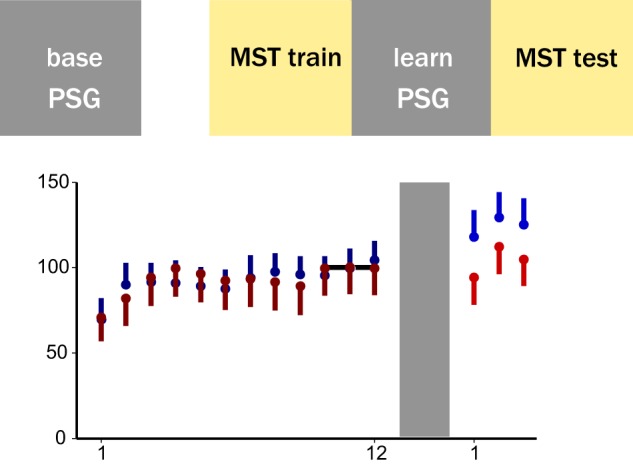
The slow waves (SW) of non-rapid eye movement (NREM) sleep reflect neocortical components of network activity during sleep-dependent information processing; their disruption may therefore impair memory consolidation. Here, we quantify sleep-dependent consolidation of motor sequence memory, alongside sleep EEG-derived SW properties and synchronisation, and SW-spindle coupling in 21 patients suffering from schizophrenia and 19 healthy volunteers. Impaired memory consolidation in patients culminated in an overnight improvement in motor sequence task performance of only 1.6%, compared with 15% in controls. During sleep after learning, SW amplitudes and densities were comparable in healthy controls and patients. However, healthy controls showed a significant 45% increase in frontal-to-occipital SW coherence during sleep after motor learning in comparison with a baseline night (baseline: 0.22 ± 0.05, learning: 0.32 ± 0.05); patient EEG failed to show this increase (baseline: 0.22 ± 0.04, learning: 0.19 ± 0.04). The experience-dependent nesting of spindles in SW was similarly disrupted in patients: frontal-to-occipital SW-spindle phase-amplitude coupling (PAC) significantly increased after learning in healthy controls (modulation index baseline: 0.17 ± 0.02, learning: 0.22 ± 0.02) but not in patients (baseline: 0.13 ± 0.02, learning: 0.14 ± 0.02). Partial least-squares regression modelling of coherence and PAC data from all electrode pairs confirmed distributed SW coherence and SW-spindle coordination as superior predictors of overnight memory consolidation in healthy controls but not in patients. Quantifying the full repertoire of NREM EEG oscillations and their long-range covariance therefore presents learning-dependent changes in distributed SW and spindle coordination as fingerprints of impaired cognition in schizophrenia.
期刊介绍:
npj Schizophrenia is an international, peer-reviewed journal that aims to publish high-quality original papers and review articles relevant to all aspects of schizophrenia and psychosis, from molecular and basic research through environmental or social research, to translational and treatment-related topics. npj Schizophrenia publishes papers on the broad psychosis spectrum including affective psychosis, bipolar disorder, the at-risk mental state, psychotic symptoms, and overlap between psychotic and other disorders.






 京公网安备 11010802042870号
京ICP备2023020795号-1
京公网安备 11010802042870号
京ICP备2023020795号-1

 分享
分享
 求助内容:
求助内容: 应助结果提醒方式:
 扫码关注我们
