Y. Sadati-Keneti, M. V. Sebt, R. Tavakkoli-Moghaddam, M. Rahbari, M. J. Jafari
{"title":"Risk assessment in the supply chain of hazardous materials with carbon cap and trade mechanism: multi-objective red deer algorithm","authors":"Y. Sadati-Keneti, M. V. Sebt, R. Tavakkoli-Moghaddam, M. Rahbari, M. J. Jafari","doi":"10.1007/s10479-023-05531-y","DOIUrl":null,"url":null,"abstract":"<div><p>The sustainable development goals (SDGs) are designed for the prosperity and peace of the people of the world and the planet in the present and especially in the future. One of the main challenges facing hazardous materials (hazmat) of manufacturing and government is the operational decisions related to hazmat. This is because any accident occurring for hazmat can result in irreversible consequences for society. Therefore, according to numbers 3 and 8 in the SDGs, the objectives of this study are to: (1) examine hazmat management in a supply chain and (2) minimize the supply chain costs and the risk caused by hazmat in the network simultaneously. In this study, according to numbers 12 and 13 in the SDGs, the carbon cap and trade mechanism are used to control the amount of carbon emissions in the network. The carbon cap and trade mechanism is one of the most effective techniques to control greenhouse gas emissions in the international community. In this study, a location-inventory-routing problem (LIRP) is investigated by considering the heterogeneous fleet vehicle, in which production decisions are taken into account. A bi-objective mixed-integer linear programming (MILP) model is presented to formulate the problem. The supply chain network of hazmat is divided into two levels: customers, factories, disposal facilities, and intermediate nodes. A multi-objective red deer algorithm (MORDA), as one of the main novelties of this study, is presented, and also its performance is compared with that of the non-dominated sorting genetic algorithm (NSGA-II) and multi-objective particle swarm optimization (MOPSO). Ultimately, three new metrics are presented to investigate the performance of the applied meta-heuristics, and also a new technique is proposed to choose the most reliable solution.</p></div>","PeriodicalId":8215,"journal":{"name":"Annals of Operations Research","volume":"356 2-3","pages":"1149 - 1189"},"PeriodicalIF":4.5000,"publicationDate":"2023-08-26","publicationTypes":"Journal Article","fieldsOfStudy":null,"isOpenAccess":false,"openAccessPdf":"","citationCount":"0","resultStr":null,"platform":"Semanticscholar","paperid":null,"PeriodicalName":"Annals of Operations Research","FirstCategoryId":"91","ListUrlMain":"https://link.springer.com/article/10.1007/s10479-023-05531-y","RegionNum":3,"RegionCategory":"管理学","ArticlePicture":[],"TitleCN":null,"AbstractTextCN":null,"PMCID":null,"EPubDate":"","PubModel":"","JCR":"Q1","JCRName":"OPERATIONS RESEARCH & MANAGEMENT SCIENCE","Score":null,"Total":0}
引用次数: 0
Abstract
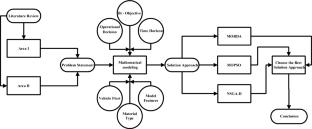
The sustainable development goals (SDGs) are designed for the prosperity and peace of the people of the world and the planet in the present and especially in the future. One of the main challenges facing hazardous materials (hazmat) of manufacturing and government is the operational decisions related to hazmat. This is because any accident occurring for hazmat can result in irreversible consequences for society. Therefore, according to numbers 3 and 8 in the SDGs, the objectives of this study are to: (1) examine hazmat management in a supply chain and (2) minimize the supply chain costs and the risk caused by hazmat in the network simultaneously. In this study, according to numbers 12 and 13 in the SDGs, the carbon cap and trade mechanism are used to control the amount of carbon emissions in the network. The carbon cap and trade mechanism is one of the most effective techniques to control greenhouse gas emissions in the international community. In this study, a location-inventory-routing problem (LIRP) is investigated by considering the heterogeneous fleet vehicle, in which production decisions are taken into account. A bi-objective mixed-integer linear programming (MILP) model is presented to formulate the problem. The supply chain network of hazmat is divided into two levels: customers, factories, disposal facilities, and intermediate nodes. A multi-objective red deer algorithm (MORDA), as one of the main novelties of this study, is presented, and also its performance is compared with that of the non-dominated sorting genetic algorithm (NSGA-II) and multi-objective particle swarm optimization (MOPSO). Ultimately, three new metrics are presented to investigate the performance of the applied meta-heuristics, and also a new technique is proposed to choose the most reliable solution.
期刊介绍:
The Annals of Operations Research publishes peer-reviewed original articles dealing with key aspects of operations research, including theory, practice, and computation. The journal publishes full-length research articles, short notes, expositions and surveys, reports on computational studies, and case studies that present new and innovative practical applications.
In addition to regular issues, the journal publishes periodic special volumes that focus on defined fields of operations research, ranging from the highly theoretical to the algorithmic and the applied. These volumes have one or more Guest Editors who are responsible for collecting the papers and overseeing the refereeing process.



 京公网安备 11010802042870号
京ICP备2023020795号-1
京公网安备 11010802042870号
京ICP备2023020795号-1

 分享
分享
 求助内容:
求助内容: 应助结果提醒方式:
 扫码关注我们
