Daniela Remonatto , Bárbara Fernandes Izidoro , Vítor Teixeira Mazziero , Bianca Pavan Catarino , João Francisco Cabral do Nascimento , Marcel Otávio Cerri , Grazielle Santos Silva Andrade , Ariela Veloso de Paula
{"title":"3D printing and enzyme immobilization: An overview of current trends","authors":"Daniela Remonatto , Bárbara Fernandes Izidoro , Vítor Teixeira Mazziero , Bianca Pavan Catarino , João Francisco Cabral do Nascimento , Marcel Otávio Cerri , Grazielle Santos Silva Andrade , Ariela Veloso de Paula","doi":"10.1016/j.bprint.2023.e00289","DOIUrl":null,"url":null,"abstract":"<div><p><span><span>Given their enormous flexibility and freedom of design, 3D printing<span> technologies have been applied in various fields, such in the production of high value-added products via biocatalysis. By combining the ease of construction of additive manufacturing with the characteristic selectivity of </span></span>enzymatic processes, 3D printing offers a series of novel possibilities that have streamlined the screening of fundamental parameters for optimization of </span>enzyme immobilization<span><span> and process sustainability. This review aimed to examine scientific studies published on the topic between 2016 and 2023 and assess the most critical factors determining the use of 3D printing technologies in the manufacture of enzyme immobilization supports. A discussion is presented on the main advantages and opportunities of commonly used 3D printing techniques and raw materials, as well as on support geometry and chemical functionalization methods. In the current literature, there is great interest in combining the benefits of 3D printing technologies and moldable raw materials for the development of reinforced biopolymers with improved </span>mechanical properties and minimal environmental impacts.</span></p></div>","PeriodicalId":72406,"journal":{"name":"","volume":"33 ","pages":"Article e00289"},"PeriodicalIF":0.0,"publicationDate":"2023-09-01","publicationTypes":"Journal Article","fieldsOfStudy":null,"isOpenAccess":false,"openAccessPdf":"","citationCount":"4","resultStr":null,"platform":"Semanticscholar","paperid":null,"PeriodicalName":"","FirstCategoryId":"1085","ListUrlMain":"https://www.sciencedirect.com/science/article/pii/S2405886623000325","RegionNum":0,"RegionCategory":null,"ArticlePicture":[],"TitleCN":null,"AbstractTextCN":null,"PMCID":null,"EPubDate":"","PubModel":"","JCR":"","JCRName":"","Score":null,"Total":0}
引用次数: 4
Abstract
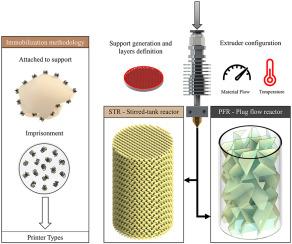
Given their enormous flexibility and freedom of design, 3D printing technologies have been applied in various fields, such in the production of high value-added products via biocatalysis. By combining the ease of construction of additive manufacturing with the characteristic selectivity of enzymatic processes, 3D printing offers a series of novel possibilities that have streamlined the screening of fundamental parameters for optimization of enzyme immobilization and process sustainability. This review aimed to examine scientific studies published on the topic between 2016 and 2023 and assess the most critical factors determining the use of 3D printing technologies in the manufacture of enzyme immobilization supports. A discussion is presented on the main advantages and opportunities of commonly used 3D printing techniques and raw materials, as well as on support geometry and chemical functionalization methods. In the current literature, there is great interest in combining the benefits of 3D printing technologies and moldable raw materials for the development of reinforced biopolymers with improved mechanical properties and minimal environmental impacts.



 京公网安备 11010802042870号
京ICP备2023020795号-1
京公网安备 11010802042870号
京ICP备2023020795号-1

 分享
分享
 求助内容:
求助内容: 应助结果提醒方式:
 扫码关注我们
