Yi Wen, Faizan Rashid, Zeeshan Fazal, Ratnakar Singh, Michael J Spinella, Joseph Irudayaraj
{"title":"Nephrotoxicity of perfluorooctane sulfonate (PFOS)-effect on transcription and epigenetic factors.","authors":"Yi Wen, Faizan Rashid, Zeeshan Fazal, Ratnakar Singh, Michael J Spinella, Joseph Irudayaraj","doi":"10.1093/eep/dvac010","DOIUrl":null,"url":null,"abstract":"<p><p>Perfluorooctane sulfonate (PFOS) is a widespread persistent environmental pollutant implicated in nephrotoxicity with altered metabolism, carcinogenesis, and fibrosis potential. We studied the underlying epigenetic mechanism involving transcription factors of PFOS-induced kidney injury. A 14-day orally dosed mouse model was chosen to study acute influences <i>in vivo</i>. Messenger RNA expression analysis and gene set enrichment analysis were performed to elucidate the relationship between epigenetic regulators, transcription factors, kidney disease, and metabolism homeostasis. PFOS was found to accumulate in mouse kidney in a dose-dependent manner. Kidney injury markers <i>Acta2</i> and <i>Bcl2l1</i> increased in expression significantly. Transcription factors, including <i>Nef2l2, Hes1, Ppara</i>, and <i>Ppard,</i> were upregulated, while <i>Smarca2</i> and <i>Pparg</i> were downregulated. Furthermore, global DNA methylation levels decreased and the gene expression of histone demethylases <i>Kdm1a</i> and <i>Kdm4c</i> were upregulated. Our work implicates PFOS-induced gene expression alterations in epigenetics, transcription factors, and kidney biomarkers with potential implications for kidney fibrosis and kidney carcinogenesis. Future experiments can focus on epigenetic mechanisms to establish a panel of PFOS-induced biomarkers for nephrotoxicity evaluation.</p>","PeriodicalId":4,"journal":{"name":"ACS Applied Energy Materials","volume":" ","pages":"dvac010"},"PeriodicalIF":5.5000,"publicationDate":"2022-04-16","publicationTypes":"Journal Article","fieldsOfStudy":null,"isOpenAccess":false,"openAccessPdf":"https://www.ncbi.nlm.nih.gov/pmc/articles/PMC9134076/pdf/","citationCount":"0","resultStr":null,"platform":"Semanticscholar","paperid":null,"PeriodicalName":"ACS Applied Energy Materials","FirstCategoryId":"88","ListUrlMain":"https://doi.org/10.1093/eep/dvac010","RegionNum":3,"RegionCategory":"材料科学","ArticlePicture":[],"TitleCN":null,"AbstractTextCN":null,"PMCID":null,"EPubDate":"2022/1/1 0:00:00","PubModel":"eCollection","JCR":"Q2","JCRName":"CHEMISTRY, PHYSICAL","Score":null,"Total":0}
引用次数: 0
Abstract
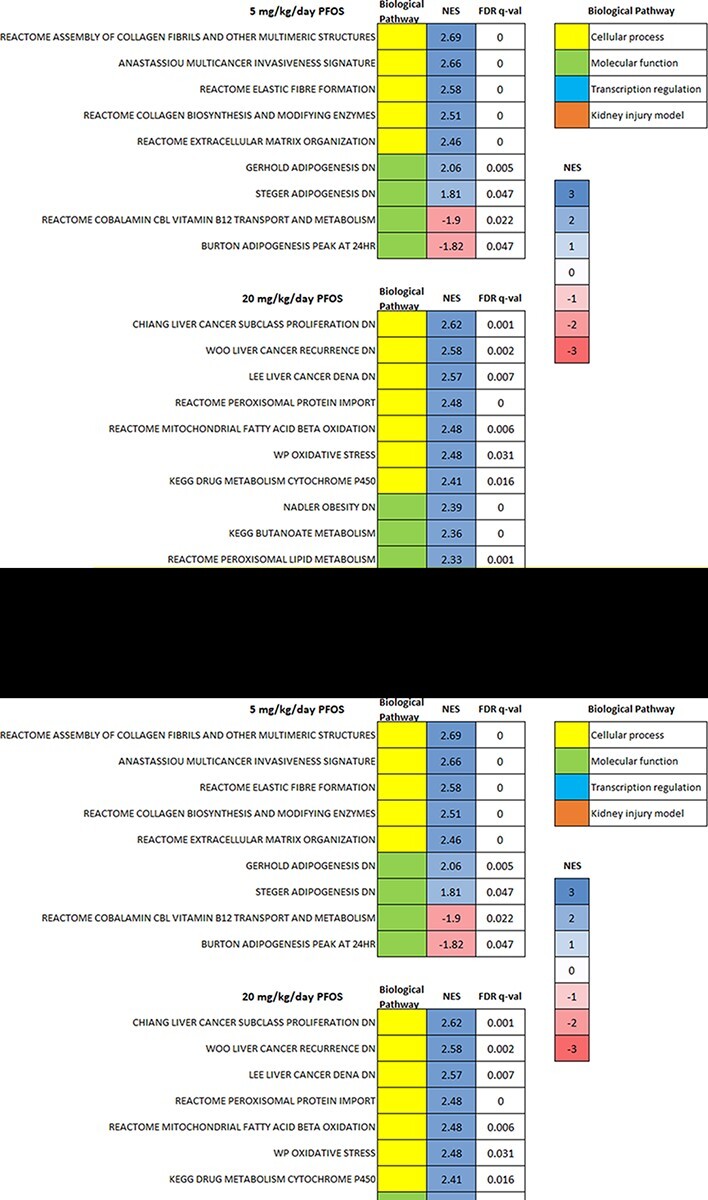
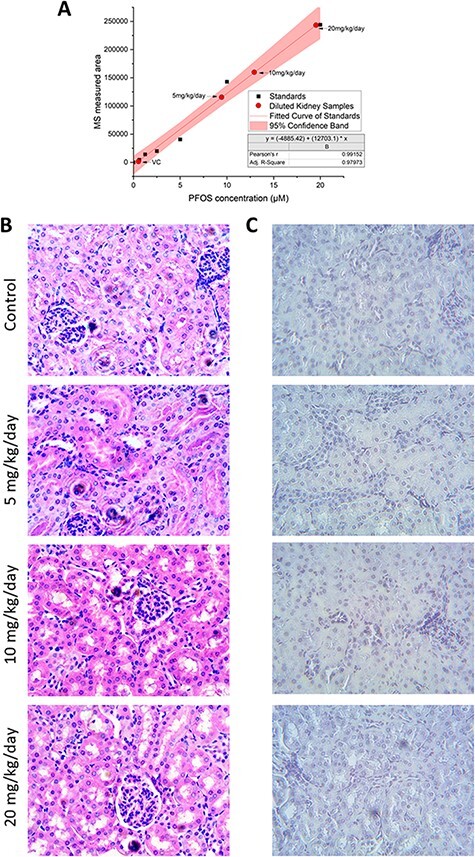
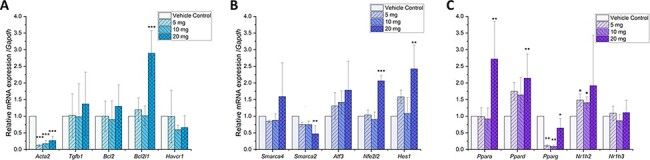
Perfluorooctane sulfonate (PFOS) is a widespread persistent environmental pollutant implicated in nephrotoxicity with altered metabolism, carcinogenesis, and fibrosis potential. We studied the underlying epigenetic mechanism involving transcription factors of PFOS-induced kidney injury. A 14-day orally dosed mouse model was chosen to study acute influences in vivo. Messenger RNA expression analysis and gene set enrichment analysis were performed to elucidate the relationship between epigenetic regulators, transcription factors, kidney disease, and metabolism homeostasis. PFOS was found to accumulate in mouse kidney in a dose-dependent manner. Kidney injury markers Acta2 and Bcl2l1 increased in expression significantly. Transcription factors, including Nef2l2, Hes1, Ppara, and Ppard, were upregulated, while Smarca2 and Pparg were downregulated. Furthermore, global DNA methylation levels decreased and the gene expression of histone demethylases Kdm1a and Kdm4c were upregulated. Our work implicates PFOS-induced gene expression alterations in epigenetics, transcription factors, and kidney biomarkers with potential implications for kidney fibrosis and kidney carcinogenesis. Future experiments can focus on epigenetic mechanisms to establish a panel of PFOS-induced biomarkers for nephrotoxicity evaluation.
期刊介绍:
ACS Applied Energy Materials is an interdisciplinary journal publishing original research covering all aspects of materials, engineering, chemistry, physics and biology relevant to energy conversion and storage. The journal is devoted to reports of new and original experimental and theoretical research of an applied nature that integrate knowledge in the areas of materials, engineering, physics, bioscience, and chemistry into important energy applications.



 京公网安备 11010802042870号
京ICP备2023020795号-1
京公网安备 11010802042870号
京ICP备2023020795号-1

 分享
分享
 求助内容:
求助内容: 应助结果提醒方式:
 扫码关注我们
