Identification of new biomarkers for sarcopenia and characterization of cathepsin D biomarker

Corine L'hôte, Benoît Cordier, Alain Labasse, Christelle Boileau, Bérénice Costes, Yves Henrotin
{"title":"Identification of new biomarkers for sarcopenia and characterization of cathepsin D biomarker","authors":"Corine L'hôte,&nbsp;Benoît Cordier,&nbsp;Alain Labasse,&nbsp;Christelle Boileau,&nbsp;Bérénice Costes,&nbsp;Yves Henrotin","doi":"10.1002/rco2.26","DOIUrl":null,"url":null,"abstract":"<div>\n \n \n <section>\n \n <h3> Background</h3>\n \n <p>Sarcopenia is the progressive generalized loss of skeletal muscle mass, strength, and function that occurs with aging. This study was undertaken to identify new biomarkers of sarcopenia by proteomics analysis of female sera.</p>\n </section>\n \n <section>\n \n <h3> Methods</h3>\n \n <p>A case–control study was set up, for which 19 sarcopenic subjects and 20 control subjects, according to the European Working Group on Sarcopenia Older People criteria published in 2010 (EWGSOP1), were enrolled. All the subjects were at least 65 years old and in majority female. Biomarker screening was performed by a comparative mass spectrometry analysis. Protein expression levels between the two groups were compared. One of the identified biomarkers, cathepsin D, was measured by immunoassay on the serum of the full sample set (<i>n</i> = 39). Its diagnostic performance was evaluated with a receiver operating characteristic curve (ROC curve).</p>\n </section>\n \n <section>\n \n <h3> Results</h3>\n \n <p>Two biomarkers were identified: fructose-biphosphate aldolase A (<i>P</i> ≤ 0.05) and cathepsin D (<i>P</i> ≤ 0.05). The levels of all of them were higher in sarcopenic patients. It was confirmed by immunoassay that cathepsin D levels in serum were significantly higher in the sarcopenic group of patients (<i>P</i> = 0.038). An inverse correlation (−0.385) was observed between cathepsin D levels in serum and gait speed. The area under the ROC curve measurement (AUC = 0.696) demonstrated that cathepsin D levels could discriminate between sarcopenic and non-sarcopenic subjects. A predictive model including cathepsin D, age, and body mass index was established to improve the diagnostic performance (AUC = 0.908).</p>\n </section>\n \n <section>\n \n <h3> Conclusions</h3>\n \n <p>Cathepsin D has been identified as a diagnostic biomarker of sarcopenia.</p>\n </section>\n </div>","PeriodicalId":73544,"journal":{"name":"JCSM rapid communications","volume":"4 2","pages":"122-132"},"PeriodicalIF":0.0000,"publicationDate":"2021-03-18","publicationTypes":"Journal Article","fieldsOfStudy":null,"isOpenAccess":false,"openAccessPdf":"https://sci-hub-pdf.com/10.1002/rco2.26","citationCount":"8","resultStr":null,"platform":"Semanticscholar","paperid":null,"PeriodicalName":"JCSM rapid communications","FirstCategoryId":"1085","ListUrlMain":"https://onlinelibrary.wiley.com/doi/10.1002/rco2.26","RegionNum":0,"RegionCategory":null,"ArticlePicture":[],"TitleCN":null,"AbstractTextCN":null,"PMCID":null,"EPubDate":"","PubModel":"","JCR":"","JCRName":"","Score":null,"Total":0}
引用次数: 8

Abstract

Background

Sarcopenia is the progressive generalized loss of skeletal muscle mass, strength, and function that occurs with aging. This study was undertaken to identify new biomarkers of sarcopenia by proteomics analysis of female sera.

Methods

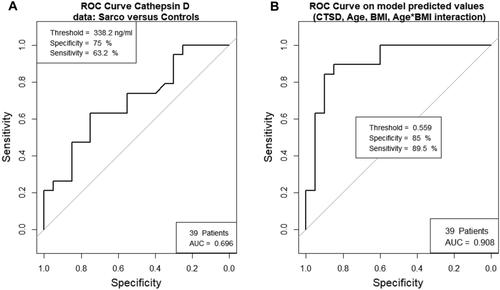
A case–control study was set up, for which 19 sarcopenic subjects and 20 control subjects, according to the European Working Group on Sarcopenia Older People criteria published in 2010 (EWGSOP1), were enrolled. All the subjects were at least 65 years old and in majority female. Biomarker screening was performed by a comparative mass spectrometry analysis. Protein expression levels between the two groups were compared. One of the identified biomarkers, cathepsin D, was measured by immunoassay on the serum of the full sample set (n = 39). Its diagnostic performance was evaluated with a receiver operating characteristic curve (ROC curve).

Results

Two biomarkers were identified: fructose-biphosphate aldolase A (P ≤ 0.05) and cathepsin D (P ≤ 0.05). The levels of all of them were higher in sarcopenic patients. It was confirmed by immunoassay that cathepsin D levels in serum were significantly higher in the sarcopenic group of patients (P = 0.038). An inverse correlation (−0.385) was observed between cathepsin D levels in serum and gait speed. The area under the ROC curve measurement (AUC = 0.696) demonstrated that cathepsin D levels could discriminate between sarcopenic and non-sarcopenic subjects. A predictive model including cathepsin D, age, and body mass index was established to improve the diagnostic performance (AUC = 0.908).

Conclusions

Cathepsin D has been identified as a diagnostic biomarker of sarcopenia.
Abstract Image

查看原文
分享 分享
微信好友 朋友圈 QQ好友 复制链接
本刊更多论文
肌少症新标志物的鉴定及组织蛋白酶D生物标志物的鉴定
骨骼肌减少症是随着年龄增长而发生的骨骼肌质量、力量和功能的进行性全身性丧失。本研究旨在通过对女性血清的蛋白质组学分析,寻找新的肌肉减少症的生物标志物。方法采用病例对照研究,根据欧洲老年人肌少症工作组2010年发布的标准(EWGSOP1),选取19名肌少症患者和20名对照患者。所有受试者年龄均在65岁以上,以女性居多。通过比较质谱分析进行生物标志物筛选。比较两组间蛋白表达水平。鉴定的生物标志物之一,组织蛋白酶D,通过免疫分析法在全样本组(n = 39)的血清中进行测定。采用受试者工作特征曲线(ROC曲线)评价其诊断效果。结果鉴定出两个生物标志物:果糖-二磷酸醛缩酶A (P≤0.05)和组织蛋白酶D (P≤0.05)。在肌肉减少症患者中,这些物质的含量都较高。免疫分析证实,肌减少组患者血清组织蛋白酶D水平明显升高(P = 0.038)。血清组织蛋白酶D水平与步态速度呈负相关(- 0.385)。ROC曲线下面积测量(AUC = 0.696)表明,组织蛋白酶D水平可以区分肌肉减少症和非肌肉减少症受试者。建立包括组织蛋白酶D、年龄和体重指数在内的预测模型以提高诊断效能(AUC = 0.908)。结论:组织蛋白酶D已被确定为肌少症的诊断性生物标志物。
本文章由计算机程序翻译,如有差异,请以英文原文为准。
求助全文
约1分钟内获得全文 去求助
来源期刊
自引率
0.00%
发文量
0
审稿时长
10 weeks
期刊最新文献
Comparison of Computed Tomography Derived Muscle Cross-Sectional Area With Dual-Energy X-Ray Absorptiometry Derived Whole-Body Muscle Mass in COVID-19 Survivors Association of Sarcopenia With Phase Angle and Urinary Titin Fragment in Patients With Gastrointestinal Malignancies Effect of Stretching on Skeletal Muscle Fibrosis in Sarcopenia Velocity-Based-Training Induces Positive Changes in Muscle Morphology in Parkinson's Disease Patients: A Pilot Study A Novel Mouse Model Recapitulating the Clinical Progression of Cancer Cachexia Induced by Renal Carcinoma Cells
×
引用
GB/T 7714-2015
复制
MLA
复制
APA
复制
导出至
BibTeX EndNote RefMan NoteFirst NoteExpress
×
×
提示
您的信息不完整,为了账户安全,请先补充。
现在去补充
×
提示
您因"违规操作"
具体请查看互助需知
我知道了
×
提示
现在去查看 取消
×
提示
确定
0
微信
客服QQ
Book学术公众号 扫码关注我们
反馈
×
意见反馈
请填写您的意见或建议
请填写您的手机或邮箱
已复制链接
已复制链接
快去分享给好友吧!
我知道了
×
扫码分享
扫码分享
Book学术官方微信
Book学术文献互助
Book学术文献互助群
群 号:604180095
Book学术
文献互助 智能选刊 最新文献 互助须知 联系我们:info@booksci.cn
Book学术提供免费学术资源搜索服务,方便国内外学者检索中英文文献。致力于提供最便捷和优质的服务体验。
Copyright © 2023 Book学术 All rights reserved.
ghs 京公网安备 11010802042870号 京ICP备2023020795号-1






