Characteristics associated with differences in 24-hour device-measured and self-reported sleep, sedentary behaviour and physical activity in a sample of Australian primary school children.
Joshua Gauci, Timothy Olds, Carol Maher, Amanda Watson, François Fraysse, Mason Munzberg, Isaac Hoepfl, Dorothea Dumuid
{"title":"Characteristics associated with differences in 24-hour device-measured and self-reported sleep, sedentary behaviour and physical activity in a sample of Australian primary school children.","authors":"Joshua Gauci, Timothy Olds, Carol Maher, Amanda Watson, François Fraysse, Mason Munzberg, Isaac Hoepfl, Dorothea Dumuid","doi":"10.1186/s44167-023-00023-7","DOIUrl":null,"url":null,"abstract":"<p><strong>Background: </strong>How much time children spend sleeping, being sedentary and participating in physical activity affects their health and well-being. To provide accurate guidelines for children's time use, it is important to understand the differences between device-measured and self-reported use-of-time measures, and what may influence these differences. Among Australian primary school-aged children, this study aimed to describe the differences between device-measured and self-reported sleep, sedentary behaviour, light-intensity physical activity (LPA), and moderate-vigorous-intensity physical activity (MVPA), and to explore how sociodemographic and personal characteristics were associated with these differences.</p><p><strong>Methods: </strong>Participants (n = 120, 67% female, age 9-11 years) were drawn from the Life on Holidays cohort study. Device measured use of time was from 7-day accelerometry worn over five timepoints in a 2-year period, and self-reported use of time was from 2-day Multimedia Activity Recall for Children and Adults (MARCA), conducted at the same timepoints. For each participant and measurement method, average daily time spent in sleep, sedentary time, LPA and MVPA was derived for any overlapping days (that had both types of measurement) across the study period. Participant characteristics were either obtained from baseline parental survey (age, sex, parental education, puberty) or derived from the average of direct measurements across the study timepoints (aerobic fitness from shuttle run, body mass index from anthropometric measurements, academic performance from national standardised tests). Differences between device-measured and self-reported use of time were described using Bland-Altmann plots. Compositional outcome linear-regression models were used to determine which participant characteristics were associated with differences by use-of-time measurement type.</p><p><strong>Results: </strong>Relative to device-measured, self-reported daily LPA was underestimated by 83 min (35% difference), whilst sleep (+ 37 min; 6% difference), MVPA (+ 34 min; 33% difference) and sedentary time (+ 12 min; 3% difference) were overestimated. Characteristics underpinning the differences between measurement types were sex (χ<sup>2</sup> = 11.9, p = 0.008), parental education (χ<sup>2</sup> = 23.0, p = 0.001), aerobic fitness (χ<sup>2</sup> = 10.7, p = 0.01) and academic performance (χ<sup>2</sup> = 15.9, p = 0.001).</p><p><strong>Conclusions: </strong>Among primary school-aged children, device-measured and self-reported use-of-time measurements should not be used interchangeably as there are systematic biases and differences relative to socio-demographic characteristics.</p>","PeriodicalId":73581,"journal":{"name":"Journal of activity, sedentary and sleep behaviors","volume":" ","pages":"14"},"PeriodicalIF":0.0000,"publicationDate":"2023-07-03","publicationTypes":"Journal Article","fieldsOfStudy":null,"isOpenAccess":false,"openAccessPdf":"https://www.ncbi.nlm.nih.gov/pmc/articles/PMC11960218/pdf/","citationCount":"0","resultStr":null,"platform":"Semanticscholar","paperid":null,"PeriodicalName":"Journal of activity, sedentary and sleep behaviors","FirstCategoryId":"1085","ListUrlMain":"https://doi.org/10.1186/s44167-023-00023-7","RegionNum":0,"RegionCategory":null,"ArticlePicture":[],"TitleCN":null,"AbstractTextCN":null,"PMCID":null,"EPubDate":"","PubModel":"","JCR":"","JCRName":"","Score":null,"Total":0}
引用次数: 0
Abstract
Background: How much time children spend sleeping, being sedentary and participating in physical activity affects their health and well-being. To provide accurate guidelines for children's time use, it is important to understand the differences between device-measured and self-reported use-of-time measures, and what may influence these differences. Among Australian primary school-aged children, this study aimed to describe the differences between device-measured and self-reported sleep, sedentary behaviour, light-intensity physical activity (LPA), and moderate-vigorous-intensity physical activity (MVPA), and to explore how sociodemographic and personal characteristics were associated with these differences.
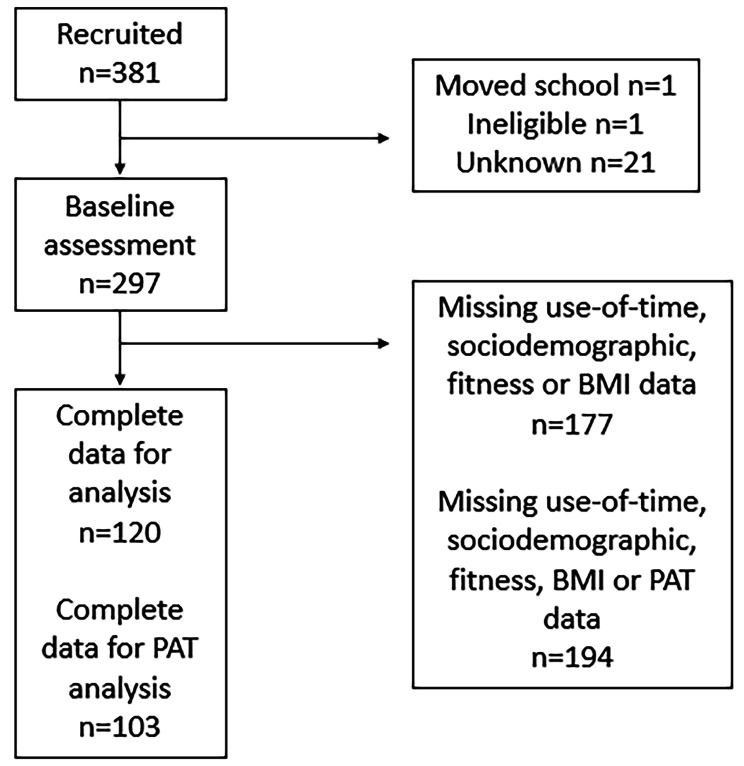
Methods: Participants (n = 120, 67% female, age 9-11 years) were drawn from the Life on Holidays cohort study. Device measured use of time was from 7-day accelerometry worn over five timepoints in a 2-year period, and self-reported use of time was from 2-day Multimedia Activity Recall for Children and Adults (MARCA), conducted at the same timepoints. For each participant and measurement method, average daily time spent in sleep, sedentary time, LPA and MVPA was derived for any overlapping days (that had both types of measurement) across the study period. Participant characteristics were either obtained from baseline parental survey (age, sex, parental education, puberty) or derived from the average of direct measurements across the study timepoints (aerobic fitness from shuttle run, body mass index from anthropometric measurements, academic performance from national standardised tests). Differences between device-measured and self-reported use of time were described using Bland-Altmann plots. Compositional outcome linear-regression models were used to determine which participant characteristics were associated with differences by use-of-time measurement type.
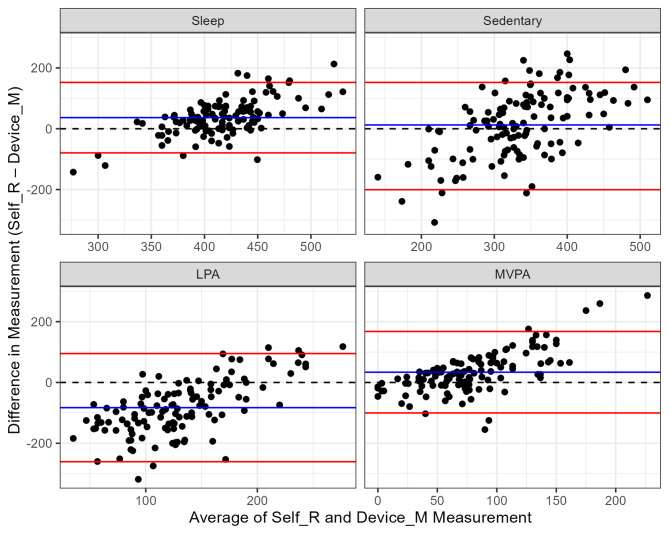
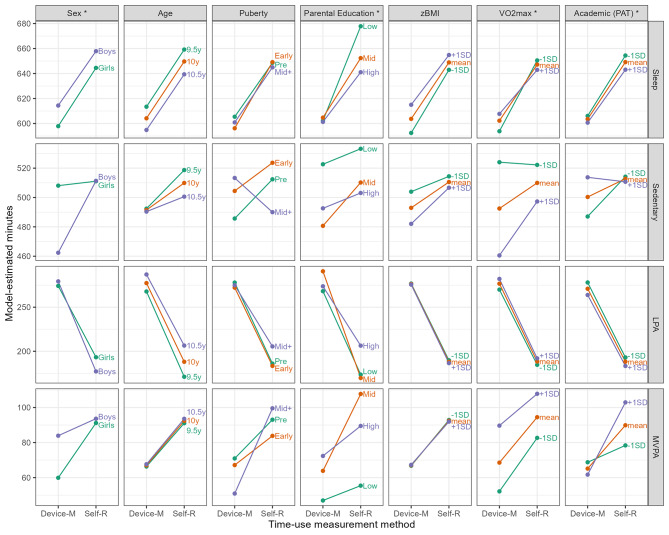
Results: Relative to device-measured, self-reported daily LPA was underestimated by 83 min (35% difference), whilst sleep (+ 37 min; 6% difference), MVPA (+ 34 min; 33% difference) and sedentary time (+ 12 min; 3% difference) were overestimated. Characteristics underpinning the differences between measurement types were sex (χ2 = 11.9, p = 0.008), parental education (χ2 = 23.0, p = 0.001), aerobic fitness (χ2 = 10.7, p = 0.01) and academic performance (χ2 = 15.9, p = 0.001).
Conclusions: Among primary school-aged children, device-measured and self-reported use-of-time measurements should not be used interchangeably as there are systematic biases and differences relative to socio-demographic characteristics.



 京公网安备 11010802042870号
京ICP备2023020795号-1
京公网安备 11010802042870号
京ICP备2023020795号-1

 分享
分享

 求助内容:
求助内容: 应助结果提醒方式:
 扫码关注我们
