Effectiveness of Psychosocial Intervention and Psychoeducation in Improving Psychological Well-being and Cognitive Functioning in Caregivers of Substance Use Issues: A Pilot Study.
K A Agnes Ashmitha, C N Ram Gopal, O T Sabari Sridhar, Kinjari Kancharla
{"title":"Effectiveness of Psychosocial Intervention and Psychoeducation in Improving Psychological Well-being and Cognitive Functioning in Caregivers of Substance Use Issues: A Pilot Study.","authors":"K A Agnes Ashmitha, C N Ram Gopal, O T Sabari Sridhar, Kinjari Kancharla","doi":"10.1177/09727531231185925","DOIUrl":null,"url":null,"abstract":"<p><strong>Background: </strong>Family caregivers of individuals with substance use disorder (SUD) face significant challenges that can impact their well-being, coping abilities, and cognitive functioning. However, the empowerment of these caregivers often goes unnoticed, highlighting the need for supportive interventions.</p><p><strong>Purpose: </strong>To develop and evaluate the effectiveness of a one-on-one intervention program for family caregivers of SUD patients using pre-test and post-test assessments.</p><p><strong>Methods: </strong>A pilot study was conducted using a randomized controlled trial design with 40 family caregivers of individuals with SUD. Through a lottery method, participants were randomly assigned to either the control or experimental groups, with each group consisting of 20 caregivers. The intervention program consisted of 12 one-on-one sessions. Pre-test and post-test assessments utilized the Ryff Psychological Well-being Scale, Ways of Coping, revised by Lazarus and Folkman, the Hamilton Anxiety Rating Scale, and the Kingston Caregiver Stress Scale. Descriptive and inferential statistics were analyzed using SPSS software.</p><p><strong>Results: </strong>Significant differences were observed between the control and experimental groups in psychological well-being, cognitive functioning, coping, anxiety, and stress (<i>p</i> < .01). The one-on-one intervention program significantly improved well-being and coping skills while reducing anxiety and stress levels. Consequently, the program empowered caregivers and enhanced their psychological resilience in the caregiving process.</p><p><strong>Conclusion: </strong>The findings support the effectiveness of the one-on-one intervention program in enhancing the well-being, coping skills, cognitive functioning, anxiety, and stress levels of family caregivers of individuals with SUD. This intervention program has the potential to empower caregivers and enable them to better cope with the challenges they face in providing care.</p>","PeriodicalId":1,"journal":{"name":"Accounts of Chemical Research","volume":" ","pages":"157-165"},"PeriodicalIF":17.7000,"publicationDate":"2024-07-01","publicationTypes":"Journal Article","fieldsOfStudy":null,"isOpenAccess":false,"openAccessPdf":"https://www.ncbi.nlm.nih.gov/pmc/articles/PMC11325685/pdf/","citationCount":"0","resultStr":null,"platform":"Semanticscholar","paperid":null,"PeriodicalName":"Accounts of Chemical Research","FirstCategoryId":"1085","ListUrlMain":"https://doi.org/10.1177/09727531231185925","RegionNum":1,"RegionCategory":"化学","ArticlePicture":[],"TitleCN":null,"AbstractTextCN":null,"PMCID":null,"EPubDate":"2023/8/16 0:00:00","PubModel":"Epub","JCR":"Q1","JCRName":"CHEMISTRY, MULTIDISCIPLINARY","Score":null,"Total":0}
引用次数: 0
Abstract
Background: Family caregivers of individuals with substance use disorder (SUD) face significant challenges that can impact their well-being, coping abilities, and cognitive functioning. However, the empowerment of these caregivers often goes unnoticed, highlighting the need for supportive interventions.
Purpose: To develop and evaluate the effectiveness of a one-on-one intervention program for family caregivers of SUD patients using pre-test and post-test assessments.
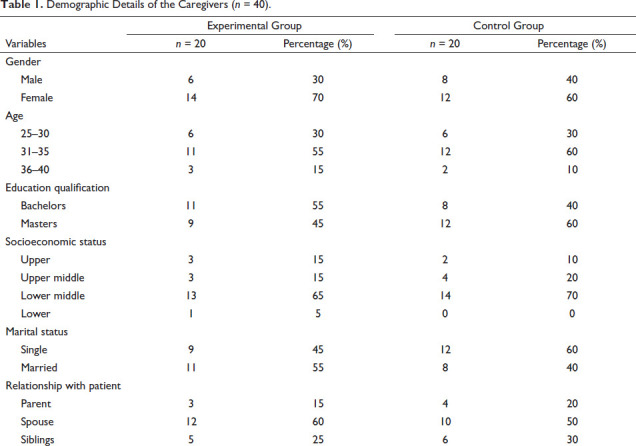
Methods: A pilot study was conducted using a randomized controlled trial design with 40 family caregivers of individuals with SUD. Through a lottery method, participants were randomly assigned to either the control or experimental groups, with each group consisting of 20 caregivers. The intervention program consisted of 12 one-on-one sessions. Pre-test and post-test assessments utilized the Ryff Psychological Well-being Scale, Ways of Coping, revised by Lazarus and Folkman, the Hamilton Anxiety Rating Scale, and the Kingston Caregiver Stress Scale. Descriptive and inferential statistics were analyzed using SPSS software.
Results: Significant differences were observed between the control and experimental groups in psychological well-being, cognitive functioning, coping, anxiety, and stress (p < .01). The one-on-one intervention program significantly improved well-being and coping skills while reducing anxiety and stress levels. Consequently, the program empowered caregivers and enhanced their psychological resilience in the caregiving process.
Conclusion: The findings support the effectiveness of the one-on-one intervention program in enhancing the well-being, coping skills, cognitive functioning, anxiety, and stress levels of family caregivers of individuals with SUD. This intervention program has the potential to empower caregivers and enable them to better cope with the challenges they face in providing care.
期刊介绍:
Accounts of Chemical Research presents short, concise and critical articles offering easy-to-read overviews of basic research and applications in all areas of chemistry and biochemistry. These short reviews focus on research from the author’s own laboratory and are designed to teach the reader about a research project. In addition, Accounts of Chemical Research publishes commentaries that give an informed opinion on a current research problem. Special Issues online are devoted to a single topic of unusual activity and significance.
Accounts of Chemical Research replaces the traditional article abstract with an article "Conspectus." These entries synopsize the research affording the reader a closer look at the content and significance of an article. Through this provision of a more detailed description of the article contents, the Conspectus enhances the article's discoverability by search engines and the exposure for the research.






 京公网安备 11010802042870号
京ICP备2023020795号-1
京公网安备 11010802042870号
京ICP备2023020795号-1

 分享
分享
 求助内容:
求助内容: 应助结果提醒方式:
 扫码关注我们
