{"title":"Age-specific percentile-based prostate-specific antigen cutoff values predict the risk of prostate cancer: A single hospital observation.","authors":"Teng-Fu Hsieh, Hung-Lin Chen, Ying-Fang Hsia, Che-Chen Lin, Hsiu-Yin Chiang, Min-Yen Wu, Sheng-Hsuan Chen, Po-Fan Hsieh, Hsi-Chin Wu, Han Chang, Chin-Chi Kuo","doi":"10.37796/2211-8039.1415","DOIUrl":null,"url":null,"abstract":"<p><strong>Background: </strong>Testing for prostate-specific antigen (PSA) is often recommended for men with a potential risk of prostate cancer (PCa) before requiring advanced examination. However, the best PSA cutoff value remains controversial.</p><p><strong>Object: </strong>We compared the predictive performance of age-specific percentile-based PSA thresholds with a conventional cutoff of >4 ng/mL for the risk of PCa.</p><p><strong>Methods: </strong>We included men who received PSA measurements between 2003 and 2017 in a medical center in Taiwan. Logistic regression modeling was used to assess the association between age-specific percentile-based PSA thresholds and PCa risk in age subgroups. We further applied C-statistic and decision curve analysis to compare the predictive performance of age-specific percentile-based PSA with that of a conventional cutoff PSA.</p><p><strong>Results: </strong>We identified 626 patients with PCa and 40 836 patients without PCa. The slope of PSA in patients >60-year-old was almost 3 times that of those <60-year-old (0.713 vs 0.259). The risk effect sizes of the 75th percentile PSA cutoff (<60-year-old: 2.19; 60-70-year-old: 4.36; >70-year-old: 5.84 ng/mL) were comparable to those observed based on the conventional cutoff in all age groups. However, the discrimination performance of the 75th percentile PSA cutoff was better than that of the conventional cutoff among patients aged <60-year-old (C-statistic, 0.783 vs. 0.729, <i>p</i> < 0.05). The 75th percentile cutoffs also correctly identified an additional 2 patients with PCa for every 100 patients with PSA screening at the threshold probability of 20%.</p><p><strong>Conclusions: </strong>Our data support the use of the 75th percentile PSA cutoff to facilitate individualized risk assessment, particularly for patients aged <60-year-old.</p>","PeriodicalId":2,"journal":{"name":"ACS Applied Bio Materials","volume":" ","pages":"9-24"},"PeriodicalIF":4.7000,"publicationDate":"2023-09-01","publicationTypes":"Journal Article","fieldsOfStudy":null,"isOpenAccess":false,"openAccessPdf":"https://www.ncbi.nlm.nih.gov/pmc/articles/PMC10627214/pdf/","citationCount":"0","resultStr":null,"platform":"Semanticscholar","paperid":null,"PeriodicalName":"ACS Applied Bio Materials","FirstCategoryId":"1085","ListUrlMain":"https://doi.org/10.37796/2211-8039.1415","RegionNum":0,"RegionCategory":null,"ArticlePicture":[],"TitleCN":null,"AbstractTextCN":null,"PMCID":null,"EPubDate":"2023/1/1 0:00:00","PubModel":"eCollection","JCR":"Q2","JCRName":"MATERIALS SCIENCE, BIOMATERIALS","Score":null,"Total":0}
引用次数: 0
Abstract
Background: Testing for prostate-specific antigen (PSA) is often recommended for men with a potential risk of prostate cancer (PCa) before requiring advanced examination. However, the best PSA cutoff value remains controversial.
Object: We compared the predictive performance of age-specific percentile-based PSA thresholds with a conventional cutoff of >4 ng/mL for the risk of PCa.
Methods: We included men who received PSA measurements between 2003 and 2017 in a medical center in Taiwan. Logistic regression modeling was used to assess the association between age-specific percentile-based PSA thresholds and PCa risk in age subgroups. We further applied C-statistic and decision curve analysis to compare the predictive performance of age-specific percentile-based PSA with that of a conventional cutoff PSA.
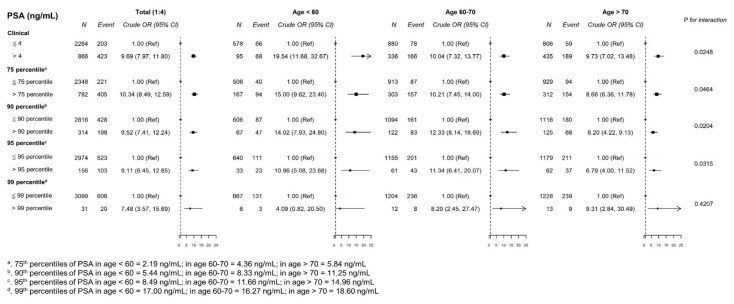
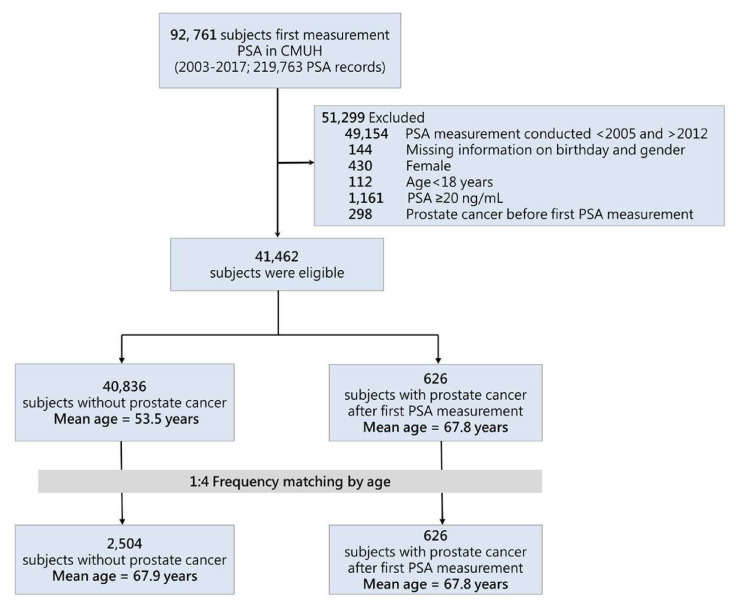
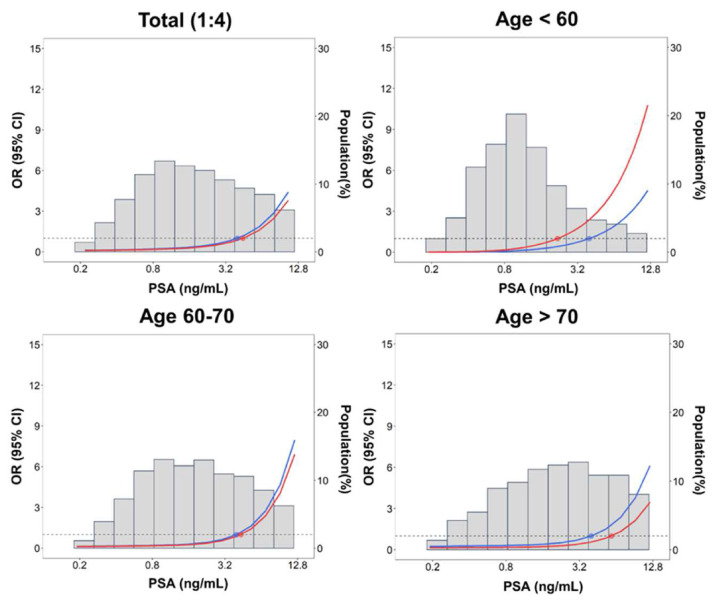
Results: We identified 626 patients with PCa and 40 836 patients without PCa. The slope of PSA in patients >60-year-old was almost 3 times that of those <60-year-old (0.713 vs 0.259). The risk effect sizes of the 75th percentile PSA cutoff (<60-year-old: 2.19; 60-70-year-old: 4.36; >70-year-old: 5.84 ng/mL) were comparable to those observed based on the conventional cutoff in all age groups. However, the discrimination performance of the 75th percentile PSA cutoff was better than that of the conventional cutoff among patients aged <60-year-old (C-statistic, 0.783 vs. 0.729, p < 0.05). The 75th percentile cutoffs also correctly identified an additional 2 patients with PCa for every 100 patients with PSA screening at the threshold probability of 20%.
Conclusions: Our data support the use of the 75th percentile PSA cutoff to facilitate individualized risk assessment, particularly for patients aged <60-year-old.
期刊介绍:
ACS Applied Bio Materials is an interdisciplinary journal publishing original research covering all aspects of biomaterials and biointerfaces including and beyond the traditional biosensing, biomedical and therapeutic applications.
The journal is devoted to reports of new and original experimental and theoretical research of an applied nature that integrates knowledge in the areas of materials, engineering, physics, bioscience, and chemistry into important bio applications. The journal is specifically interested in work that addresses the relationship between structure and function and assesses the stability and degradation of materials under relevant environmental and biological conditions.




 京公网安备 11010802042870号
京ICP备2023020795号-1
京公网安备 11010802042870号
京ICP备2023020795号-1

 分享
分享
 求助内容:
求助内容: 应助结果提醒方式:
 扫码关注我们
