Kacey D. Aukema, Marcelo O. Wallau, Derek R. Faust, David W. Archer, John R. Hendrickson, Scott L. Kronberg, Mark A. Liebig
{"title":"Soil CO2 efflux dynamics in an integrated crop–livestock system","authors":"Kacey D. Aukema, Marcelo O. Wallau, Derek R. Faust, David W. Archer, John R. Hendrickson, Scott L. Kronberg, Mark A. Liebig","doi":"10.1002/saj2.20546","DOIUrl":null,"url":null,"abstract":"<p>Integrated crop–livestock (ICL) systems have shown potential to provide a variety of environmental benefits including soil carbon (C) increases relative to conventional row cropping systems. However, studies documenting C dynamics of ICL systems in the northern Great Plains are lacking relative to other agroecosystems. Soil carbon dioxide (CO<sub>2</sub>) efflux, crop biomass, and soil organic matter (SOM) pools were monitored over 3 years in an ICL rotation (corn [<i>Zea mays</i> L.]/soybean [<i>Glycine max</i> L.]–spring wheat [<i>Triticum aestivum</i> L.] + cover crop–cover crop) with fall grazing, a conventional cropping system rotation (corn–spring wheat–soybean) and fall grazed and ungrazed mixed-grass pasture near Mandan, ND. Cropped treatments were under no-till management. Annual aboveground crop residue biomass C was similar in the ICL and conventional systems, while less in the grazed pasture (4.18, 3.83, and 1.21 Mg C ha<sup>−1</sup> year<sup>−1</sup> respectively; <i>p</i> = 0.039). Annual soil CO<sub>2</sub> efflux was greater in the ICL, grazed, and ungrazed pasture systems than the conventional system (8.05, 8.73, 8.25, and 5.81 Mg C ha<sup>−1</sup> year<sup>−1</sup>, respectively; <i>p</i> < 0.001). Among crop phases in the ICL and conventional cropping systems, cover crops contributed to greater CO<sub>2</sub> efflux in the spring and fall. SOM and C mineralization were greater at 0–5 cm in the ICL system compared to the conventional cropping system (6.6% vs. 6.3%, <i>p</i> = 0.028 and 248 vs. 184 mg CO<sub>2</sub>–C kg<sup>−1</sup>, <i>p</i> < 0.001, respectively). Interseeded cover crops in ICL systems can contribute increased root respiration and enhanced SOM pools relative to conventional cropping systems under semiarid conditions.</p>","PeriodicalId":101043,"journal":{"name":"Proceedings - Soil Science Society of America","volume":"87 4","pages":"948-962"},"PeriodicalIF":0.0000,"publicationDate":"2023-03-13","publicationTypes":"Journal Article","fieldsOfStudy":null,"isOpenAccess":false,"openAccessPdf":"https://onlinelibrary.wiley.com/doi/epdf/10.1002/saj2.20546","citationCount":"0","resultStr":null,"platform":"Semanticscholar","paperid":null,"PeriodicalName":"Proceedings - Soil Science Society of America","FirstCategoryId":"1085","ListUrlMain":"https://onlinelibrary.wiley.com/doi/10.1002/saj2.20546","RegionNum":0,"RegionCategory":null,"ArticlePicture":[],"TitleCN":null,"AbstractTextCN":null,"PMCID":null,"EPubDate":"","PubModel":"","JCR":"","JCRName":"","Score":null,"Total":0}
引用次数: 0
Abstract
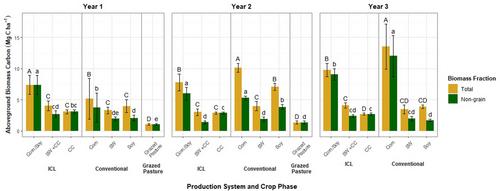
Integrated crop–livestock (ICL) systems have shown potential to provide a variety of environmental benefits including soil carbon (C) increases relative to conventional row cropping systems. However, studies documenting C dynamics of ICL systems in the northern Great Plains are lacking relative to other agroecosystems. Soil carbon dioxide (CO2) efflux, crop biomass, and soil organic matter (SOM) pools were monitored over 3 years in an ICL rotation (corn [Zea mays L.]/soybean [Glycine max L.]–spring wheat [Triticum aestivum L.] + cover crop–cover crop) with fall grazing, a conventional cropping system rotation (corn–spring wheat–soybean) and fall grazed and ungrazed mixed-grass pasture near Mandan, ND. Cropped treatments were under no-till management. Annual aboveground crop residue biomass C was similar in the ICL and conventional systems, while less in the grazed pasture (4.18, 3.83, and 1.21 Mg C ha−1 year−1 respectively; p = 0.039). Annual soil CO2 efflux was greater in the ICL, grazed, and ungrazed pasture systems than the conventional system (8.05, 8.73, 8.25, and 5.81 Mg C ha−1 year−1, respectively; p < 0.001). Among crop phases in the ICL and conventional cropping systems, cover crops contributed to greater CO2 efflux in the spring and fall. SOM and C mineralization were greater at 0–5 cm in the ICL system compared to the conventional cropping system (6.6% vs. 6.3%, p = 0.028 and 248 vs. 184 mg CO2–C kg−1, p < 0.001, respectively). Interseeded cover crops in ICL systems can contribute increased root respiration and enhanced SOM pools relative to conventional cropping systems under semiarid conditions.
作物-牲畜一体化(ICL)系统已经显示出提供各种环境效益的潜力,包括相对于传统行作系统增加土壤碳(C)。然而,与其他农业生态系统相比,大平原北部ICL系统的C动态研究较少。在西北丹州Mandan附近,采用ICL轮作(玉米[Zea mays L.]/大豆[Glycine max L.] -春小麦[Triticum aestivum L.] +覆盖作物-覆盖作物)、常规轮作(玉米-春小麦-大豆)和秋季放牧和未放牧混合草地,对土壤二氧化碳(CO2)外排、作物生物量和土壤有机质(SOM)库进行了3年的监测。作物处理采用免耕管理。ICL系统和常规系统的年地上作物残茬生物量C基本相同,而放牧系统的年地上作物残茬生物量C较少,分别为4.18、3.83和1.21 Mg C ha - 1 year - 1;p = 0.039)。ICL系统、放牧系统和未放牧系统的年土壤CO2通量均大于常规系统(分别为8.05、8.73、8.25和5.81 Mg C ha - 1年);p & lt;0.001)。在ICL和常规种植系统的作物阶段中,覆盖作物在春季和秋季贡献了更大的CO2外排。ICL系统在0-5 cm处的SOM和C矿化高于常规种植系统(6.6%比6.3%,p = 0.028, 248比184 mg CO2-C kg - 1, p <;分别为0.001)。在半干旱条件下,ICL系统中间种覆盖作物与传统种植系统相比,可以增加根系呼吸和增加SOM库。



 京公网安备 11010802042870号
京ICP备2023020795号-1
京公网安备 11010802042870号
京ICP备2023020795号-1

 分享
分享

 求助内容:
求助内容: 应助结果提醒方式:
 扫码关注我们
