{"title":"Analysis of Fractal and Energy Consumption Characteristics of Concrete under Impact Loading","authors":"Yutao Li, Faning Dang, Mei Zhou, Jie Ren","doi":"10.1155/2021/2370363","DOIUrl":null,"url":null,"abstract":"<div>\n <p>In order to study the compressive deformation and energy evolution characteristics of concrete under dynamic loading, impact compression tests with impact velocities of 5, 6, and 7 m/s were carried out on concrete samples with aggregate volume ratios of 0, 32%, 37%, and 42%, respectively, using a split Hopkinson pressure bar test apparatus. The broken concrete pieces after destruction were collected and arranged. The fractal characteristics of fragmentation distribution of concrete specimens with different aggregate rates under impact were discussed, and the roughness of the fragment surface was characterized by the fractal dimension of the broken fragment and the crack surface energy was calculated. In addition, the analytical equation of the fractal dimension of the broken fragment and the crack surface energy was established. The relationship between the specimen energy absorption and the crack surface energy was compared and analyzed. The results show that the concrete specimens are mainly tensile split failure modes under different impact speeds. The fractal dimension, absorption energy, and crack surface energy all increase with the increase in impact speed and decrease with the increase in the aggregate rate. When the aggregate rate is different, the effective utilization rate of the absorbed energy is the largest when the aggregate content is 37%. The surface energy of the crack can be used to estimate the concrete dynamic intensity.</p>\n </div>","PeriodicalId":12512,"journal":{"name":"Geofluids","volume":"2021 1","pages":""},"PeriodicalIF":1.2000,"publicationDate":"2021-10-25","publicationTypes":"Journal Article","fieldsOfStudy":null,"isOpenAccess":false,"openAccessPdf":"https://onlinelibrary.wiley.com/doi/epdf/10.1155/2021/2370363","citationCount":"0","resultStr":null,"platform":"Semanticscholar","paperid":null,"PeriodicalName":"Geofluids","FirstCategoryId":"89","ListUrlMain":"https://onlinelibrary.wiley.com/doi/10.1155/2021/2370363","RegionNum":4,"RegionCategory":"地球科学","ArticlePicture":[],"TitleCN":null,"AbstractTextCN":null,"PMCID":null,"EPubDate":"","PubModel":"","JCR":"Q3","JCRName":"GEOCHEMISTRY & GEOPHYSICS","Score":null,"Total":0}
引用次数: 0
Abstract
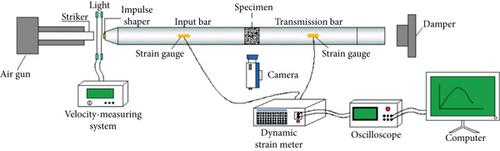
In order to study the compressive deformation and energy evolution characteristics of concrete under dynamic loading, impact compression tests with impact velocities of 5, 6, and 7 m/s were carried out on concrete samples with aggregate volume ratios of 0, 32%, 37%, and 42%, respectively, using a split Hopkinson pressure bar test apparatus. The broken concrete pieces after destruction were collected and arranged. The fractal characteristics of fragmentation distribution of concrete specimens with different aggregate rates under impact were discussed, and the roughness of the fragment surface was characterized by the fractal dimension of the broken fragment and the crack surface energy was calculated. In addition, the analytical equation of the fractal dimension of the broken fragment and the crack surface energy was established. The relationship between the specimen energy absorption and the crack surface energy was compared and analyzed. The results show that the concrete specimens are mainly tensile split failure modes under different impact speeds. The fractal dimension, absorption energy, and crack surface energy all increase with the increase in impact speed and decrease with the increase in the aggregate rate. When the aggregate rate is different, the effective utilization rate of the absorbed energy is the largest when the aggregate content is 37%. The surface energy of the crack can be used to estimate the concrete dynamic intensity.
期刊介绍:
Geofluids is a peer-reviewed, Open Access journal that provides a forum for original research and reviews relating to the role of fluids in mineralogical, chemical, and structural evolution of the Earth’s crust. Its explicit aim is to disseminate ideas across the range of sub-disciplines in which Geofluids research is carried out. To this end, authors are encouraged to stress the transdisciplinary relevance and international ramifications of their research. Authors are also encouraged to make their work as accessible as possible to readers from other sub-disciplines.
Geofluids emphasizes chemical, microbial, and physical aspects of subsurface fluids throughout the Earth’s crust. Geofluids spans studies of groundwater, terrestrial or submarine geothermal fluids, basinal brines, petroleum, metamorphic waters or magmatic fluids.



 京公网安备 11010802042870号
京ICP备2023020795号-1
京公网安备 11010802042870号
京ICP备2023020795号-1

 分享
分享
 求助内容:
求助内容: 应助结果提醒方式:
 扫码关注我们
