Sebastian Sanchez, Jacob M Miller, Matthew T Jones, Diego J Ojeda, Edgar A Samaniego
{"title":"Intracranial Atherosclerotic Plaque Morphologic Pattern and Enhancement Change With High-Intensity Statin Therapy.","authors":"Sebastian Sanchez, Jacob M Miller, Matthew T Jones, Diego J Ojeda, Edgar A Samaniego","doi":"10.1161/SVIN.123.000942","DOIUrl":null,"url":null,"abstract":"<p><strong>Background: </strong>Plaque enhancement after gadolinium contrast administration may assess plaque instability and response to medical therapy. We used high-resolution vessel wall imaging to evaluate changes in plaque morphologic pattern and enhancement after treatment with high-intensity statins.</p><p><strong>Methods: </strong>Patients with a history of stroke or transient ischemic attack attributable to intracranial atherosclerotic disease underwent 7-T high-resolution vessel wall imaging. T1 and T1+gadolinium sequences were obtained at baseline. Follow-up images were acquired at a minimum of 6 months after the initial scan. Low-density lipoprotein levels were also recorded at baseline and at follow-up, after maximal medical therapy was started. Plaque burden, degree of stenosis, and area degree of stenosis were calculated at baseline and follow-up. Gadolinium enhancement was quantified using a 3-dimensional pipeline for plaque analysis.</p><p><strong>Results: </strong>Five patients were included. The mean age was 56 years, and the average time to follow-up imaging was 17.7 months. Low-density lipoprotein decreased from a mean of 122 to 111 mg/dL at follow-up. Plaque burden decreased from μ=76% to 60%, area degree of stenosis decreased from μ=61% to 56%, and gadolinium uptake decreased from a mean of μ=4.11 to 3.76. Furthermore, a lower low-density lipoprotein at follow-up was correlated with decreased plaque burden (<i>r</i>=0.86), lower area degree of stenosis (<i>r</i>=0.8), and less gadolinium uptake (<i>r</i>=0.82).</p><p><strong>Conclusions: </strong>Plaque morphologic pattern and gadolinium uptake changed at follow-up with high-intensity statin therapy. High-resolution vessel wall imaging shows promise in assessing plaque response to medical therapy.</p>","PeriodicalId":74875,"journal":{"name":"Stroke (Hoboken, N.J.)","volume":" ","pages":"e000942"},"PeriodicalIF":2.8000,"publicationDate":"2023-06-14","publicationTypes":"Journal Article","fieldsOfStudy":null,"isOpenAccess":false,"openAccessPdf":"https://www.ncbi.nlm.nih.gov/pmc/articles/PMC12778715/pdf/","citationCount":"0","resultStr":null,"platform":"Semanticscholar","paperid":null,"PeriodicalName":"Stroke (Hoboken, N.J.)","FirstCategoryId":"1085","ListUrlMain":"https://doi.org/10.1161/SVIN.123.000942","RegionNum":0,"RegionCategory":null,"ArticlePicture":[],"TitleCN":null,"AbstractTextCN":null,"PMCID":null,"EPubDate":"2023/11/1 0:00:00","PubModel":"eCollection","JCR":"Q3","JCRName":"CLINICAL NEUROLOGY","Score":null,"Total":0}
引用次数: 0
Abstract
Background: Plaque enhancement after gadolinium contrast administration may assess plaque instability and response to medical therapy. We used high-resolution vessel wall imaging to evaluate changes in plaque morphologic pattern and enhancement after treatment with high-intensity statins.
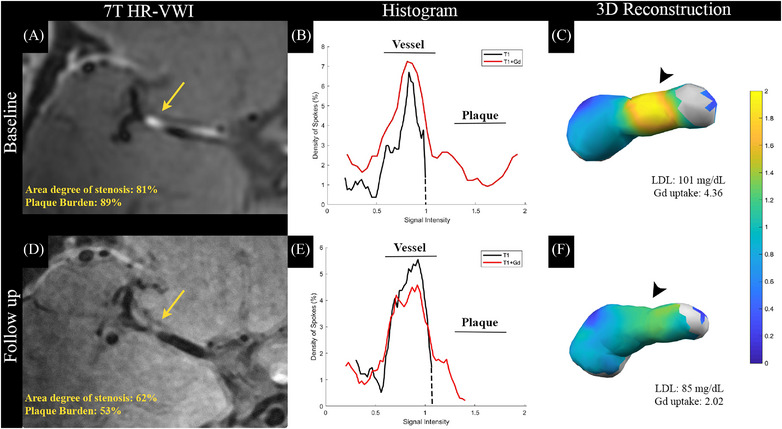
Methods: Patients with a history of stroke or transient ischemic attack attributable to intracranial atherosclerotic disease underwent 7-T high-resolution vessel wall imaging. T1 and T1+gadolinium sequences were obtained at baseline. Follow-up images were acquired at a minimum of 6 months after the initial scan. Low-density lipoprotein levels were also recorded at baseline and at follow-up, after maximal medical therapy was started. Plaque burden, degree of stenosis, and area degree of stenosis were calculated at baseline and follow-up. Gadolinium enhancement was quantified using a 3-dimensional pipeline for plaque analysis.
Results: Five patients were included. The mean age was 56 years, and the average time to follow-up imaging was 17.7 months. Low-density lipoprotein decreased from a mean of 122 to 111 mg/dL at follow-up. Plaque burden decreased from μ=76% to 60%, area degree of stenosis decreased from μ=61% to 56%, and gadolinium uptake decreased from a mean of μ=4.11 to 3.76. Furthermore, a lower low-density lipoprotein at follow-up was correlated with decreased plaque burden (r=0.86), lower area degree of stenosis (r=0.8), and less gadolinium uptake (r=0.82).
Conclusions: Plaque morphologic pattern and gadolinium uptake changed at follow-up with high-intensity statin therapy. High-resolution vessel wall imaging shows promise in assessing plaque response to medical therapy.



 京公网安备 11010802042870号
京ICP备2023020795号-1
京公网安备 11010802042870号
京ICP备2023020795号-1

 分享
分享

 求助内容:
求助内容: 应助结果提醒方式:
 扫码关注我们
