Dan Yu, Hong-Li Suo, Jing Liu, Lin Ma, Jin Cui, Yao-Tang Ji, Shaheen Kausar, Min Liu, Yi Wang
{"title":"Intermediate annealing and strong cube texture of Ni8W/Ni12W/Ni8W composite substrates","authors":"Dan Yu, Hong-Li Suo, Jing Liu, Lin Ma, Jin Cui, Yao-Tang Ji, Shaheen Kausar, Min Liu, Yi Wang","doi":"10.1007/s10853-018-2691-8","DOIUrl":null,"url":null,"abstract":"<p>The deformation and recrystallization of Ni8W/Ni12W/Ni8W composite substrates by means of cold rolling and intermediate annealing have been studied. The work reveals the increase in the brass orientation fractions, accompanied by the decrease in the copper and cube orientation fractions during the deformation process. A typical brass-type rolling texture is obtained finally. To get the deeper understanding of the intermediate heat treatment effect at different levels of deformation and recrystallization, four intermediate anneals (i.e., 550?°C/120?min) were introduced at the rolling thickness of 4, 2, 1, and 0.5?mm, and 2, 1, 0.5, and 0.25?mm, respectively. The result shows that the transformation from the copper type to the brass type of the former deformation set occurs at 0.5?mm, while for the latter one, it is detected at 0.25?mm. Furthermore, the EBSD maps of the cross sections of the recovery samples reveal that the decrease of the shear structure and the increase of the copper, S and cube orientation are the main sources for promotion of the homogeneous deformation. This can enhance the formation of the copper-type deformation texture and hence finally promotes the formation of strong cube texture.</p>","PeriodicalId":645,"journal":{"name":"Journal of Materials Science","volume":"53 21","pages":"15298 - 15307"},"PeriodicalIF":3.9000,"publicationDate":"2018-07-16","publicationTypes":"Journal Article","fieldsOfStudy":null,"isOpenAccess":false,"openAccessPdf":"https://sci-hub-pdf.com/10.1007/s10853-018-2691-8","citationCount":"6","resultStr":null,"platform":"Semanticscholar","paperid":null,"PeriodicalName":"Journal of Materials Science","FirstCategoryId":"88","ListUrlMain":"https://link.springer.com/article/10.1007/s10853-018-2691-8","RegionNum":3,"RegionCategory":"材料科学","ArticlePicture":[],"TitleCN":null,"AbstractTextCN":null,"PMCID":null,"EPubDate":"","PubModel":"","JCR":"Q2","JCRName":"MATERIALS SCIENCE, MULTIDISCIPLINARY","Score":null,"Total":0}
引用次数: 6
Abstract
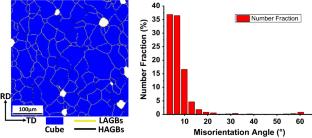
The deformation and recrystallization of Ni8W/Ni12W/Ni8W composite substrates by means of cold rolling and intermediate annealing have been studied. The work reveals the increase in the brass orientation fractions, accompanied by the decrease in the copper and cube orientation fractions during the deformation process. A typical brass-type rolling texture is obtained finally. To get the deeper understanding of the intermediate heat treatment effect at different levels of deformation and recrystallization, four intermediate anneals (i.e., 550?°C/120?min) were introduced at the rolling thickness of 4, 2, 1, and 0.5?mm, and 2, 1, 0.5, and 0.25?mm, respectively. The result shows that the transformation from the copper type to the brass type of the former deformation set occurs at 0.5?mm, while for the latter one, it is detected at 0.25?mm. Furthermore, the EBSD maps of the cross sections of the recovery samples reveal that the decrease of the shear structure and the increase of the copper, S and cube orientation are the main sources for promotion of the homogeneous deformation. This can enhance the formation of the copper-type deformation texture and hence finally promotes the formation of strong cube texture.
期刊介绍:
The Journal of Materials Science publishes reviews, full-length papers, and short Communications recording original research results on, or techniques for studying the relationship between structure, properties, and uses of materials. The subjects are seen from international and interdisciplinary perspectives covering areas including metals, ceramics, glasses, polymers, electrical materials, composite materials, fibers, nanostructured materials, nanocomposites, and biological and biomedical materials. The Journal of Materials Science is now firmly established as the leading source of primary communication for scientists investigating the structure and properties of all engineering materials.



 京公网安备 11010802042870号
京ICP备2023020795号-1
京公网安备 11010802042870号
京ICP备2023020795号-1

 分享
分享
 求助内容:
求助内容: 应助结果提醒方式:
 扫码关注我们
