Jean-Marc Moulis , Zorica Bulat , Aleksandra Buha Djordjevic
{"title":"Threshold in the toxicology of metals: Challenges and pitfalls of the concept","authors":"Jean-Marc Moulis , Zorica Bulat , Aleksandra Buha Djordjevic","doi":"10.1016/j.cotox.2019.10.004","DOIUrl":null,"url":null,"abstract":"<div><p>Metals qualitatively dominate the chemical elements found on Earth, but life has found a use for only a minority of them. Most metals are mobilized as cations, and thereby interact and are processed by living species. Animals are exposed to environmental metals at chronic low concentrations through food, air particles, and other ways, under conditions that are too rarely reproduced in laboratory settings. Actual metal detoxification systems in animals are not many and of limited efficiency which casts doubt on the existence of any safe concentration — a threshold for nonessential metals. Hence the mechanisms of action of toxic metals at very low doses still have to be adequately addressed to provide means for knowledge-based risk assessment that is increasingly requested by diverse communities.</p></div>","PeriodicalId":37736,"journal":{"name":"Current Opinion in Toxicology","volume":"19 ","pages":"Pages 28-33"},"PeriodicalIF":3.6000,"publicationDate":"2020-02-01","publicationTypes":"Journal Article","fieldsOfStudy":null,"isOpenAccess":false,"openAccessPdf":"https://sci-hub-pdf.com/10.1016/j.cotox.2019.10.004","citationCount":"3","resultStr":null,"platform":"Semanticscholar","paperid":null,"PeriodicalName":"Current Opinion in Toxicology","FirstCategoryId":"1085","ListUrlMain":"https://www.sciencedirect.com/science/article/pii/S2468202019300701","RegionNum":0,"RegionCategory":null,"ArticlePicture":[],"TitleCN":null,"AbstractTextCN":null,"PMCID":null,"EPubDate":"","PubModel":"","JCR":"Q1","JCRName":"TOXICOLOGY","Score":null,"Total":0}
引用次数: 3
Abstract
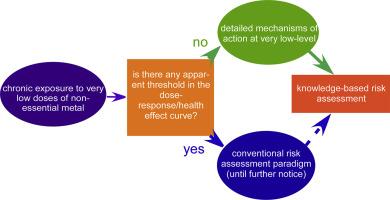
Metals qualitatively dominate the chemical elements found on Earth, but life has found a use for only a minority of them. Most metals are mobilized as cations, and thereby interact and are processed by living species. Animals are exposed to environmental metals at chronic low concentrations through food, air particles, and other ways, under conditions that are too rarely reproduced in laboratory settings. Actual metal detoxification systems in animals are not many and of limited efficiency which casts doubt on the existence of any safe concentration — a threshold for nonessential metals. Hence the mechanisms of action of toxic metals at very low doses still have to be adequately addressed to provide means for knowledge-based risk assessment that is increasingly requested by diverse communities.
期刊介绍:
The aims and scope of Current Opinion in Toxicology is to systematically provide the reader with timely and provocative views and opinions of the highest qualified and recognized experts on current advances in selected topics within the field of toxicology. The goal is that Current Opinion in Toxicology will be an invaluable source of information and perspective for researchers, teachers, managers and administrators, policy makers and students. Division of the subject into sections: For this purpose, the scope of Toxicology is divided into six selected high impact themed sections, each of which is reviewed once a year: Mechanistic Toxicology, Metabolic Toxicology, Risk assessment in Toxicology, Genomic Toxicology, Systems Toxicology, Translational Toxicology.



 京公网安备 11010802042870号
京ICP备2023020795号-1
京公网安备 11010802042870号
京ICP备2023020795号-1

 分享
分享
 求助内容:
求助内容: 应助结果提醒方式:
 扫码关注我们
