Kaitlyn Harper, Emily H Belarmino, Francesco Acciai, Farryl Bertmann, Punam Ohri-Vachaspati
{"title":"Patterns of Food Assistance Program Participation, Food Insecurity, and Pantry Use among U.S. Households with Children during the COVID-19 Pandemic.","authors":"Kaitlyn Harper, Emily H Belarmino, Francesco Acciai, Farryl Bertmann, Punam Ohri-Vachaspati","doi":"10.3390/nu14050988","DOIUrl":null,"url":null,"abstract":"<p><p>This study aims to describe differences in participation in the Supplemental Nutrition Assistance Program (SNAP), Special Supplemental Nutrition Program for Women and Children (WIC), and school meal programs by household characteristics prior to and during the pandemic, and to examine the association of program participation with food security status and food pantry use. We analyze secondary data (<i>n</i> = 470) from an online survey collected in July/August 2020 using weighted multiple logistic regression models. Participation in SNAP declined among households with children in the first four months of the pandemic, while participation in WIC increased slightly, and participation in school meals remained unchanged. There were significant differences in SNAP, WIC, and school meal programs use by race/ethnicity, income, and urbanicity before and during the pandemic. Food insecurity prevalence was higher among SNAP participants at both periods but the gap between participants and non-participants was smaller during the pandemic. Pantry use and food insecurity rates were consistently higher among federal nutrition assistance program participants, possibly suggesting unmet food needs. These results highlight the need for increased program benefits and improved access to food, particularly during periods of hardship.</p>","PeriodicalId":4,"journal":{"name":"ACS Applied Energy Materials","volume":" ","pages":""},"PeriodicalIF":5.5000,"publicationDate":"2022-02-26","publicationTypes":"Journal Article","fieldsOfStudy":null,"isOpenAccess":false,"openAccessPdf":"https://www.ncbi.nlm.nih.gov/pmc/articles/PMC8912740/pdf/","citationCount":"0","resultStr":null,"platform":"Semanticscholar","paperid":null,"PeriodicalName":"ACS Applied Energy Materials","FirstCategoryId":"3","ListUrlMain":"https://doi.org/10.3390/nu14050988","RegionNum":3,"RegionCategory":"材料科学","ArticlePicture":[],"TitleCN":null,"AbstractTextCN":null,"PMCID":null,"EPubDate":"","PubModel":"","JCR":"Q2","JCRName":"CHEMISTRY, PHYSICAL","Score":null,"Total":0}
引用次数: 0
Abstract
This study aims to describe differences in participation in the Supplemental Nutrition Assistance Program (SNAP), Special Supplemental Nutrition Program for Women and Children (WIC), and school meal programs by household characteristics prior to and during the pandemic, and to examine the association of program participation with food security status and food pantry use. We analyze secondary data (n = 470) from an online survey collected in July/August 2020 using weighted multiple logistic regression models. Participation in SNAP declined among households with children in the first four months of the pandemic, while participation in WIC increased slightly, and participation in school meals remained unchanged. There were significant differences in SNAP, WIC, and school meal programs use by race/ethnicity, income, and urbanicity before and during the pandemic. Food insecurity prevalence was higher among SNAP participants at both periods but the gap between participants and non-participants was smaller during the pandemic. Pantry use and food insecurity rates were consistently higher among federal nutrition assistance program participants, possibly suggesting unmet food needs. These results highlight the need for increased program benefits and improved access to food, particularly during periods of hardship.
期刊介绍:
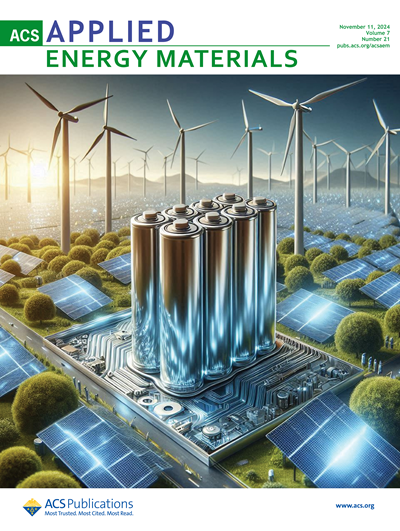
ACS Applied Energy Materials is an interdisciplinary journal publishing original research covering all aspects of materials, engineering, chemistry, physics and biology relevant to energy conversion and storage. The journal is devoted to reports of new and original experimental and theoretical research of an applied nature that integrate knowledge in the areas of materials, engineering, physics, bioscience, and chemistry into important energy applications.




 京公网安备 11010802042870号
京ICP备2023020795号-1
京公网安备 11010802042870号
京ICP备2023020795号-1

 分享
分享
 求助内容:
求助内容: 应助结果提醒方式:
 扫码关注我们
