Christopher J Daughney, Uwe Morgenstern, Magali Moreau, Richard W McDowell
{"title":"Reference conditions and threshold values for nitrate-nitrogen in New Zealand groundwaters.","authors":"Christopher J Daughney, Uwe Morgenstern, Magali Moreau, Richard W McDowell","doi":"10.1080/03036758.2023.2221034","DOIUrl":null,"url":null,"abstract":"<p><p>Management of groundwater quality is assisted by an understanding of reference conditions, which describe the concentration ranges expected for key substances in the absence of human impact. This study evaluates reference conditions for NO<sub>3</sub>-N in New Zealand groundwater based on three complementary methods: hierarchical cluster analysis, relationships to groundwater age, and regression against a measure of land-use impact. The three methods result in very similar national-scale estimates of reference conditions for NO<sub>3</sub>-N concentration in oxic, minimally impacted groundwater, with the 80th, 90th and 95th percentiles found to be 1.65 ± 0.12, 1.97 ± 0.14 and 2.32 ± 0.14 mg/l, respectively (weighted average ± 95% confidence level), in good general agreement with previous studies from New Zealand and overseas. Anoxic groundwaters were treated separately for definition of reference conditions, with the 80th and 90th percentiles of NO<sub>3</sub>-N found to be 0.04 ± 0.01 and 0.16 ± 0.01, respectively (the 95th percentile could not be estimated reliably). For both oxic and anoxic groundwater, where a site-specific investigation has not been conducted to estimate reference conditions at a local scale, we suggest that the 80th percentile is an appropriate national-scale default threshold, to match the thresholds used for surface waters under the Australian and New Zealand Guidelines for Fresh and Marine Water Quality.</p>","PeriodicalId":49984,"journal":{"name":"Journal of the Royal Society of New Zealand","volume":" ","pages":"1-31"},"PeriodicalIF":2.1000,"publicationDate":"2023-06-12","publicationTypes":"Journal Article","fieldsOfStudy":null,"isOpenAccess":false,"openAccessPdf":"https://www.ncbi.nlm.nih.gov/pmc/articles/PMC11619017/pdf/","citationCount":"0","resultStr":null,"platform":"Semanticscholar","paperid":null,"PeriodicalName":"Journal of the Royal Society of New Zealand","FirstCategoryId":"103","ListUrlMain":"https://doi.org/10.1080/03036758.2023.2221034","RegionNum":4,"RegionCategory":"综合性期刊","ArticlePicture":[],"TitleCN":null,"AbstractTextCN":null,"PMCID":null,"EPubDate":"2025/1/1 0:00:00","PubModel":"eCollection","JCR":"Q2","JCRName":"MULTIDISCIPLINARY SCIENCES","Score":null,"Total":0}
引用次数: 0
Abstract
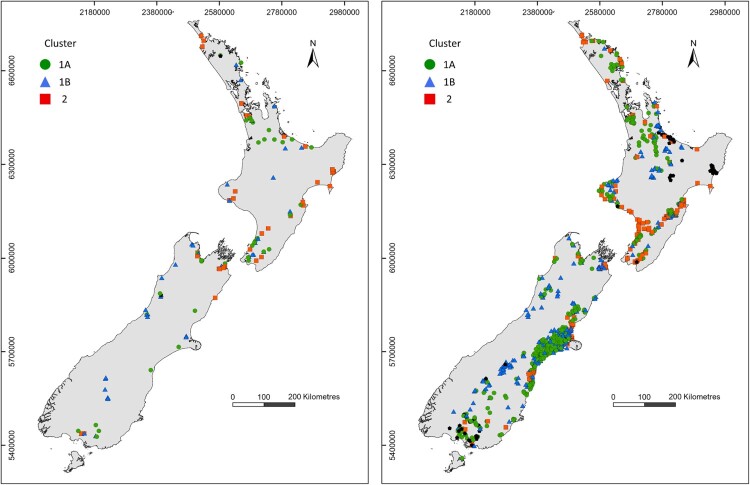
Management of groundwater quality is assisted by an understanding of reference conditions, which describe the concentration ranges expected for key substances in the absence of human impact. This study evaluates reference conditions for NO3-N in New Zealand groundwater based on three complementary methods: hierarchical cluster analysis, relationships to groundwater age, and regression against a measure of land-use impact. The three methods result in very similar national-scale estimates of reference conditions for NO3-N concentration in oxic, minimally impacted groundwater, with the 80th, 90th and 95th percentiles found to be 1.65 ± 0.12, 1.97 ± 0.14 and 2.32 ± 0.14 mg/l, respectively (weighted average ± 95% confidence level), in good general agreement with previous studies from New Zealand and overseas. Anoxic groundwaters were treated separately for definition of reference conditions, with the 80th and 90th percentiles of NO3-N found to be 0.04 ± 0.01 and 0.16 ± 0.01, respectively (the 95th percentile could not be estimated reliably). For both oxic and anoxic groundwater, where a site-specific investigation has not been conducted to estimate reference conditions at a local scale, we suggest that the 80th percentile is an appropriate national-scale default threshold, to match the thresholds used for surface waters under the Australian and New Zealand Guidelines for Fresh and Marine Water Quality.
期刊介绍:
Aims: The Journal of the Royal Society of New Zealand reflects the role of Royal Society Te Aparangi in fostering research and debate across natural sciences, social sciences, and the humanities in New Zealand/Aotearoa and the surrounding Pacific. Research published in Journal of the Royal Society of New Zealand advances scientific knowledge, informs government policy, public awareness and broader society, and is read by researchers worldwide.





 京公网安备 11010802042870号
京ICP备2023020795号-1
京公网安备 11010802042870号
京ICP备2023020795号-1

 分享
分享
 求助内容:
求助内容: 应助结果提醒方式:
 扫码关注我们
