Eva Mueller , Afshin Abrishamkar , Ron Galaev, Kwan Kiu Lau, Laura Neely, Todd Hoare
{"title":"Coaxial extrusion bioprinting of hydrazone crosslinked POEGMA hydrogels: Optimizing needle geometry to achieve improved print quality","authors":"Eva Mueller , Afshin Abrishamkar , Ron Galaev, Kwan Kiu Lau, Laura Neely, Todd Hoare","doi":"10.1016/j.bprint.2023.e00307","DOIUrl":null,"url":null,"abstract":"<div><p><span><span>Facilitating effective mixing of two or more functional polymers remains a challenge when </span>translating </span><em>in situ-</em><span><span>crosslinking click chemistry hydrogels to extrusion bioprinting applications. In this work, the conventional flush coaxial needle was modified to introduce a mixing region to promote the mixing of low-viscosity hydrazide and aldehyde-functionalized poly (oligoethylene glycol methacrylate) (POEGMA) polymers that form dynamic </span>hydrazone<span> bonds upon crosslinking. The inclusion of the mixing region significantly reduced the spreading of the printed fibers and improved the homogeneity of both the printed hydrogel and the encapsulated cells. Computational modeling based on non-Newtonian fluid behavior in the mixing zone confirmed that increasing the length of the mixing zone improved the mixing efficiency, a finding supported by experimental printing results. As such, particularly with less viscous bioinks like the oligomeric hydrazide/aldehyde-functionalized POEGMA polymers used herein, the inclusion of this mixing region provides an effective means of printing functional precursor polymers that can chemically crosslink upon mixing.</span></span></p></div>","PeriodicalId":72406,"journal":{"name":"","volume":"35 ","pages":"Article e00307"},"PeriodicalIF":0.0,"publicationDate":"2023-08-26","publicationTypes":"Journal Article","fieldsOfStudy":null,"isOpenAccess":false,"openAccessPdf":"","citationCount":"0","resultStr":null,"platform":"Semanticscholar","paperid":null,"PeriodicalName":"","FirstCategoryId":"1085","ListUrlMain":"https://www.sciencedirect.com/science/article/pii/S2405886623000507","RegionNum":0,"RegionCategory":null,"ArticlePicture":[],"TitleCN":null,"AbstractTextCN":null,"PMCID":null,"EPubDate":"","PubModel":"","JCR":"","JCRName":"","Score":null,"Total":0}
引用次数: 0
Abstract
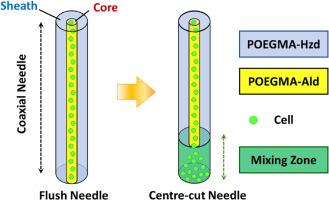
Facilitating effective mixing of two or more functional polymers remains a challenge when translating in situ-crosslinking click chemistry hydrogels to extrusion bioprinting applications. In this work, the conventional flush coaxial needle was modified to introduce a mixing region to promote the mixing of low-viscosity hydrazide and aldehyde-functionalized poly (oligoethylene glycol methacrylate) (POEGMA) polymers that form dynamic hydrazone bonds upon crosslinking. The inclusion of the mixing region significantly reduced the spreading of the printed fibers and improved the homogeneity of both the printed hydrogel and the encapsulated cells. Computational modeling based on non-Newtonian fluid behavior in the mixing zone confirmed that increasing the length of the mixing zone improved the mixing efficiency, a finding supported by experimental printing results. As such, particularly with less viscous bioinks like the oligomeric hydrazide/aldehyde-functionalized POEGMA polymers used herein, the inclusion of this mixing region provides an effective means of printing functional precursor polymers that can chemically crosslink upon mixing.



 京公网安备 11010802042870号
京ICP备2023020795号-1
京公网安备 11010802042870号
京ICP备2023020795号-1

 分享
分享
 求助内容:
求助内容: 应助结果提醒方式:
 扫码关注我们
