A tractable analytical model for interference characterization and minimum distance enforcement to reuse resources in three-dimensional in-building dense small cell networks
{"title":"A tractable analytical model for interference characterization and minimum distance enforcement to reuse resources in three-dimensional in-building dense small cell networks","authors":"Rony Kumer Saha, Chaodit Aswakul","doi":"10.1002/dac.3240","DOIUrl":null,"url":null,"abstract":"<div>\n \n <p>In this paper, we address mainly 2 important issues, namely, characterizing co-channel interference and enforcing a minimum distance between femtocell base stations (FCBSs) for reusing resources in FCBSs deployed in a 3-dimentional multi-floor building. Each floor is modeled as a group of square-grid apartments, with one FCBS per apartment. We propose a simple yet reasonable analytical model by using planar-Wyner model for intra-floor interference and linear-Wyner model for inter-floor interference modeling in a 3-dimensional multi-floor building to derive a minimum distance between co-channel FCBSs for optimization constraints, namely, link level interference, spectral efficiency, and capacity. As opposed to orthogonal resource reuse and allocation (ORRA) where resources are reused once, using the proposed model, we develop 2 strategies for reusing resources more than once, that is, non-ORRA, within a multi-floor building. An algorithm of the proposed model is developed by including an application of the model to an ultra-dense deployment of multi-floor buildings. With an extensive numerical analysis and system level simulation, we demonstrate the capacity outperformance of non-ORRA over ORRA by manifold. Further, with a fairly accurate yet realistic estimation, we show that the expected spectral efficiency of fifth-generation networks can be achieved by applying the proposed model to an ultra-dense deployment of FCBSs.</p>\n </div>","PeriodicalId":13946,"journal":{"name":"International Journal of Communication Systems","volume":"30 11","pages":""},"PeriodicalIF":1.8000,"publicationDate":"2017-01-10","publicationTypes":"Journal Article","fieldsOfStudy":null,"isOpenAccess":false,"openAccessPdf":"https://sci-hub-pdf.com/10.1002/dac.3240","citationCount":"18","resultStr":null,"platform":"Semanticscholar","paperid":null,"PeriodicalName":"International Journal of Communication Systems","FirstCategoryId":"94","ListUrlMain":"https://onlinelibrary.wiley.com/doi/10.1002/dac.3240","RegionNum":4,"RegionCategory":"计算机科学","ArticlePicture":[],"TitleCN":null,"AbstractTextCN":null,"PMCID":null,"EPubDate":"","PubModel":"","JCR":"Q3","JCRName":"ENGINEERING, ELECTRICAL & ELECTRONIC","Score":null,"Total":0}
引用次数: 18
Abstract
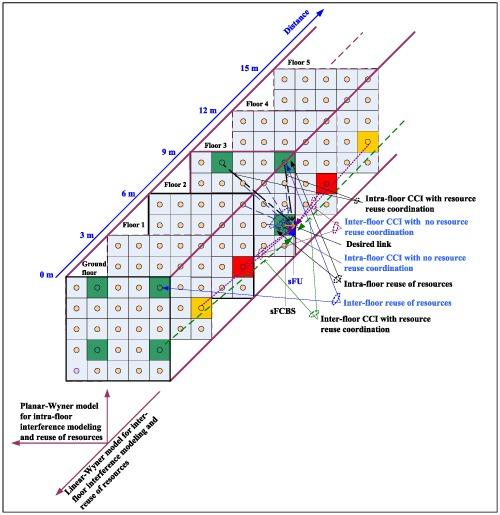
In this paper, we address mainly 2 important issues, namely, characterizing co-channel interference and enforcing a minimum distance between femtocell base stations (FCBSs) for reusing resources in FCBSs deployed in a 3-dimentional multi-floor building. Each floor is modeled as a group of square-grid apartments, with one FCBS per apartment. We propose a simple yet reasonable analytical model by using planar-Wyner model for intra-floor interference and linear-Wyner model for inter-floor interference modeling in a 3-dimensional multi-floor building to derive a minimum distance between co-channel FCBSs for optimization constraints, namely, link level interference, spectral efficiency, and capacity. As opposed to orthogonal resource reuse and allocation (ORRA) where resources are reused once, using the proposed model, we develop 2 strategies for reusing resources more than once, that is, non-ORRA, within a multi-floor building. An algorithm of the proposed model is developed by including an application of the model to an ultra-dense deployment of multi-floor buildings. With an extensive numerical analysis and system level simulation, we demonstrate the capacity outperformance of non-ORRA over ORRA by manifold. Further, with a fairly accurate yet realistic estimation, we show that the expected spectral efficiency of fifth-generation networks can be achieved by applying the proposed model to an ultra-dense deployment of FCBSs.
期刊介绍:
The International Journal of Communication Systems provides a forum for R&D, open to researchers from all types of institutions and organisations worldwide, aimed at the increasingly important area of communication technology. The Journal''s emphasis is particularly on the issues impacting behaviour at the system, service and management levels. Published twelve times a year, it provides coverage of advances that have a significant potential to impact the immense technical and commercial opportunities in the communications sector. The International Journal of Communication Systems strives to select a balance of contributions that promotes technical innovation allied to practical relevance across the range of system types and issues.
The Journal addresses both public communication systems (Telecommunication, mobile, Internet, and Cable TV) and private systems (Intranets, enterprise networks, LANs, MANs, WANs). The following key areas and issues are regularly covered:
-Transmission/Switching/Distribution technologies (ATM, SDH, TCP/IP, routers, DSL, cable modems, VoD, VoIP, WDM, etc.)
-System control, network/service management
-Network and Internet protocols and standards
-Client-server, distributed and Web-based communication systems
-Broadband and multimedia systems and applications, with a focus on increased service variety and interactivity
-Trials of advanced systems and services; their implementation and evaluation
-Novel concepts and improvements in technique; their theoretical basis and performance analysis using measurement/testing, modelling and simulation
-Performance evaluation issues and methods.



 京公网安备 11010802042870号
京ICP备2023020795号-1
京公网安备 11010802042870号
京ICP备2023020795号-1

 分享
分享
 求助内容:
求助内容: 应助结果提醒方式:
 扫码关注我们
