B E Yunker, A Holmgren, K F Stupic, J L Wagner, S Huddle, R Shandas, R F Weir, K E Keenan, E Garboczi, S E Russek
{"title":"Characterization of 3-Dimensional Printing and Casting Materials for use in Computed Tomography and X-ray Imaging Phantoms.","authors":"B E Yunker, A Holmgren, K F Stupic, J L Wagner, S Huddle, R Shandas, R F Weir, K E Keenan, E Garboczi, S E Russek","doi":"10.6028/jres.125.029","DOIUrl":null,"url":null,"abstract":"<p><p>Imaging phantoms are used to calibrate and validate the performance of medical computed tomography (CT) systems. Many new materials developed for three-dimensional (3D) printing processes may be useful in the direct printing or casting of biomimetic and geometrically accurate CT and X-ray phantoms. The X-ray linear attenuation coefficients of polymer samples were measured to discover materials for use as tissue mimics in phantoms. This study included a cohort of polymer compounds that were tested in cured form. The cohort consisted of 101 standardized polymer samples fabricated from: two-part silicones and polyurethanes used in commercial casting processes; one-part optically cured polyurethanes used in 3D printing; and fused deposition thermoplastics used in 3D printing. The testing was performed with a commercial micro-CT imaging system from 40 kVp to 140 kVp. The X-ray linear coefficients of the samples and human tissues were plotted with error bars to allow the reader to identify suitable mimics. The X-ray linear attenuation coefficients of the tested material samples spanned a wide range of values, with a small number of them overlapping established human tissue mimic values. Twenty 3D printer materials and one castable polyurethane tracked nylon and polymethyl methacrylate (PMMA) as established X-ray mimics for fat. Five 3D printer materials tracked water as an established X-ray mimic for muscle.</p>","PeriodicalId":1,"journal":{"name":"Accounts of Chemical Research","volume":" ","pages":"125029"},"PeriodicalIF":17.7000,"publicationDate":"2020-09-15","publicationTypes":"Journal Article","fieldsOfStudy":null,"isOpenAccess":false,"openAccessPdf":"https://www.ncbi.nlm.nih.gov/pmc/articles/PMC11441636/pdf/","citationCount":"0","resultStr":null,"platform":"Semanticscholar","paperid":null,"PeriodicalName":"Accounts of Chemical Research","FirstCategoryId":"5","ListUrlMain":"https://doi.org/10.6028/jres.125.029","RegionNum":1,"RegionCategory":"化学","ArticlePicture":[],"TitleCN":null,"AbstractTextCN":null,"PMCID":null,"EPubDate":"2020/1/1 0:00:00","PubModel":"eCollection","JCR":"Q1","JCRName":"CHEMISTRY, MULTIDISCIPLINARY","Score":null,"Total":0}
引用次数: 0
Abstract
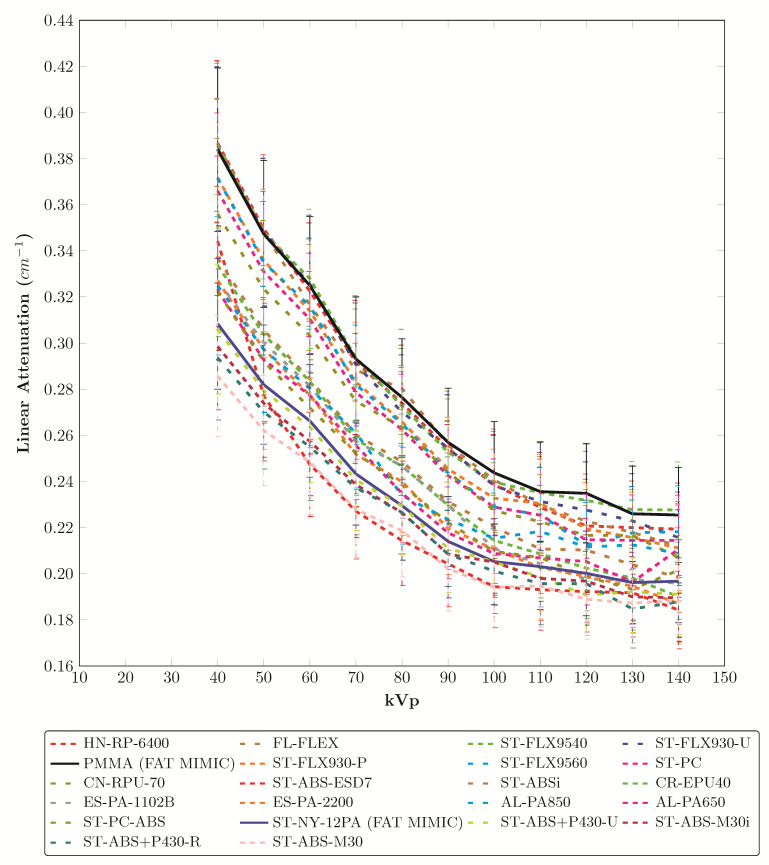
Imaging phantoms are used to calibrate and validate the performance of medical computed tomography (CT) systems. Many new materials developed for three-dimensional (3D) printing processes may be useful in the direct printing or casting of biomimetic and geometrically accurate CT and X-ray phantoms. The X-ray linear attenuation coefficients of polymer samples were measured to discover materials for use as tissue mimics in phantoms. This study included a cohort of polymer compounds that were tested in cured form. The cohort consisted of 101 standardized polymer samples fabricated from: two-part silicones and polyurethanes used in commercial casting processes; one-part optically cured polyurethanes used in 3D printing; and fused deposition thermoplastics used in 3D printing. The testing was performed with a commercial micro-CT imaging system from 40 kVp to 140 kVp. The X-ray linear coefficients of the samples and human tissues were plotted with error bars to allow the reader to identify suitable mimics. The X-ray linear attenuation coefficients of the tested material samples spanned a wide range of values, with a small number of them overlapping established human tissue mimic values. Twenty 3D printer materials and one castable polyurethane tracked nylon and polymethyl methacrylate (PMMA) as established X-ray mimics for fat. Five 3D printer materials tracked water as an established X-ray mimic for muscle.
期刊介绍:
Accounts of Chemical Research presents short, concise and critical articles offering easy-to-read overviews of basic research and applications in all areas of chemistry and biochemistry. These short reviews focus on research from the author’s own laboratory and are designed to teach the reader about a research project. In addition, Accounts of Chemical Research publishes commentaries that give an informed opinion on a current research problem. Special Issues online are devoted to a single topic of unusual activity and significance.
Accounts of Chemical Research replaces the traditional article abstract with an article "Conspectus." These entries synopsize the research affording the reader a closer look at the content and significance of an article. Through this provision of a more detailed description of the article contents, the Conspectus enhances the article's discoverability by search engines and the exposure for the research.





 京公网安备 11010802042870号
京ICP备2023020795号-1
京公网安备 11010802042870号
京ICP备2023020795号-1

 分享
分享
 求助内容:
求助内容: 应助结果提醒方式:
 扫码关注我们
