Alan J. Franzluebbers, Katiuça Sueko Tanaka, Letusa Momesso, Juliano Carlos Calonego, Carlos Alexandre Costa Crusciol
{"title":"Mean-weight diameter of aggregation as affected by initial screen size of two fine-textured soils","authors":"Alan J. Franzluebbers, Katiuça Sueko Tanaka, Letusa Momesso, Juliano Carlos Calonego, Carlos Alexandre Costa Crusciol","doi":"10.1002/saj2.20517","DOIUrl":null,"url":null,"abstract":"<p>Soil aggregation is considered a key indicator of soil health to protect soil against erosion, enhance organic C storage, and offer habitat for soil organisms. Various methods to assess aggregation may change interpretations of management, and therefore should be cross-calibrated. We assessed the impact of initial sieve opening size (8 or 4.75 mm) prior to determination of dry-stable and water-stable mean-weight diameter (MWD) from two fine-textured soils—a Rhodic Hapludox from São Paulo, Brazil and a Rhodic Kanhapludult from North Carolina, United States. Both soils were subjected to management expected to alter surface soil conditions. As expected, initial sieving through 8 mm led to greater dry-stable MWD (3.37 ± 0.60 mm) than initial sieving through 4.75 mm (1.94 ± 0.28 mm). However, soil stability index (water-stable MWD/dry-stable MWD) was not affected by initial sieve size opening (0.56 ± 0.13 mm mm<sup>−1</sup> under both initial sieve openings). Management interpretations were consistent with both approaches as well, and in particular to detect the strong depth effect on water-stable MWD (i.e., declining with depth). Water-stable macroaggregates had 32% ± 25% greater C concentration than microaggregates; similarly under both initial sieving conditions. Soil stability index when initially sieved through 4.75 mm was highly associated with aggregate stability of 1–2-mm sized dry aggregates, which is a more common procedure. We conclude that passing soil through a screen with 4.75-mm openings to conduct a diversity of soil analyses can be appropriate for obtaining reasonable estimates of and interpretations about surface soil aggregation.</p>","PeriodicalId":101043,"journal":{"name":"Proceedings - Soil Science Society of America","volume":"87 3","pages":"644-655"},"PeriodicalIF":0.0000,"publicationDate":"2023-01-25","publicationTypes":"Journal Article","fieldsOfStudy":null,"isOpenAccess":false,"openAccessPdf":"https://onlinelibrary.wiley.com/doi/epdf/10.1002/saj2.20517","citationCount":"0","resultStr":null,"platform":"Semanticscholar","paperid":null,"PeriodicalName":"Proceedings - Soil Science Society of America","FirstCategoryId":"1085","ListUrlMain":"https://onlinelibrary.wiley.com/doi/10.1002/saj2.20517","RegionNum":0,"RegionCategory":null,"ArticlePicture":[],"TitleCN":null,"AbstractTextCN":null,"PMCID":null,"EPubDate":"","PubModel":"","JCR":"","JCRName":"","Score":null,"Total":0}
引用次数: 0
Abstract
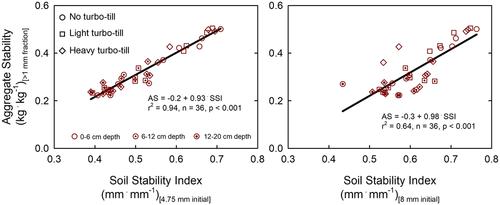
Soil aggregation is considered a key indicator of soil health to protect soil against erosion, enhance organic C storage, and offer habitat for soil organisms. Various methods to assess aggregation may change interpretations of management, and therefore should be cross-calibrated. We assessed the impact of initial sieve opening size (8 or 4.75 mm) prior to determination of dry-stable and water-stable mean-weight diameter (MWD) from two fine-textured soils—a Rhodic Hapludox from São Paulo, Brazil and a Rhodic Kanhapludult from North Carolina, United States. Both soils were subjected to management expected to alter surface soil conditions. As expected, initial sieving through 8 mm led to greater dry-stable MWD (3.37 ± 0.60 mm) than initial sieving through 4.75 mm (1.94 ± 0.28 mm). However, soil stability index (water-stable MWD/dry-stable MWD) was not affected by initial sieve size opening (0.56 ± 0.13 mm mm−1 under both initial sieve openings). Management interpretations were consistent with both approaches as well, and in particular to detect the strong depth effect on water-stable MWD (i.e., declining with depth). Water-stable macroaggregates had 32% ± 25% greater C concentration than microaggregates; similarly under both initial sieving conditions. Soil stability index when initially sieved through 4.75 mm was highly associated with aggregate stability of 1–2-mm sized dry aggregates, which is a more common procedure. We conclude that passing soil through a screen with 4.75-mm openings to conduct a diversity of soil analyses can be appropriate for obtaining reasonable estimates of and interpretations about surface soil aggregation.



 京公网安备 11010802042870号
京ICP备2023020795号-1
京公网安备 11010802042870号
京ICP备2023020795号-1

 分享
分享

 求助内容:
求助内容: 应助结果提醒方式:
 扫码关注我们
