Paul Doniol-Valcroze, Sylvain Ursenbacher, Konrad Mebert, Samuele Ghielmi, Lorenzo Laddaga, Patricia Sourrouille, Mert Kariş, Pierre-André Crochet
{"title":"Conflicting relationships of Vipera walser inferred from nuclear genes sequences and mitochondrial DNA","authors":"Paul Doniol-Valcroze, Sylvain Ursenbacher, Konrad Mebert, Samuele Ghielmi, Lorenzo Laddaga, Patricia Sourrouille, Mert Kariş, Pierre-André Crochet","doi":"10.1111/jzs.12543","DOIUrl":null,"url":null,"abstract":"<p>The description of <i>Vipera walser</i> from the Northern Italian Alps as a new species (Ghielmi et al., 2016, <i>Journal of Zoological Systematics and Evolutionary Research</i>, 54, 161) was one of the most unexpected surprises of European herpetology in the 21st century. In mitochondrial (mt) DNA, it is closely related to a group of vipers only present in the Caucasus region and Northeastern Anatolia. However, its morphology is similar to the <i>V</i>. <i>berus</i> populations that inhabit nearby mountains in the Swiss-Italian Alps, which raises questions on its relationships and status. We thus sequenced five nuclear (nu) genes to determine the position of <i>V</i>. <i>walser</i> relative to <i>V</i>. <i>berus</i> and to the Caucasian/Northeastern Anatolian vipers in nuDNA. We also reanalyzed five previously sequenced mtDNA fragments. NuDNA markers recovered <i>V</i>. <i>walser</i> as closely related to Italian populations of <i>V</i>. <i>berus</i> and not to the Caucasian/Anatolian species, thus contradicting the mtDNA phylogeny. We checked that each of the five mtDNA fragments independently amplified by Ghielmi et al. (2016, <i>Journal of Zoological Systematics and Evolutionary Research</i>, 54, 161) produced individual gene trees compatible with the concatenated mtDNA phylogeny, thus excluding the hypothesis that NUMTs sequencing generated the mtDNA relationships reported by Ghielmi et al. (2016, <i>Journal of Zoological Systematics and Evolutionary Research</i>, 54, 161). Given the low level of nuclear differentiation between <i>V</i>. <i>walser</i> and the Italian population of <i>V</i>. <i>berus</i>, we argue that ancient admixture between <i>V</i>. <i>berus</i> and the ancestral population of <i>V</i>. <i>walser</i> is the most likely explanation for this case of cyto-nuclear discordance and we discuss the consequences of these results on the systematic status of <i>V</i>. <i>walser</i>.</p>","PeriodicalId":91350,"journal":{"name":"","volume":"59 8","pages":"2307-2320"},"PeriodicalIF":0.0,"publicationDate":"2021-10-23","publicationTypes":"Journal Article","fieldsOfStudy":null,"isOpenAccess":false,"openAccessPdf":"","citationCount":"3","resultStr":null,"platform":"Semanticscholar","paperid":null,"PeriodicalName":"","FirstCategoryId":"99","ListUrlMain":"https://onlinelibrary.wiley.com/doi/10.1111/jzs.12543","RegionNum":0,"RegionCategory":null,"ArticlePicture":[],"TitleCN":null,"AbstractTextCN":null,"PMCID":null,"EPubDate":"","PubModel":"","JCR":"","JCRName":"","Score":null,"Total":0}
引用次数: 3
Abstract
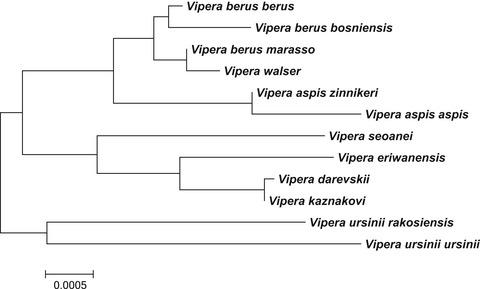
The description of Vipera walser from the Northern Italian Alps as a new species (Ghielmi et al., 2016, Journal of Zoological Systematics and Evolutionary Research, 54, 161) was one of the most unexpected surprises of European herpetology in the 21st century. In mitochondrial (mt) DNA, it is closely related to a group of vipers only present in the Caucasus region and Northeastern Anatolia. However, its morphology is similar to the V. berus populations that inhabit nearby mountains in the Swiss-Italian Alps, which raises questions on its relationships and status. We thus sequenced five nuclear (nu) genes to determine the position of V. walser relative to V. berus and to the Caucasian/Northeastern Anatolian vipers in nuDNA. We also reanalyzed five previously sequenced mtDNA fragments. NuDNA markers recovered V. walser as closely related to Italian populations of V. berus and not to the Caucasian/Anatolian species, thus contradicting the mtDNA phylogeny. We checked that each of the five mtDNA fragments independently amplified by Ghielmi et al. (2016, Journal of Zoological Systematics and Evolutionary Research, 54, 161) produced individual gene trees compatible with the concatenated mtDNA phylogeny, thus excluding the hypothesis that NUMTs sequencing generated the mtDNA relationships reported by Ghielmi et al. (2016, Journal of Zoological Systematics and Evolutionary Research, 54, 161). Given the low level of nuclear differentiation between V. walser and the Italian population of V. berus, we argue that ancient admixture between V. berus and the ancestral population of V. walser is the most likely explanation for this case of cyto-nuclear discordance and we discuss the consequences of these results on the systematic status of V. walser.
来自意大利北部阿尔卑斯山脉的毒蛇walser被描述为一个新种(Ghielmi et al., 2016, Journal of Zoological Systematics and Evolutionary Research, 54,161),这是21世纪欧洲爬虫学最意想不到的惊喜之一。在线粒体(mt) DNA中,它与仅存在于高加索地区和安纳托利亚东北部的一组毒蛇密切相关。然而,它的形态与居住在瑞士-意大利阿尔卑斯山附近山区的V. berus种群相似,这就提出了关于它的关系和地位的问题。因此,我们对5个核(nu)基因进行了测序,以确定walser在nuna与V. berus和高加索/东北安纳托利亚毒蛇的相对位置。我们还重新分析了先前测序的五个mtDNA片段。ndna标记恢复了walser与意大利的V. berus种群密切相关,而不是与高加索/安纳托利亚物种,因此与mtDNA系统发育相矛盾。我们检查了Ghielmi等人(2016,Journal of Zoological Systematics and Evolutionary Research, 54,161)独立扩增的5个mtDNA片段中的每一个都产生了与串联mtDNA系统发育兼容的个体基因树,从而排除了NUMTs测序产生Ghielmi等人(2016,Journal of Zoological Systematics and Evolutionary Research, 54,161)报道的mtDNA关系的假设。鉴于紫斑蝽与意大利紫斑蝽种群之间的核分化水平较低,我们认为紫斑蝽与紫斑蝽祖先种群之间的古代混合是最可能解释这种细胞-核不一致的情况,并讨论了这些结果对紫斑蝽系统地位的影响。



 京公网安备 11010802042870号
京ICP备2023020795号-1
京公网安备 11010802042870号
京ICP备2023020795号-1

 分享
分享
 求助内容:
求助内容: 应助结果提醒方式:
 扫码关注我们
